
January–March 2013, Volume 40
Features
Transforming Greed
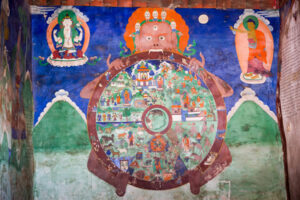
Material well-being of course is important for a secure, fulfilled life, to which all people have the right. Excessive desire for material well-being, however, most often brings unhappiness to oneself and others.
The current troubled global economy has long been sustained by making the most of people’s desire for abundance and convenience. Strong commercialism helped by deregulation of the financial markets over the past few decades has created new billionaires but left other billions of people much worse off, some of them even in dire poverty. It has also seriously degraded the environment, and future generations will bear the consequences.
The world economy sustains itself by constantly fueling consumers’ desires and is based on an economic structure that approves of and even encourages greed, under the guise of the need for economic growth.
Buddhism considers greed one of the three poisons afflicting all people. When greed involves corporate organizations, nation states, and global markets, it can cause appalling suffering. Today greed has become virtually normal in society as a whole and has permeated economic structures to a degree of which people are often unaware.
In our special feature on greed, we hope to deal with a problem that has troubled many religious traditions since time immemorial, but needs our renewed attention. How should we people of religion become aware of and find antidotes to the poison of greed? How can we affect the mainstream economy, and what alternatives can we present? From a Buddhist point of view, how can greed be transformed into generosity? Can the world’s religions work together for that transformation?
“Engaging Structural Greed” was the theme of the consultations that the Lutheran World Federation held jointly with the World Council of Churches in Thailand in 2010, and again independently in Malaysia in 2011, in which religious leaders and scholars of Buddhism, Christianity, and Islam took part.
Dharma World shares the same sense of urgency toward finding ways to help overcome greed and is pleased to invite suggestions from noted scholars of religion for finding ways to help achieve this.
Features
Greed, Desire, and the Lotus Sutra
by Miriam Levering
The English word greed is usually defined as the passionate desire to possess more than a person or family needs or deserves, especially at the expense of others. We are taught from childhood that we should not take two cupcakes when the hostess has prepared only one per child. Yet we are not taught not to desire.
Institutionalized Greed
by David R. Loy
Much of our problem with greed today is that to increase corporate profits and keep the economy growing, we are conditioned into finding the meaning of our lives in buying and consuming. In fact, this has become such an essential part of our lives that perhaps it is no exaggeration to talk about consumerism as a new religion.
We Do Not Need to Live Like Rats Fighting for Scraps
by Mark Hulsether
In a society premised on hypercompetition for success and radical insecurity for “failures,” large amounts of stress and suffering are hardwired into the system. It is obvious how this blights the lives of the most vulnerable—homeless military veterans, minimum-wage workers with sick children, people living in unsafe and polluted neighborhoods. But it also causes suffering for the middle class. There is an enormous amount of room for improvement in quality of life
Wisdom, Greed, and Generosity: Christian and Buddhist Perspectives
by Leo D. Lefebure
Both the Buddhist and Christian traditions have long viewed uncontrolled greed as a deadly poison whose allure arises from ignorance. Both traditions see the promises made by greed as illusory and challenge their followers to true wisdom that nurtures lives of generosity
A Path to Heal Our Troubled World
by Kamran Mofid
A fundamental reappraisal of our place in reality is urgently called for in order to break the iron grip of materialism, consumerism, selfishness, greed, and individualism, thus freeing us to lead a life with heart and soul.
Transforming Greed: An Interfaith Common Word
by Martin L. Sinaga
Greed is said to describe a desire to acquire more material goods than necessary for human well-being. Greed is about exceeding the limit of basic human needs for a good life. It is about possessing all of a culture’s greatest riches and then exceeding the limits defined by the society itself
Essay
Issues of Dharma Missions in
by Brook Ziporyn
The author gave a presentation in November 2011 on Rissho Kosei-kai’s cross-cultural dissemination of the teachings of the Lotus Sutra, at the International Dharma Missions Symposium held at Rissho Kosei-kai headquarters in Tokyo. The following essay is based on and amplifies the content of that presentation.
Founder’s Memoirs
Practice and Learning: The Two Ways
by Nikkyo Niwano
Niwano Peace Prize
Peaceful Coexistence through Reconciliation An Interview with Rosalina Tuyuc Velásquez
The Niwano Peace Foundation awarded the twenty-ninth Niwano Peace Prize on May 10, 2012, to Mrs. Rosalina Tuyuc Velásquez, a human rights activist and political leader in Guatemala. She was honored for unflagging work that exemplifies the great potential and wisdom of indigenous peoples in marking paths to peace. The following interview was conducted with her on May 11 at the International House of Japan in Tokyo, by Rev. Kinjiro Niwano, chair of the Niwano Peace Foundation. They discussed how people can live in ways that nurture all life.