
January–March 2012, Volume 39
Features
The Meaning of Modern Pilgrimage
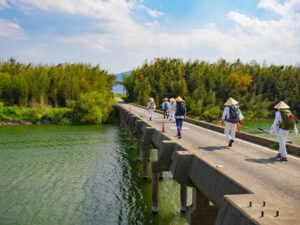
Pilgrimage is important to many religious traditions. By viewing its various aspects and learning about the significance of places of pilgrimage, we can deepen our understanding of, and often our respect for, other religious faiths and their adherents. We should also note that pilgrimages are not always religious, and may be journeys to important secular sites. With our special feature we hope to deepen people’s understanding of humanity’s aspiration for the sacred by examining the significance of pilgrimage, whether religious or secular, for contemporary society.
Group Pilgrimages Unite Hearts and Minds
by Keiko Yamao
Participants must work together and cooperate, their minds becoming as one, as reflected in the phrase “many in body, but one in spirit.”
Buddhism, the Shikoku Pilgrimage, and Wandering Saints in Japan
by Ian Reader
Until the twentieth century, the only way to do the pilgrimage was by foot, but as Japan modernized and developed increasingly efficient transport systems, the options for pilgrims broadened. There is no stipulated rule that says that pilgrims should walk, and Shikoku pilgrims have always made use of whatever means could enable them to make the pilgrimage in the ways they wished
Pilgrims Are Seekers
by Juan Masiá
Pilgrims are seekers searching for the transcendent. And seekers are pilgrims, because they are in search of the ultimate or absolute.
Canterbury Trails—Ways of Twenty-First-Century Pilgrims
by Peter Kenny
Not all of the modern-day pilgrims are Anglicans; many of them are Roman Catholics, and some these days are Buddhists. Some may not have any particular spiritual beliefs.
Pilgrimage and Interreligious Understanding: A Case Study of Sri Pada Mountain in Sri Lanka
by Elizabeth J. Harris
Pilgrimage, I would suggest, has the power to unite people of different religions because it deals in the affective, in what is connected with the emotions.
The World Shall Come to Walsingham
by Gaynor Sekimori
The modern reconstruction of Walsingham began in the middle years of the nineteenth century, a product of Victorian romanticism and antiquarianism and, more important, nostalgia for the medieval Catholic past within certain Anglican circles.
Only Dialogue Can Change the World
An interview with Alberto Quattrucci
Alberto Quattrucci is the secretary-general of International Meetings Peoples and Religions, the Department of the Community of Sant’Egidio for Interreligious Dialogue. Sant’Egidio is a Rome-based worldwide Catholic lay organization recognized by the Vatican. The community is involved in a wide range of peace activities, including the mediation of armed conflicts, care for the elderly and homeless, and relief for disaster victims worldwide. Professor Quattrucci visited Rissho Kosei-kai headquarters in Tokyo in June 2011 before a fact-finding tour in northeastern Japan, where nearly twenty thousand people had died in the March earthquake and tsunami. Dharma World interviewed him and asked him how people of religion can promote world peace and help people around the world overcome their hardships.
Essays
Bearing Witness as an Atomic Bomb Victim
by Akiyo Hada
I have come to realize that the reason I was the only person in my family to survive the bombing was so that I could live to bear witness to the bombing.
The Zen of Mutual Acceptance and Respect
by Jikisai Minami
I find that if I listen quietly and patiently to what the other person is saying over an extended period of time, his or her words may catch my heart.
Good Encounters Give Us New Life
by Koitsu Yokoyama
Deep mind contains the seeds of love for others and the desire to make them happy. To encourage the growth and development of these potential forces, you have to pursue positive encounters actively. . . . That is why we put others first and ourselves last.
Japanese Buddhism and Christian “Good News”: A Christian Reflection on Aspects of the Buddhist Approach to Reality
by Cinto Busquet
Being faithful to one’s own religious convictions and at the same time remaining radically open to the other’s truth—this is what assures that together we may experience a deeper presence of God, the Ultimate Truth.