
April–June 2010, Volume 37
Features
Religion’s Role in Abolishing Nuclear Weapons
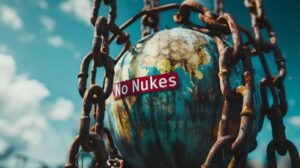
Nuclear Disarmament Could Help End the War-and-Peace Dilemma
by Masamichi Kamiya
When the Nobel Peace Prize Committee announced that the prize for 2009 was being awarded to President Barack Obama of the United States, a controversy arose basically on two fronts. Some people argued that Mr. Obama had not yet achieved much on the world political stage, and some criticized the committee’s decision by saying that he is the commander in chief of the U.S. military, which is currently fighting two wars, one in Iraq and the other in Afghanistan. . .
The Heart of Nuclear Weapons
by Scilla Elworthy
Since we can no longer afford the luxury of competition, we are obliged—perhaps for the first time in human history—to learn how to cooperate on a national, international, and global scale.
Religion and Politics
by Steven Lloyd Leeper
In confronting the problem of nuclear weapons, we are being forced to confront far more fundamental questions. What kind of global system do we want to live in? Do we want to continue living in a political system that worships winning and power?
Turning Japan toward a World Free of Nuclear Weapons
by Hiromichi Umebayashi
The thinking that Japan must rely on nuclear arms has deep roots in the nation’s defense and diplomatic establishments. There is, however, a countervailing force – the endeavor to abolish nuclear weapons by a nation that has firsthand experience of nuclear devastation.
Central Asia’s Commendable Nuclear Weapon-Free Zone
by Tsutomu Ishiguri
The treaty setting up the zone by Kazakhstan, Kyrgyzstan, Tajikistan, Turkmenistan, and Uzbekistan is a concrete contribution to the implementation of the Treaty on the Non-Proliferation of Nuclear Weapons.
Shared Security: the Path Forward to Save Humanity
by Yoshiaki Sanada
Human security can only be manifested in real terms when grounded in a renewed understanding of security as viewed from the standpoint of shared human dignity, human rights, and human needs.
An Enduring Mission: Religion’s Work for Nuclear Disarmament
by Allison Pytlak
Ridding the world of nuclear weapons is a monumental task that will necessitate cooperation and trust, overcoming narrow national interests and boundaries. But it is not easy work and will require cooperation from many sides.
Religion Holds the Key to Disarmament
An interview with Ven. Gijun Sugitani
On January 29, when the 2010 Review Conference of the Nuclear Non-Proliferation Treaty (NPT) was approaching, Dharma World interviewed Ven. Gijun Sugitani, a Japanese Tendai cleric and the chairperson of the International Standing Commission on Disarmament and Security of Religions for Peace, on religion’s role in making the abolition of nuclear weapons a reality.
Nuclear Weapons Must Not Exist in This World:
Testimony of a Doctor Who Treated Atomic Bomb Victims
by Shuntaro Hida
On July 14, 2009, the Peace Research Institute of the Japanese Committee of the World Conference of Religions for Peace invited to its study session Dr. Shuntaro Hida, former director of the Hibakusha Counseling Center of the Japan Confederation of A- and H-Bomb Sufferers Organizations. Born in 1917, Dr. Hida, who was himself irradiated by the bomb dropped on Hiroshima, has, over a period of more than sixty years, treated six thousand patients suffering from illnesses resulting from atomic bomb radiation. Dr. Hida spoke from his experience with acute radiation syndrome and internal exposure caused by the atomic bomb. The following is a portion of his talk.
The Development of Rissho Kosei-kai’s Nuclear Disarmament Activities
by Katsuji Suzuki
Rissho Kosei-kai’s unceasing efforts since 1970 at UN and interreligious conferences to promote a vision of a world free of nuclear weapons will culminate this year.
Reflections
Aiming for a World without War
by Nikkyo Niwano
Let Us Become Good Friends in the Dharma
by Nichiko Niwano
Rissho Kosei-kai’s president explains how the Sangha in Buddhism helps individual believers grasp the teachings and become spiritually self-reliant.