
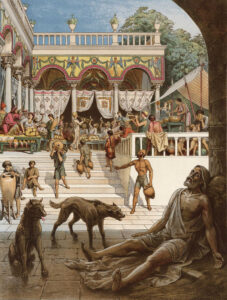
There are many lessons to be learned from this well-known parable, including some that we may teach ourselves.
As we have seen, in chapter 3 of the Lotus Sutra the parable of the three vehicles was used by the Buddha to explain why there is a diversity of Buddhist teachings and why he is now teaching the One Buddha Way. Having heard this explanation, four shravakas, Subhuti, Maha-Katyayana, Maha-Kashyapa, and Maha-Maudgalyayana—all “living a life of wisdom,” hearing from the Buddha a teaching what they had never heard before, and also hearing the Buddha’s assurance of Shariputra’s eventual supreme awakening, were astonished and ecstatic with joy. In chapter 4 of the Dharma Flower Sutra they tell the parable of the rich father and the poor son as a way of checking out whether they have understood the Buddha correctly.1
The Story
When still a boy, a man ran away from home, only to live a life of desperate poverty, moving from place to place in search of menial work. Meanwhile his father, who had become extremely rich and powerful, searched everywhere for the lost son but could not find him.
One day the son accidentally came to the place where the father lived. He saw his father in the distance surrounded by servants and other signs of great wealth but he did not recognize him and began to flee in fear of such wealth and power. But the father, secretly longed for his son for many decades and wanting the son to have his inheritance, recognized the man immediately and sent a servant after him. But when the servant caught up with him, the son, fearing that he would be forced to work or even be killed, pleaded that he had done nothing wrong and fell to the ground in a faint. Seeing this, the father told the servant to douse him with cold water to wake him up, tell him he could go wherever he liked, and then leave him alone.
The son went off to another village to look for food and clothing. Later, the father secretly sent two unimposing, poorly dressed servants to go to the son and offer to hire him to work with them at double pay shoveling animal dung. To this, the son agreed and, and he went to work at his father’s house. Later, seeing how poorly the son looked, the father, disguised himself as a lowly worker, went to the son, praised his work, and promised him better wages and treatment if he would continue to work for him, explaining that as he was old he wanted to treat the man just like a son. The son was pleased, and continued to shovel dung for another twenty years, gradually becoming more confident and more trusted by the father. But still lacking self-confidence, he nonetheless continued to have a very low regard for himself and live in a hovel outside the gate.2
Eventually the rich man became ill. Knowing he would die soon, he asked the son to take charge of his various properties and businesses. As the time of his death grew near, the father called together various officials and all of his relatives and friends and servants and revealed to them that the poor man was in fact his son and would inherit all of his wealth. With such enormous wealth coming to him quite unexpectedly, the son was very amazed.
Some Lessons
Imbedded in this story are many of the lessons which are to be found throughout the Dharma Flower Sutra. Below are some of them. No doubt you will find others as well.
(1) Have faith in yourself
At a meeting some time ago of the International Buddhist Congregation in Tokyo, a young woman described how, dissatisfied with the faith in which she had been raised, she had searched among Christian and Buddhist traditions for an appropriate faith for herself, finally discovering with some joy the importance of having faith in herself. We might think that faith in oneself is not enough. And indeed it isn’t. But it is an important beginning. The poor man in this story was not able to become a functioning contributor to his family and society until he gained some respect for and confidence in himself.
The Dharma Flower Sutra stresses that each of us is somebody important—important to himself or herself, important to others, and important to the Buddha. Each of us is a person of great potential. For this reason we are sought after by the Buddha. The Buddha’s wealth—supreme awakening or enlightenment—is not something you have to earn or purchase in any way; it already belongs to you; it was yours from before your birth; it is your rightful inheritance.
Self-respect and self-confidence are primarily attitudes, types of emotional and psychological states, but they also entail respecting what has been given to you, including your body. If we eat, or drink, or take drugs to excess, we show disrespect for ourselves and deprive the Buddha of what he is trying to achieve in our lives, through us. The Buddha needs us, needs everyone. The Buddha’s compassion is for all the living.
(2) Oppression
We should not be overly humble or servile—or allow others to be oppressed into such servility. Oppression is the worst kind of evil, because it denies the buddha nature of all creatures. It is an insult to the Buddha.
Though this story does not directly advocate social responsibility, it makes evident the need for those who seek to follow the Dharma Flower Sutra to be concerned about social as well as individual evil. War, class oppression, racism, and environmental pollution are affronts to the Buddha. They are affronts to the Buddha precisely because they assault and insult the buddha nature in people and give rise to totally unnecessary suffering.
(3) Apart from the Buddha
Apart from the Buddha and blind to the Buddha Dharma, we are like someone wandering around, destitute, impoverished, without purpose, miserable. In a sense, this is the destiny of those who do not, in some way, follow the Buddha Way. In some way. This does not mean, however, that one has to be a Buddhist in the ordinary sense. To follow the Buddha is to put one’s trust in and devote oneself to the happiness of others and the life of the whole. It is to share in a kind of common human faith that life is meaningful, a faith that finds expression in a variety of religious and other forms.
(4) The Buddha needs you
The focus of this story is the poor son and his attitude toward himself, but it is also, in important ways not always recognized, a story about the Buddha. Here we are told that the Buddha needs his son, yearns for his son, and seeks to find him. Why? Because he wants to give him the great treasure that is his inheritance.
Shakyamuni Buddha was a human being who lived for a time in India, eating and sleeping like other human beings. He left to his descendants, his followers, a great treasure house of profound teachings. He died and his body was cremated, the ashes being distributed and installed in stupas. He is no longer around in the way that he once was. Responsibility for taking care of that great treasure house, for preserving those teachings and developing them by applying them in new situations, and especially for sharing them with others, is given to the Buddha’s children. The Buddha’s work must be done by us, can only be done by us. It is we who can embody the Buddha in the contemporary world, enabling the Buddha to continue to live.
(5) We are children of the Buddha
In the Dharma Flower Sutra, the term “children of the Buddha” is used primarily to refer to bodhisattvas, including those who do not even understand that they are bodhisattvas. A bodhisattva is one who is on the way to being a buddha, one who is becoming a buddha, by doing bodhisattva practices—that is, by teaching and helping others. We are children of the Buddha because our lives have been shaped by the Buddha.
While saying that we are children of the Buddha says something important about us, it also says something important about the Buddha, a “father to the whole world.” And this sense of the Buddha as father is reinforced dramatically in several parables, where, as in this one, the Buddha is represented by a father-figure. Far from being some kind of philosophical “absolute,” the Buddha of the Dharma Flower Sutra yearns for his lost son, and for all of his children. That is another meaning of being a child of the Buddha.
(6) The Buddha is nearer than we think
Even when we think we cannot see him, the Buddha can be found right next to us. The Buddha may not even go by the name of a buddha. Sometimes perhaps he goes by the name of Christ, or Krishna or even Jane. Belonging to Rissho Kosei-kai or any other such organization is not, in itself, the Buddha Way, nor is it the only way to enter or follow the Buddha Way. The “universal gate” is many gates, many more than you or I could possibly know in a lifetime.
Among those many gates can be our family members, or friends, our neighbors. The Buddha lives all around us, even if we are unaware of his being near us.
(7) Led to the Buddha
Sometimes we are being led to the Buddha even when we do not know it. Even when we are not looking for the Buddha Way, probably we are being led to it. At the beginning of this story, the son is not looking for his father, at least not consciously. He is satisfied with a very low level of existence, almost bare subsistence. He has no ambition and feels no need to improve himself. It is the father who seeks him out and guides him. But what he guides him to is a gradual recovery of his self-confidence, and hence of his strength and his ability to contribute. The son is given guidance by the father not only because he is weak, but also because he is strong, at least potentially. We can be led by the Buddha precisely because the potential to become awakened, to enter the Way, is already in us.
For followers of the Dharma Flower Sutra, there is no such thing as a “hopeless case.” Everyone, without exception, has within himself or herself an inner strength, a great power, to flourish in some way.
(8) Running away
The son, seeing the great power and wealth of the father, runs away in fear. Sometimes, when we see how great is the Buddha’s treasury—how great the responsibility of compassionate knowing—we too may run away in fear. It is not easy to be a follower of the Dharma Flower Sutra or of the bodhisattva way. It involves taking responsibility, both for one’s own life and for the lives of others. And that can be frightening. That is why it is not enough for a religion to teach doctrine; it must provide assurance, over and over again—assurance that life can be meaningful, even wonderful; assurance that can overcome our natural tendency to run away in fear.
(9) Menial tasks
Menial tasks may be beneficial. Sometimes a very humble task, such as removing dung, is important preparation for something greater. One of the basic lessons of the Lotus Sutra is that one can find in every situation that there is something to be learned. Sometimes an unpleasant situation or task can be understood as being a present given to us by the Buddha, an opportunity for learning and growth, just as the son in this story received from his father the present of shoveling dung. We can learn from just about any situation, even from very unpleasant ones, if we approach it with a right attitude.
Of course, what might be learned in some situations is that the best thing to do is to change the situation or even flee from it. The Dharma Flower Sutra is not a recipe for being passive and accepting every situation no matter how bad. But it does urge us not to be mere sufferers or victims, but always, inasmuch as we are able, to learn from and seek the best in any situation.
(10) End as beginning
At the end of this story, the son is happy, as he has acquired great wealth, much greater wealth than he had ever imagined having. But, while it is the end of the story, we must not imagine that it is the end of the matter. We can even say that his difficulties—that is, his responsibilities—have now really only just begun. Awakening is a process—a responsibility as much as an achievement or a gift.
As the shravakas say right after the telling of this parable, we should never become complacent and satisfied with some lesser level of awakening, such as some great experience of nirvana, but always pursue the Buddha Way.
Perhaps above all, this chapter is an exhortation never to be complacent with what one has achieved, an invitation to continue to grow in wisdom, compassion, and service.
That is the bodhisattva way, the bodhisattva way of becoming a buddha.
Notes
- The Chinese/Japanese title of this chapter 信解 (xìn jiě in Chinese pronunciation and shinge in Japanese) can be reasonably translated as “Faith and Understanding,” “Faithful Understanding,” or something similar. But the meaning of the chapter title in Sanskrit, adhimukti, is quite different. It means something more like a disposition or attitude. It is a reference to the son’s attitude toward his own life. So it seems that Kumarajiva, rather than translating, may have devised a new chapter title. Though the term is used in a scattering of places throughout the sutra, it does not appear at all in chapter 4 itself.
- It is worth noting that when the shravakas who have told this story explain it, they say that “nirvana” is “like a mere day’s pay”—it gets you somewhere, but not far. Very often in the Lotus Sutra, nirvana, which is often taken elsewhere to be the goal of Buddhist practice, is understood to be a lesser goal, something that facilitates one’s going on to bodhisattva practice and to the goal of becoming a buddha.