
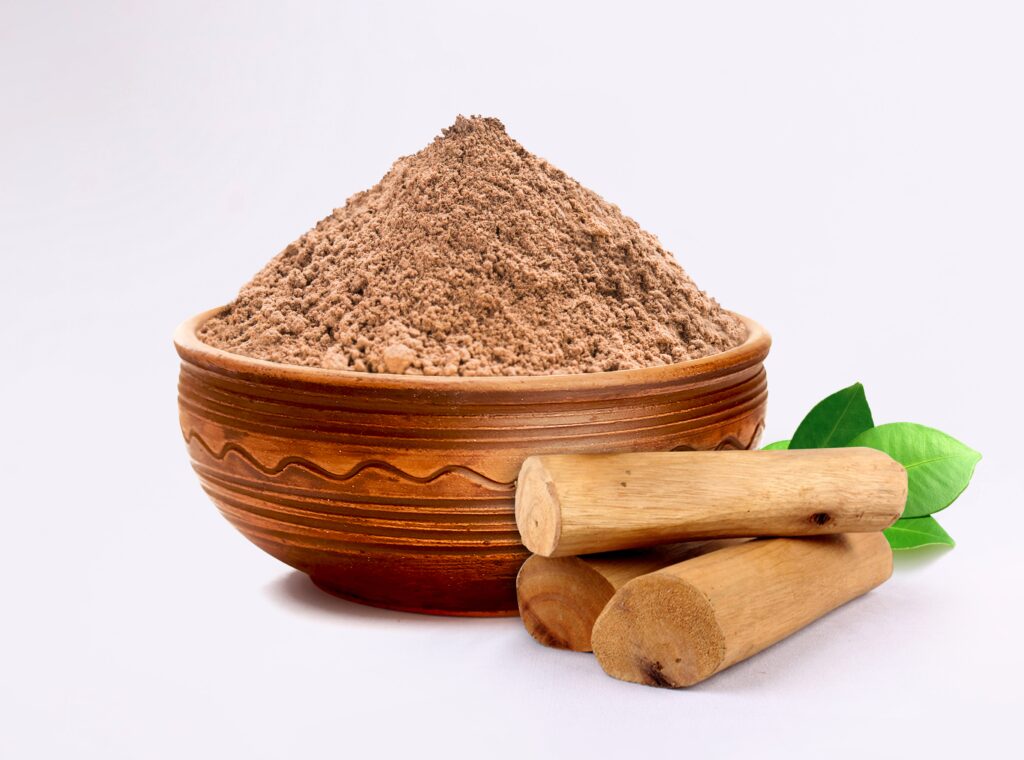
Neither sandalwood nor aloeswood is a flowering tree known for its blossoms of beautiful form or color; rather, they are aromatic woods, famed as sources of sandalwood incense and aloeswood incense, both of which are processed products.
There is a saying in Japan that “sandalwood is fragrant from its seed leaves,” meaning that genius will display itself at an early age. Sandalwood (candana in Sanskrit) is known to have been used as building material for mausoleums and stupas, but in the Lotus Sutra it is more important as the source of a fine powdered incense. The chapter “Discrimination of Merits” in the Lotus Sutra says, “It also rained incense of fine sandalwood, aloes, and so forth.” Images of happiness are associated with beauty rather than ugliness, with fragrance rather than foul odors. The incense of sandalwood and aloeswood became minor props for glorifying the Buddha, the truth he discovered, its embodiment in the form of the most wondrous Lotus Sutra, and the world of its practitioners, the preachers of the Law.
While flowers that rain down from heaven have both visual and olfactory appeal on account of both their color and form and their scent, the seven kinds of precious metals and gems known as the precious seven and used to adorn stupas and so on have only visual appeal. Does this mean that, just as the precious seven have only visual appeal, sandalwood and aloeswood appeal only to our sense of smell? Perhaps we should reread from such a perspective the chapter “The Merits of the Preacher,” which begins with the following description of the merits of a preacher of the Lotus Sutra: “If any good son or good daughter receives and keeps this Law-Flower Sutra, or reads, or recites, or expounds, or copies it, that person will obtain eight hundred merits of the eye, twelve hundred merits of the ear, eight hundred merits of the nose, twelve hundred merits of the tongue, eight hundred merits of the body, and twelve hundred merits of the mind; with these merits he will dignify his six organs, making them all serene.”
This means that by practicing the teachings of the Lotus Sutra, the five sense organs—eyes, ears, nose, tongue, and body—and the mind, the sixth, internal, organ that controls the other five sense organs, will be finely honed and the way to rigorously differentiating between true and false fragrance will be opened up.
Atsushi Kanazawa is a professor emeritus in the Faculty of Buddhism at Komazawa University, Tokyo. He specializes in the Indian philosophy of language and the history of Indian philosophy and culture.