
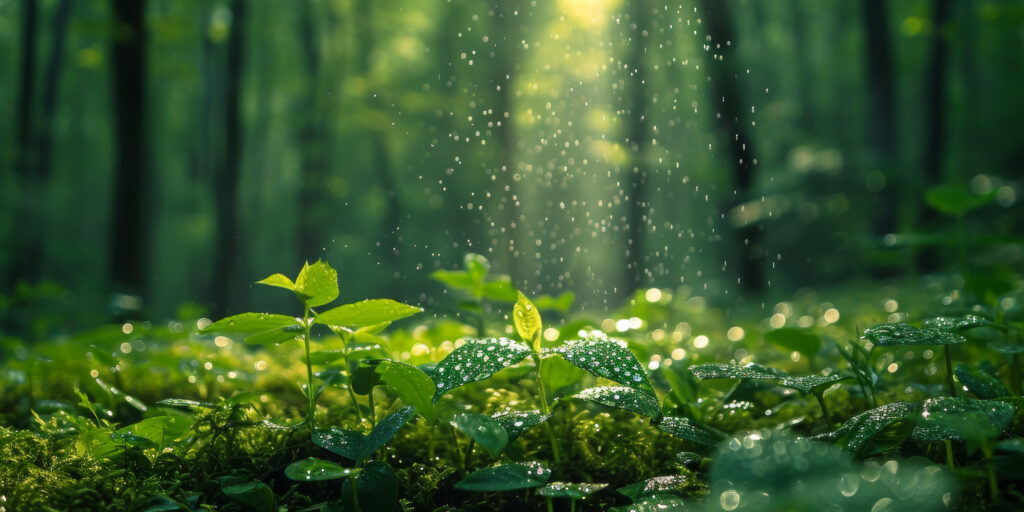
Just as a cloud drops rain upon all plants, and the sun and moon shed light upon all things, so is the One Vehicle for all beings. We are all nourished by it and in turn can nourish others—and thus become like buddhas ourselves.
Chapter 5 of the Lotus Sutra is sometimes entitled “The Parable of the Medicinal Herbs,” but in the version translated by Kumarajiva and used in East Asia, and upon which almost all European versions are based, no such parable can be found. While medicinal plants or herbs are mentioned in the central story, which is a simile, they play only a very minor role. In Sanskrit versions of the Lotus Sutra, however, there is a parable about medicinal herbs. As is true with some other parables, in this case too there are both prose and verse versions. Here is a telling of the parable that makes use of both.
A Parable of Medicinal Herbs1
Once upon a time there was a man who was born blind. He supposed, therefore, that there was no such thing as a beautiful or an ugly shape and no such thing as living beings who could see beautiful or ugly things—no sun, moon, stars, or planets, and no one to see such things. When people told him there were such things, he did not believe them.
When a certain physician met this blind man, he realized right away that the man’s condition was due to something that had happened in a previous life, and he knew that this illness could not be treated effectively with commonly available medicines. He knew also that on the snowy King of Mountains there were four medicinal herbs that would work. One contained all flavors, colors, and tastes; another cured all ailments; another destroyed all poisons; and there was one that brought happiness to all who stood in the right place. Out of compassion for the blind man, and by using some sort of magical device, the physician went to that mountain, climbed it, and searched all over it to find the four herbs. After returning with them, he gave these herbs to the blind man in a variety of ways—chewed, pounded, raw in a mixture with other things, boiled in a mixture with other things, by piercing the man’s body, after burning them, and so forth.
The blind man soon was able to see, and he saw such things as the light of the sun and the moon, the stars and planets, and a great variety of shapes. He realized that he had been a fool for not believing those who had told him about such things when he was still blind. And he began to think that since he was no longer blind he could see everything.
There were also in that place some seers, men who were endowed with the five divine powers: the powers to go anywhere and to transform oneself or other things, to see anything at any distance, to hear anything at any distance, to know the thoughts in the minds of others, and to know one’s own former lives and those of others. They said to the man who had been blind: “Now you can see, but you still do not know anything. Why are you so arrogant? When you are in your house you cannot see what is outside. You don’t know who likes or dislikes you. And you can’t hear or understand the voice of someone only five kilometers away, or hear a drum or the sound of a conch off in the distance. You can’t go anywhere without lifting your feet and following a path. You can’t even remember being in your mother’s womb. How can you say you see everything? What makes you think you are so wise? Do you want to take darkness for light?”
Then the man asked the seers how they had obtained such powers. And they told him, “If you want such powers you should live in a forest, or sit in a mountain cave, and think only of the Dharma. You must get rid of all your faults.”
So the man went off into a forest, concentrated on a single thing, got rid of his worldly desires, and obtained the five holy powers. Then he thought to himself, “In the past, no matter what I did, nothing good ever came of it. I was blind and not wise. Now I can go wherever I want.”
The text goes on to tell us that a variety of herbs are needed because there is a variety of entrances into the Dharma. The blind man, we are told, just like ordinary people, is blinded by desire, while the man who thinks he can see everything is like the shravakas. Then the man is encouraged to further his awakening.
The Buddha of Many Guises
An interesting aspect of this parable is that, within the same story, the Buddha is likened both to the physician and to the seers. Perhaps this is a way of telling us that the Buddha appears in many guises. An extremely important aspect of Buddhist practice for followers of the Lotus Sutra is the practice of recognizing the buddha nature in others. This “buddha nature” is nothing but the Buddha himself as a kind of potential. Thus, we need to develop the ability to see the Buddha in others. And what the Dharma Flower Sutra insists on is that we should learn to see the Buddha not just in special, holy people or leaders, but in all others. Thus, for those of sufficient skill, the Buddha can indeed be found in many guises, as both a physician and a seer.
I am reminded of the many stories in Chinese of how Manjushri Bodhisattva appears in many different disguises—as a beggar or a cripple, for example—in order to lead people to the sacred mountain, Wu-tai, which is the Chinese home of Manjushri. Chapters 24 and 25 of the Lotus Sutra tell us of the many forms in which the bodhisattvas Wonderful Voice and Regarder of the Sounds of the World (Guanyin) appear to people in need. Such bodhisattvas, of course, embody the Buddha, enabling the Buddha to live in the world by being the Buddha for some. Thus, when we encounter someone who might be regarded as a rival or even an enemy, we should pause and consider how this person might be the Buddha in disguise—at least for us.
The Cloud and the Rain
Although there is no parable of medicinal herbs in the chapter by that title, what we do have there, however, is a simile that is very important for understanding the Dharma Flower Sutra.2
In this simile the Buddha is said to be like a great cloud that covers the entire world and dispenses a universal rain, a rain that falls everywhere. The rain, like the Dharma, is the same everywhere. But the living beings nourished by the rain are like an enormous variety of plants—some large, some small, some red, some blue, some growing on hills, some in valleys, some growing in sand, others in clay or water, and so forth. The rain nourishes all the plants equally, the big, the medium-sized, and the small, penetrating everywhere, from the tops of tall trees to the deepest roots.
The passage itself is so succinct it is worth quoting here: “Kashyapa,” says the Buddha, “suppose that in the three-thousand great thousandfold world, growing on mountains, along the rivers and streams, in valleys and in different soils, are plants, trees, thickets, forests, and medicinal herbs of various and numerous kinds with different names and colors. A dense cloud spreads over all of them, covering the whole three-thousand great thousandfold world, and pours rain down on all at the same time. The moisture reaches all the plants, trees, thickets, forests, and medicinal herbs, with their little roots, little stems, little branches, little leaves, their medium-sized roots, medium-sized stems, medium-sized branches, medium-sized leaves, their big roots, big stems, big branches, and big leaves. Every tree, large or small, according to whether it is superior, middling, or inferior, receives its share. The rain from the same cloud, goes to each according to nature and kind, causing it to grow, bloom, and bear fruit. Though all grow in the same soil and are moistened by the same rain, these plants and trees are all different.”
Lotus Sutra Universalism
With the simile of the cloud and the rain, the focus of the sutra has shifted somewhat—from a focus on skillful means in chapters 2 through 4 to an emphasis on the universality of the Dharma and the equality of living beings.
In the missing half of the chapter, there are two additional similes: a simile of light and one of clay and pottery. According to the first, just as the light of the sun and the moon illuminates the whole world—those living beings who do good and those who do ill, the tall and the short, things that smell good and things that smell foul—so too the light of the Buddha’s wisdom shines equally on all the living according to their capacities. Though it is received by each according to what it deserves, the light itself has no deficiency or excess. It is the same everywhere. According to the second simile, the simile of the clay and pottery, just as a potter makes different kinds of pots from the same clay—pots for sugar, for butter, for milk, and even for some filthy things—they are all made of the same clay, just as there is only one Buddha Vehicle.
It is worth noting in passing that in both of these similes there is an obvious inclusion of bad or unpleasant things. This is one of the ways in which the Dharma Flower Sutra expresses universality, the idea that there are no exceptions, no one is left out of the Dharma. Everything is affected by the Buddha Dharma. The One Vehicle is for all living beings.
Whereas the parable of the burning house can lead us to believe that the One Vehicle replaces the three vehicles just as the one cart seems to replace the three carts, here we can understand the sutra’s intention to be inclusive of all the living. The many living beings, whether good, bad, both, or neither, are all nourished by the same rain, by the same Buddha Dharma.
It is also important to recognize that the kind of universalism affirmed in the Dharma Flower Sutra does not in any way diminish the reality and importance of particular things. The fact that the pots are made of one clay does not make the pots any less real. Similarly, that many beings of various kinds that are illuminated by one light affirms both the oneness of the light and the many-ness of the living beings. Thus the universalism of the Dharma Flower Sutra is at the same time a pluralism, an affirmation of the reality and importance both of unity and of variety.
The central message of the simile of the cloud and rain is that the Buddha’s teachings, the Dharma, is equally available to everyone. The Dharma can be found anywhere, ready to nourish each and every one of us. All living beings participate in a process in which they are nourished by the same living energy as everyone else, a living energy that Buddhists call “Buddha Dharma.” But we are not all alike. We live in different cultures, have different histories, use different languages, are born in different generations, have different abilities to hear and understand, and so on. That is why the one Dharma has to be embodied in many different teachings and practices.
The variety of teachings is symbolized in chapter 3 of the Dharma Flower Sutra as the three vehicles, but we can see that in these similes, there are not just three ways—there are a great many, just as there are many different kinds of plants.
If plants, at least the vast majority of plants, receive no rain, they soon wither and die. The same is true of us: without the nourishment of the Dharma we would dry up and die. But this Dharma that nourishes all is not something to be found only in the Buddhist religion. It is universal. It is everywhere. The Dharma can be found even in the ordinary food that we eat and the water we drink, making it possible for us to live.
Ecological Harmony
According to the simile of the great cloud and rain, every living being is, in one sense, equally valuable. Each has its own function within the larger whole. Each has its own integrity, its own value for itself, its own goodness, its own purposes, its own beauty. The rain nourishes according to the needs of the various plants. A big tree requires more water than a small shoot of grass. But this does not necessarily mean that the big tree is superior to the small blade of grass; it’s just bigger. Different living beings play different roles in the ecology of the planet. Each of us depends on a vast network of living beings, which are dependent on each other. Thus, a certain harmony or peace is required—not necessarily a perfect harmony, but enough of a harmony to enable the system to function and survive through growth and modification.
Today, many believe that the minimal harmony necessary for human survival on earth is being destroyed by earth’s dominant group of living beings—human beings. Whole habitats—rainforests, wetlands, uncultivated plains, natural rivers and streams—have been destroyed and are still being destroyed, probably at an increasing rate. Increased economic activity virtually everywhere also means increasing pollution of the air and water and the very soil upon which we depend for much of our food. In addition to such environmental destruction, humankind has developed weapons of enormous destructive power that could hardly have been imagined a century ago.
In this sense, human beings have made themselves more important, that is, more powerful, than other living beings in this ecosystem. They threaten to destroy even the minimal harmony that makes life on earth possible.
This is a situation well beyond what the Indian compilers of the Lotus Sutra could have imagined. It would be foolish to claim that the sutra provides a recipe for solving the kind of problems that threaten the planet today. But, in principle, the sutra is hardly silent about such matters. It calls upon us to recognize that—in important respects—all living beings are equal. All are nourished by the same processes, symbolized in the simile as the rain of the Dharma.
The Dharma Flower Sutra calls upon us, not only to transform individuals, but also “to purify buddha lands.” From the point of view of the sutra, of course, this earth is the buddha land of Shakyamuni Buddha. This world, and especially this world, is Shakyamuni Buddha’s world. But the Buddha is not some sort of all-powerful God ruling the universe. The Buddha is embodied, made real, in the Buddha-deeds of ordinary living beings. The Buddha invites us to be partners with him in transforming this world into a pure buddha land, where there is a kind of harmony of beauty enabling living beings to flourish together in many different healthy ways, all equally depending upon the Dharma and on one another.
This chapter of the Lotus Sutra encourages us to think of the large picture and to be grateful that we are nourished by the Dharma raining on us. But it is also important to recognize that the Dharma can be rained down by us. In Zen and Western Thought the famous Zen scholar Masao Abe wrote that “the greatest debt without doubt is to my three teachers. . . . Without the Dharma rain they poured upon me, a rain which nourished me for many years, even this humble bunch of flowers could not have been gathered.”3
In other words, to follow the Buddha Way, the Dharma, is to be nourished by the Dharma, but it is also to nourish others—many kinds of others. In still other words, to follow the Buddha Way of transforming living beings and purifying buddha lands is to become a buddha oneself, at least in small but very important ways.
Notes
- This version of the parable is based on the translation of Leon Hurvitz, in Scripture of the Lotus Blossom of the Fine Dharma (The Lotus Sūtra) (New York: Columbia University Press, 1976), pp. 110–19.
- Parables and similes are forms of metaphorical language. In a parable, of which there are several in the Lotus Sutra, characters in a story represent someone else. Thus, for example, in the two parables we have already discussed in this series there is a father figure who represents the Buddha. In a simile, on the other hand, one kind of thing is said to be like another. Strictly speaking, there is no story in a simile, just a likeness or similarity.
- Abe, Zen and Western Thought (Honolulu: University of Hawaii Press, 1985), p. xxiv.