
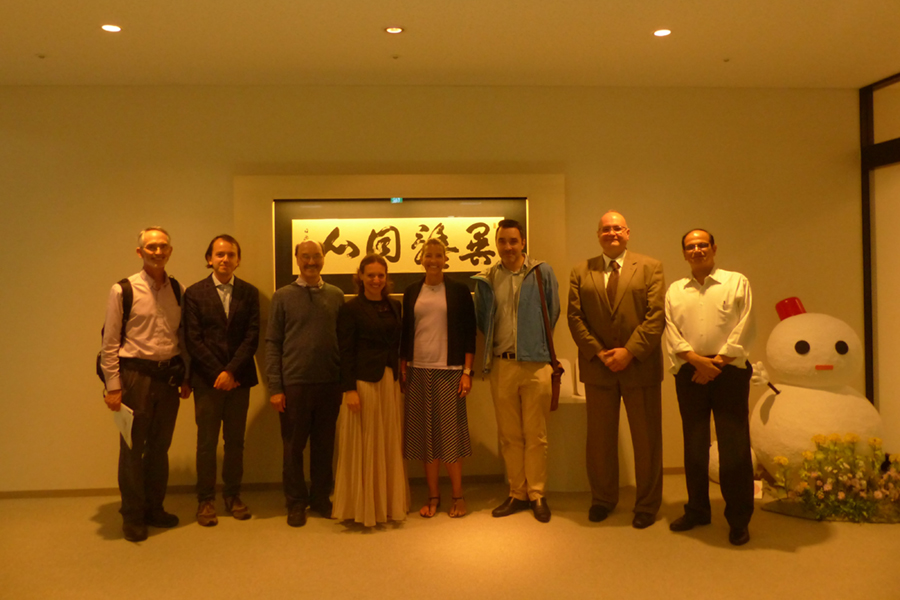
This is a report on the International Lotus Sutra Seminar held June 13–16, 2019, at the headquarters of Rissho Kosei-kai in Tokyo.
Introduction
Every year the International Lotus Sutra Seminar provides a unique venue for an international cohort of scholars in different disciplines and areas to share their current research on the Lotus Sutra and to promote the spread of knowledge about it. The format of the seminar, with each participant also commenting on one of the other presentations and with plenty of time for questions and discussion, allows for a lively and reciprocally enriching conversation, which adds a genuinely human encounter to the academic experience. In previous seminars, the fact that the presenters come from a multiplicity of backgrounds generated rich discussion on the place of the Lotus Sutra in intercultural and interfaith dialogue. But this year, this was the primary focal point, as the presentations centered on “illuminating one another in dialogue: interreligious perspectives through the prism of the Lotus Sutra.” The presenters proposed a variety of ways in which the Lotus Sutra can inform interreligious dialogue, ranging from theological and philosophical arguments to literary analysis, historical reception, and contemporary practice. The limits and problems of these approaches were discussed in the question-and-answer time. While the study of Buddhism from an interfaith perspective has historically been dominated by Buddhist-Christian dialogue, this seminar provided rich diversity, giving significant space to presentations on the Lotus Sutra and Islam, the Lotus and Judaism, and the sutra’s reception in modern European culture. These papers enriched the conversation, opening up new venues for research in this field. For example, the presentations on Islam suggested how the presence of a Muslim minority in Japan or of Buddhism in Muslim-majority countries can provide new insights for the intercultural reflection on the Lotus Sutra, especially by rethinking ideas of community and family. The reading of the Lotus Sutra in a Jewish context instead opened a discussion on the emotional response to images contained in the text and on the kind of audiences, universal or exclusive, the sutra and Jewish scriptures conceive for themselves. In addition to the presentations, the seminar included visits to two temples and to Rissho Kosei-kai’s Suginami Dharma Center. At the Tendai temple Fudōson in Meguro, and at the nearby Gohyaku Rakanji, seminar participants experienced the variety of contemporary Buddhist practices in Japan and were particularly fascinated by the role that images and statues play in them. At the Suginami Dharma Center they took part in a Rissho Kosei-kai gathering and were actively involved in the Dharma circles, where they could learn firsthand how members of Rissho Kosei-kai live social and everyday aspects of Lotus Sutra practice. The seminar opened with a moment of silence and remembrance dedicated to Gene Reeves, the Buddhist scholar who was coordinator of the seminar for many years and who passed away a few weeks before this year’s meeting. What follows is a summary of the presentations and of the discussions afterward.
“Ways of Being Religious in the Lotus Sutra: Themes for Interreligious Reflection and Dialogue”
Ruben Habito, Southern Methodist University, University Park, Texas
Dr. Habito’s presentation analyzed the Lotus Sutra, its doctrines, and its practices through the fourfold framework elaborated by the scholar of comparative religion Frederick Streng and built on this analysis to suggest how each of the four points can be fruitfully used for a comparison with Christianity and for a constructive project of interfaith dialogue. The view of the human condition that emerges from the stories contained in the sutra, characterized by suffering but also by the idea of salvation through being children of the Buddha, echoes, for Dr. Habito, existentialist conceptions of Genesis and more broadly of Christianity. The nonduality of ultimate reality expressed by the idea of the immeasurable life span of the Buddha, further elaborated by Tiantai master Zhiyi, can be compared to the way Christian mystical traditions talk about coincidence of opposites. Devotional practices centered on the Lotus Sutra, such as Nichiren’s chanting of its title, which help in translating the complex doctrines and cosmologies of the sutra into everyday practices of salvation, were likewise compared with devotional aspects of Christian traditions, such as devotion to the Virgin Mary and the contemplative tradition of Hesychasm, whose recitative meditation recalls for Dr. Habito the namu myōhō renge kyō. Finally, Dr. Habito analyzed the way in which these ideas and practices based on the Lotus Sutra have historically been translated into action in this world, quoting as examples the way devotion to the sutra influenced thinkers as different as Chigaku Tanaka and Kenji Miyazawa. Dr. Habito stressed that the religious view contained in the Lotus Sutra has a deep transformative impact at both the individual and social levels, as the devotee is encouraged to turn this world into the Dharma world. This specific fourth element of the Streng-based analysis of the Lotus Sutra becomes in Dr. Habito’s presentation a key for interfaith dialogue, as members of other religions can be inspired by the social engagement of Lotus Sutra devotees and reflect on how they translated their own religious views into everyday practice and commitment to transform the world. Dr. Habito’s presentation spurred a lively debate, which centered especially on the existential suffering generated by the three poisons, on the limits of personal agency, and on the active salvific role of the Lotus Sutra. The other participants discussed these ideas in comparison with Augustine’s concept of sin, with the idea of akunin—evil person—in Jōdo Shinshū Buddhism, and with notions of good or bad inclinations in Judaism. Dr. Habito’s closing remarks pointed out how the differences that emerged from the discussion can be suggestive of further constructive reflection.
“A Muslim’s Reflections on the Saddharma Pundarīka Sūtra, the Lotus Sutra”
Imtiyaz Yusuf, International Institute of
Islamic Thought and Civilisation (ISTACIIUM), Kuala Lumpur, Malaysia
Dr. Imtiyaz Yusuf ’s paper expanded the discussion on Buddhist-Muslim dialogue, which all participants recognized as of primary importance not only because of widespread Islamophobic prejudice but also because of the cohabitation of large Buddhist and Muslim populations in Southeast Asia, where Dr. Yusuf is based. In his presentation, Dr. Yusuf placed his own comparative reading of the Lotus Sutra and the Qur’an against the background of the intellectual encounter between Islam and Buddhism. After introducing his experience with and interest in Buddhism, Dr. Yusuf traced the history of Buddhist-Muslim encounter, focusing particularly on a number of Muslim intellectuals and poets who studied and appreciated Buddhism. This survey also problematized the more limited scope of knowledge of Buddhism present today among Muslim scholars, which is based on the legacy of colonial-period orientalist perspectives and does not facilitate a constructive engagement. Moving then toward the comparative part of his presentation, Dr. Yusuf recognized how the encounter between Islam and Buddhism is made difficult on the conceptual level by the nontheistic nature of Buddhism. However, he proposed an analogical and parallel approach to resolve this issue, aiming not for a hybrid of the two religions but for a hermeneutical expansion of horizons. Dr. Yusuf offered a practical example of this approach in his comparison of passages and concepts in the Lotus Sutra and the Qur’an. The centrality of these two texts themselves, and of the figures of the Buddha and Muhammad in the life of their devotees, suggests a potential point of encounter. Further elements discussed were an analogy between the concept of upāya in the sutra and the concept of sunnah (the model of the Prophet for the Muslim), as well as a parallel between the concept of prophecy in Islam and the role of the Buddha as carrier of a message of salvation. Dr. Yusuf ’s conclusion stressed again the pressing need for Buddhist-Muslim interfaith dialogue in the context of Southeast Asia, for example, where such a relation has recently been at the center of violence and persecution. The analogical method proposed by Dr. Yusuf was at the center of the participants’ subsequent discussion. While the risk of undervaluing important differences was pointed out, some other presenters proposed a conception of analogy as including differences rather than erasing them, while others saw in analogy just a point of departure to develop further discussion, as Dr. Yusuf ’s presentation itself has shown. In addition to offering a non-Christian point of reference for the dialogue with Buddhism, Dr. Yusuf ’s presentation started an essential debate on methodological problems in approaching interfaith dialogue. For example, the issue of the value and use of analogy resurfaced multiple times in the seminar.
“The Lotus Sutra and the Qur’an: Similarities and Differences”
Makoto Mizutani, Arabic Islamic Institute, Tokyo
The discussion on the Buddhist-Muslim encounter was expanded, after Dr. Yusuf ’s presentation, by Dr. Makoto Mizutani, who enriched the discussion with both methodological reflections on and concrete application of the comparative method with respect to the Qur’an and the Lotus Sutra. In introducing his contribution, Dr. Mizutani built on the previous debate concerning analogy and its problems in comparing religious ideas. He associated this problem with the question of semantics and differences in meaning when we use terms from different cultural and religious backgrounds, a problem that is heightened in the Buddhist-Muslim dialogue, as it often uses a vocabulary built on Christian terms. Translation itself becomes a vehicle of reflection and of religious comparison. Dr. Mizutani’s paper started with a comparison of the inductive and deductive ways of reaching the absolute in the Qur’an and the Lotus Sutra, pointing out, among other things, the centrality of reciting Allah’s names in Islam and the practice of chanting the title of the Lotus Sutra in Buddhism. Dr. Mizutani also expanded the discussion on Buddhism from the context of the Lotus tradition, including references to Jōdo Shinshū and Zen Buddhism that also present parallels with concepts in the Qur’an, such as the stages of intuition leading to the absolute. After surveying a number of comparable ideas in the two sacred texts, such as the oneness of truth, human natural dispositions, and justice, Dr. Mizutani also pointed out a series of important differences, centering on the impossibility for a Muslim to conceive merging with the absolute; the omnipresence of legal terms in the Qur’an, which reflects the lack of separation between sacred and secular in the Muslim context; and the lack of suicide in Muslim societies that Dr. Mizutani connects with the social impact of Qur’anic ideas. It is particularly this last topic, the impact of religious views on suicide in the Japanese and other societies, that dominated the discussion after Dr. Mizutani’s presentation. On the one hand, the presenters provided more cultural and social background to explain the high rate of suicides in Japan, and on the other they compared this issue with religious ideas from other contexts, such as the Christian condemnation of suicide. The discussion turned the presence of a Muslim minority in Japan—despite being limited in quantitative terms—into a resource for the Japanese to reflect on the strong sense of community and cohesion that a religion like Islam can provide, giving tools to respond to the problem of social disintegration and high suicide rates. This religious and cultural contact was interpreted as a further constructive way to avoid the “Galapagos effect” of isolation by exposing Japanese society to new ideas.
“Transformation or Rediscovery? Soteriological and Cosmological Themes in the Lotus Sutra and the Philokalic Tradition”
Thomas Cattoi, Jesuit School of Theology at Santa Clara University, California
Dr. Thomas Cattoi’s presentation offered an example of comparison between Buddhist and Christian ideas that built on similarities but kept the differences visible. The paper also pointed out the importance of expanding the comparison of doctrinal concepts to see how they affect the spiritual life of the devotee. Its main purpose was to show how forms of spirituality based on ontological and anthropological views in the Lotus Sutra find closer echoes in the early Christian Evagrian tradition, and before that in the Hellenistic thinker Origen, rather than in what became the orthodox tradition, established in the fifth century by the Council of Chalcedon. More specifically, the Christ of the Evagrian tradition becomes a mirror for the devotee to return to the original communion of intellects with God in a way that, according to Dr. Cattoi, resonates with the conception of the Buddha contained in the Lotus Sutra as the ultimate reality to which all beings are invited to recognize themselves as identical. By contrast, Dr. Cattoi noted, Chalcedonian doctrine retained the distinction between the human and the divine in the final achievement of salvation. While pointing to potential parallels, the presentation also recognized differences, such as between Origen’s view of time and the one contained in the Lotus Sutra. Dr. Cattoi also offered a historical reflection on how the presence of a central authority to establish orthodoxy in early Christianity has not allowed for the same degree of inclusivity as is found in Mahāyāna Buddhism, ultimately explaining the accusations of heresy against the Evagrian tradition. This observation sparked a lively discussion among the presenters, who discussed approaches to normativity and orthodoxy in Buddhism and Christianity. While pointing out how the lack of a strong central institution in Buddhism has led to more flexibility toward and inclusion of heterodox positions, the history of internal schisms and controversies n heresy within Buddhist traditions, including the Lotus Sutra–based Tendai and Nichiren sects, was also recognized. On this point, Dr. Munehiro Niwano interpreted Nikkyō Niwano’s view of the One Vehicle in the Lotus Sutra as turning Nichiren’s exclusivism into a more inclusive approach toward different traditions. As a concluding remark regarding a potential constructive use of Evagrian spirituality for interfaith dialogue, Dr. Cattoi mentioned the rising interest in it in scholarship but also noted how this interest has not necessarily informed a positive engagement with it in the Orthodox Church, or its application in interreligious dialogue.
“The Representative Truth and the Decisive Validity of the Lotus Sutra in an Interreligious Perspective”
Kristin Johnston Largen, United Lutheran Seminary, Gettysburg, Pennsylvania
Shall we include at the table of interfaith dialogue those who exclude the validity of other religions? Are the religious people involved in dialogue secretly just trying to include the diversity of the other into their own tradition? These are some of the questions—essential to any effort to arrive at interreligious understanding—that Dr. Kristin Largen’s presentation raised for the seminar. In her presentation, Dr. Largen built on an analysis of the Lotus Sutra and interfaith dialogue by theologian Schubert Ogden in order to propose that a representative interpretation of the claims of validity in each religious tradition can allow for a space of dialogue that avoids exclusivism, inclusivism, and indifferent pluralism. Rather than looking at the Lotus Sutra’s attitude toward different paths to truth as an example of inclusivism, in which different views are subsumed within an ultimate and superior truth, Dr. Largen built on Ogden’s reading of the Lotus Sutra’s message as representative of truth in order to inform a constructive dialogue among religions, avoiding both relativism and the denial of the other. According to this interpretation, the Lotus Sutra points to an ultimate truth that it only represents and does not define once and for all, allowing other religious traditions to conceive themselves in the same way as formally valid but not encompassing the ultimate truth. Dr. Largen then provided a close reading of the text to identify elements in support of her interpretation. She finds them in the expansive setting of the first chapter, where the teaching is defined as without time and space. The concept of upāya also allows for a representative interpretation of the message of the Lotus, which becomes itself a form of skillful means pointing to the ultimate truth without exhausting it in itself. Finally, stories such as the three carts and the burning house, the father and his estranged son, the Buddha as rainfall for everyone, and the multiplicity of the characters themselves lent support to her interpretation. After suggesting how the Gospel of John can provide a venue to reinterpret Christ’s message as representative of truth in a similar way as the Lotus Sutra’s, Dr. Largen closed with a question concerning how best to reinterpret Nichiren’s ostensibly exclusivist reading of the Lotus to foster interfaith dialogue. While the questions raised by this paper did not find a simple solution in the following discussion, Bodhisattva Never Disparaging was proposed as a model for recognizing one’s own faults as well as facing the inevitable difficulties implied in encountering the other.
“Ways to Interreligious Dialogue: The Teaching of the Lotus Sutra and the Spirituality of the Focolare Movement”
Hiroshi Munehiro Niwano, Rissho Kosei-kai Gakurin Seminary, Tokyo
Dr. Munehiro Niwano’s presentation provided the seminar with a practical example of interfaith dialogue between the Catholic Focolare movement and Rissho Kosei-kai based on parallel spiritualities of love and joy. Dr. Niwano also offered his own experience as a student of theology at Pontifical Gregorian University in Rome and at the training facilities of the Focolare movement as moments of inspirational and challenging religious encounter. In his article, Dr. Niwano started with an analysis of the paternal figure of the Buddha in the Lotus Sutra, where the Buddha’s love for all human beings and their longing for his presence become essential conditions for enlightenment. This concept finds translation in the spiritual practice of Rissho Kosei-kai members, who are invited to emulate Bodhisattva Never Disparaging’s attitude of deep respect toward all other beings. The presentation then built on Nikkyō and Nichikō Niwano’s views of joy arising from faith in the Buddha and of the reverential nature of all human beings signified by Never Disparaging as the basis for the practice of interreligious dialogue in Rissho Kosei-kai. This has been particularly developed together with the Catholic Focolare movement, founded by Chiara Lubich during World War II. Dr. Niwano introduced the spirituality of this movement, showing the parallels with Rissho Kosei-kai. The Focolare conception of faith in God as love that can be found in all beings supports a spirituality of joy and unity, which then gets put into practice by, for example, sharing with and helping the disadvantaged. Following the impact of the Second Vatican Council’s call for dialogue, the Focolare movement has increasingly seen interreligious encounters as essential to the search for spiritual unity. And this is the basis for the encounter with Rissho Kosei-kai, which has been fostered primarily through youth exchanges. Dr. Niwano also suggested a parallel between the centrality of the model of Jesus Forsaken in Focolare spirituality and Bodhisattva Never Disparaging. Contributing to this observation with a translation in practice, Dr. Scarangello pointed out how the dialogue with the Focolare movement might have helped Rissho Kosei-kai to define in more practical terms the spirituality of suffering. The subsequent discussion saw the participants expanding the reflection on inclusion and engaging particularly the experiential and emotional aspects of religious encounter. They suggested how the Lotus Sutra has turned the conception of suffering in Buddhism from one based on its solution through nirvana to one of embracing it. However, this reflection on the message of the Lotus Sutra as one of embracing suffering stirred a debate among the participants on the limits that such an accepting attitude can have, for example in how it could make sense of extreme historical cases of imposed suffering such as the genocide of the Jewish people under the Nazi regime.
“Contexts of Reception: The Lotus Sutra in Nineteenth-Century Europe, and What They Overlooked”
J. Jeffrey Franklin, the University of Colorado Denver
Dr. Jeffrey Franklin enriched the conversation of the seminar with questions suggested by a historical analysis of the reception of the Lotus Sutra in the West. By shedding light on how nineteenth- and early twentieth century scholars projected ideas and expectations on their conception of Buddhism, this paper showed that some of those biases are still present among scholars and, further, that these biases raise essential questions regarding religious encounter, since they affect whether we consider a text or a tradition to be authentic or somehow less than authentic as a result of cross cultural transmission and translation. His presentation divided the history of the reception of the Lotus Sutra in Western scholarship into two phases. The first was dominated by the search for the historical Buddha and was aimed at reconstructing the moral and philosophical content of the earliest texts, disregarding the later traditions. The second phase saw an increasing appreciation of Mahāyāna when Western scholars realized that it offered a fertile context for comparison and dialogue with Christianity; some scholars went so far as to advance hypotheses of mutual derivation between the two religions. Dr. Franklin suggested that this turn might actually have been encouraged by a closer engagement with the Lotus Sutra. After the historical analysis, Dr. Franklin first pointed out a number of instances of misunderstanding in the early reception of the Lotus Sutra in the West; then he outlined his constructive proposal for interfaith encounter. He suggested that the Lotus Sutra contains a view of eternity that need not be considered contradictory to the historical record of the life of the Buddha. In Dr. Franklin’s reading, the narratives of the Lotus Sutra can be seen as collapsing historicity such that moments of crisis in the history of Buddhism—for example, the death of the historical Buddha, internal schisms in the sangha, and the threat of persecution from outside—are figuratively healed within the text. In addition, Dr. Franklin argued that the Lotus Sutra be seen as authentic by showing how the text’s long history, from its earliest moments to its global spread, can be considered an application of the concept of skillful means, therefore demonstrating the coherence and consistency of the text. In the following discussion, the problem of authenticity of a text in the light of historical-critical analysis, and of a religious tradition in the encounter with different religions and cultures, encouraged a lively debate among the participants.
“C louds Speaking and Words Chanting: Comparing Patterns of Vision and Piety in the Lotus Sutra and in the Hebrew Bible”
Mira Niculescu, École des hautes études en sciences sociales, Paris
Dr. Mira Niculescu’s presentation expanded the conversation on interfaith dialogue and the Lotus Sutra, leading it to a venue that is recently gaining more scholarly attention: Jewish-Buddhist relations. She proposed a comparative reading of the Tanakh (the Hebrew Bible) and the Lotus Sutra based on dialogical hermeneutics as developed by Martin Buber and Emmanuel Levinas—that is, by attending to the encounter between the reader and the sacred text rather than focusing on doctrinal concepts. Dr. Niculescu centered her analysis of this encounter on revelation and piety: the first, as in Mircea Eliade’s comparative scholarship, was intended as a manifestation of the sacred described through stories and imagery in the scriptures; the second was the normative attitude of the worshipper toward the text, such as its recitation and transmission. Concerning the manifestations of the ultimate reality in these texts, Dr. Niculescu pointed to parallel images, such as the use of the colors blue and gold when the Buddha and God appear, which also find expression in ritual garments. Anticipating the metaphor of illumination in the following presentation by Dr. Lefebure, she also connected the rays of light emanating from the Buddha and from Moses at the moment in which they are delivering messages. The comparative reading also included a functional analysis of the earthquakes and other natural phenomena associated with revelation, which Dr. Niculescu interpreted as a call for the reader to wake up. The pedagogical use of metaphors and images in the text also provided a bridge in the presentation to talking about how the devotees use the text in their daily lives and transmit its message. This is explained using temporal and spatial metaphors: the vertical transmission of revelation and its horizontal spread. In the vertical dimension, Dr. Niculescu includes both the reception of revelation from above and the normative aspect that compels the devotee to transmit the legacy of the message to the following generations. The horizontal dimension, by contrast, includes patterns of approaching the text in everyday life, such as repetition of the name and prayers. Despite proposing a parallel reading, Dr. Niculescu concluded by drawing attention to the contrast between the exclusive, community-focused concept of audience in the Hebrew Bible and the universalist and open reception implied in the Lotus Sutra. This final point spurred discussion among the presenters on the problem of inclusive and exclusive attitudes implicit in sacred texts and how interfaith dialogue can engage with them. In addition, Dr. Niculescu’s attentive and insightful reading of the affective elements of the texts prompted discussion of the emotional aspect of longing in the devotee’s encounter with a sacred text.
“The Lotus Sutra and Christian Wisdom: Mutual Illumination in Interreligious Dialogue”
Leo D. Lefebure, Georgetown University, Washington D.C.
Dr. Leo Lefebure’s use of an interreligious hermeneutic to show the similarities between the Lotus Sutra and the biblical wisdom tradition provided the presenters with a potential methodological map for interfaith dialogue, which represented an ideal introduction to the concluding reflections of the seminar. In his paper, Dr. Lefebure emphasized that the centrality of a search for wisdom, rather than specific doctrinal points that inevitably reveal deep differences, can help build a bridge between Buddhism and Christianity. While moving between references to the biblical wisdom tradition and to stories contained in the Lotus Sutra, Dr. Lefebure did not ignore the long history of exclusivist hermeneutics these traditions have had. In light of this, he argued, the first of the three steps in the path to wisdom acquires a particular preparatory function toward the actual encounter: the recognition of one’s own ignorance. In addition to finding this step in the Christian tradition, which includes the Socratic admission of ignorance, as well as in the many warnings against arrogance contained in the Lotus Sutra, Dr. Lefebure built on the Jesuit theologian Bernard Lonergan’s concept of “systemic blindness,” showing how an unconscious refusal of insights can block the process of intellectual and spiritual development. Accepting with honesty these fallacies opens the way to the second moment in the path to wisdom: the illumination. This is described by Dr. Lefebure as an unexpected and sudden gift that deeply transforms the person who receives it. Such a transformative gift is expressed with metaphors of light in both traditions of wisdom, hence the name of this step. Once the insight of illumination is accepted, the third step leads toward union, which is the final moment for interfaith dialogue. However, Dr. Lefebure warned against the history of ambiguous interpretations that the concept of union in wisdom can imply. He particularly referred to how such a view was co-opted by the Christian emperors of late antiquity for their imperialist projects and also by the twentieth-century Japanese thinker Chigaku Tanaka for “Lotus nationalism.” Nikkyō Niwano’s rejection of this view of the Lotus Sutra in favor of one of dialogue further testifies to the importance of hermeneutics of the text. In concluding his presentation, Dr. Lefebure offered a concrete example of how the wisdom tradition might be applied in today’s world: if we awaken to our folly by acknowledging the worsening environmental crisis, then we might come to union by caring for our planet together. During the following discussion, all the presenters envisioned ways to apply Dr. Lefebure’s model to the practice of interfaith dialogue and suggested further examples of the wisdom model, specifically Bodhisattva Never Disparaging and the teacher of wisdom met by Moses in the Qur’an.
Concluding Remarks
In the final discussion session of the seminar, moderated by the coordinator, Dr. Dominick Scarangello, the participants shared their thoughts and suggestions about future topics. The ideas expressed echoed some of the points around which there had been previous debate. For example, reading the Lotus Sutra in a comparative frame with other religious texts encouraged people involved in the forefront of interfaith dialogue to reflect on the central issues of inclusion and exclusion that a sacred text or its historical interpretations generate. Two key terms that have inspired many of the participants to greater investigation for their application in interreligious encounter were “revelation” and “wisdom”: the first seemed appropriate in the hermeneutics of the messages of texts such as the Lotus Sutra, the Qur’an, or the Bible, while the second offered a paradigm for spiritual encounter without denying important differences. All participants were pleased with the active participation of scholars of Islam and Judaism, and it was suggested that Buddhism, as it emerged in the seminar, could effectively become a point of reference in the dialogue between Christianity, Judaism, and Islam. Finally, the practical dimension of interpersonal contact, as exemplified particularly by Dr. Munehiro Niwano’s presentation of the youth exchange between Rissho Kosei-kai and the Focolare movement, was highlighted as vital to interreligious encounter. In light of this, the coming together at the seminar was interpreted as an embodiment of dialogue, which encouraged the participants to decenter themselves in order to meet the other, which itself is a basis for a reciprocally enriching encounter. This interpretation also took the Rissho Kosei-kai staff who worked for the seminar as an example of decentering through service and active participation in the dialogic encounter. The presentations at this seminar will appear soon as articles in the Buddhist-Christian Studies journal, published by the University of Hawai‘i Press.