
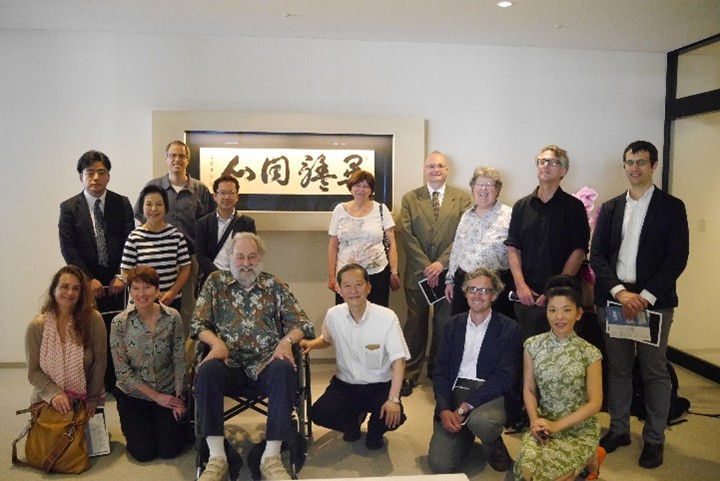
The International Lotus Sutra Seminar is an annual academic conference sponsored by Rissho Kosei-kai that brings together researchers from Japan and other countries to engage in an ongoing discussion about the Lotus Sutra. They discuss the impact it and its ideas have had on history, thought, art, and religion, from the distant past to the modern day, in India, China, Japan, and beyond. From June 28 to 30, 2016, fourteen scholars from Europe, North America, and Japan were invited to participate in this seminar at the National Women’s Education Center of Japan in the town of Ranzan, Saitama Prefecture.
The theme of this year’s seminar was “Bodhisattvas in Action: Living the Lotus Sutra in Text, Image, and History,” a theme that was open to a variety of interpretations and allowed for specialists from fields as broad-ranging as Japanese literature and East Asian art, history, and more to take part in lively discussions and debates over the course of the three days. What follows is a summary of the presentations given during the three days and of the discussions that took place afterward.
“Kenji Miyazawa: Embodying the Lotus Sutra, with Mistakes and Failures”
Gene Reeves, an international advisor to Rissho Kosei-kai, Tokyo
For the first research presentation of the seminar, Dr. Gene Reeves, one of the seminar’s founders, presented a paper on the life and work of Kenji Miyazawa (1896–1933). Although Miyazawa is best known for his literary contributions, such as Ginga tetsudō no yoru (Night of the Milky Way Railway), he was also known to have developed a passion for the Lotus Sutra and to have become acquainted with the Nichiren-inspired activist Chigaku Tanaka (1861–1939) before moving to the countryside to experience a simpler life among farmers.
Reeves’s paper tries to weave these three elements together—Miyazawa’s writing, in particular Night of the Milky Way Railway; his biography; and his relationship with the Lotus Sutra—in order to offer an overarching view of Miyazawa’s life, work, and motivations. Reeves does this by first giving a vignette of Miyazawa’s life, focusing particularly on his time in the countryside and the difficulties of adapting to life there that he is said to have had—the “mistakes and failures” Reeves alludes to in the title.
He then goes on to ask, “Why was Miyazawa powerfully attracted to the Lotus Sutra?,” giving three potential reasons: first, that the sutra “tells stories . . . that appeal to the human imagination as well as intellect”; second, that it “affirms the reality and importance of this world”; and third, that it has an “ability to empower people,” particularly through the chanting of the title of the Lotus Sutra, or o-daimoku. Reeves then goes on to explain how these elements can be seen in Night of the Milky Way Railway. At one particular point in the story the protagonist, a boy named Giovanni, finds a ticket that can “take him anywhere.” This powerful ticket, Reeves believes, symbolizes the o-daimoku and the power it has for believers, further implying that the character of Giovanni is a stand-in for Miyazawa himself.
Although respondents pointed out the importance of looking at other influences beyond the Lotus Sutra to understand Miyazawa’s work, Reeves’s paper gave us a unique insight into some potential links between Miyazawa’s life and work and the world of Buddhist scriptures.
“Giving Shape to Batō Kannon: The Kamakura-Period Reinvention of the Horse-Headed Bodhisattva of Compassion”
Benedetta Lomi, University of Bristol
With Dr. Benedetta Lomi’s paper, the discussion turned from literature and literary theory to art history and material culture. Her paper focused on Batō Kannon, a form of perhaps the most well-known bodhisattva, Avalokiteśvara, known in Japanese as Kannon, depicted with the head of a horse and a fierce, wrathful expression, a stark contrast to the gentle-looking female figure of Avalokiteśvara typically found in East Asian art. In this paper, Lomi aims to explain how Batō became used in Japanese religious iconography of the Kamakura era (1185–1333), paying particular attention to the place of Batō images in temples along pilgrimage routes.
Lomi finds two different archetypes for the stories that feature Batō in Buddhist literature, the first being that of a “flying white horse”—a mythical horse able to rescue those lost at sea; the second is that in stories involving the “favorite steed,” or aiba, of a ruler or figure of authority.
This first archetype appears to be the basis for the engi—or origin legend—of the figure of Batō Kannon housed at Matsunoodera, a temple in Kyoto, which is also the twenty-ninth temple of the Saigoku Kannon Pilgrimage route, which focuses on temples housing images of Kannon. Among the variations to this figure’s origin legend, several involve fishermen lost at sea who are saved by a white horse sent by Kannon.
The second archetype for Batō appears in the origin legend of the statue enshrined at Magōji, on the coast of the Sea of Japan in Fukui Prefecture, a temple that is part of the Hokuriku Kannon Pilgrimage route. Lomi finds that this Batō is linked to the “favorite steed” of the prince Shōtoku Taishi. Furthermore, a similar story is found in the account given by the Shingon monk Chōen (1218–84), which links Batō to the horse ridden by Shakyamuni Buddha out of his palace.
Through stories that employ these two narrative models—the flying white horse and the ruler’s favorite steed—Lomi demonstrates that “Batō’s role as protector of the animal realm was expanded and made relevant to the human realm as well.”
“Reevaluating Jikyōsha as Mountain Ascetics”
Hiroki Kikuchi, University of Tokyo
Professor Hiroki Kikuchi’s paper focused on Buddhist practitioners known as jikyōsha, or “sutra upholders,” a term that features prominently in the “Preachers of the Dharma” (hosshihon) chapter of the Lotus Sutra, but became important in later Buddhist setsuwa (a type of folk tale) literature such as the Hokkegenki (A record of miracles of the Lotus Sutra) and the Konjaku monogatari shū (Anthology of tales of times now past).
Typically, jikyōsha are depicted as ascetics who live and practice in the mountains, away from the main monastic centers, and whose practice is based mainly on the Lotus Sutra. However, Kikuchi questions some of this received wisdom in his paper, focusing in particular on the relationship between jikyōsha and centers of monastic power. Rather than strictly considering jikyōsha as people who practiced in the mountains away from society, Kikuchi’s approach “problematizes the perspective that isolates secular society from mountain practice” and instead links jikyōsha more closely to a liminal zone “between the mountains and the zone of human activity”—an area known as the satoyama.
Kikuchi does this by observing that although many of these jikyōsha were self-ordained, eventually the roles of “practitioners” and “sutra upholders” became merged under the state’s monastic ranking and ordination system, thus creating an incentive for such monks to become part of the state hierarchy.
Kikuchi also points out that many temples of this time found in the plains were coupled with a temple nearer to a mountain, a satoyama, and as part of their basic training, monks would travel between mountain and plains temples at different times of the year. At the temple in the lowlands they focused on doctrinal study (gaku), and at the mountain hermitages they focused on practice (gyō), of which sutra recitation was considered an important part. This typical pattern both of the structure of temples and of the training process shows that there was a dynamic relationship between religious practice in the mountains and in the plains.
On the whole, Kikuchi’s paper gave an overview of the development of how practitioners in the mountains and outside the centers of power functioned within the greater sphere of Buddhism in this early period, thus giving a snapshot of such “bodhisattvas in action” in the early stages of Buddhism’s development in Japan.
“Bringing the Buddha Down to Earth: Eighth-Century Chan Use of the Lotus Sutra in the Platform Sutra”
Miriam Levering, Professor Emerita, University of Tennessee, Nashville
Dr. Miriam Levering’s paper found reference to the Lotus Sutra in what may perhaps be an unexpected place: a Zen (Chn., Chan) text. Although Zen bills itself as being a separate transmission outside the teaching (kyōge betsuden) that does not rely on words or letters (furyū monji), with slogans seeming to indicate that the study of sutras was irrelevant, in fact, Levering points out, references to sutras are made frequently throughout Zen literature.
Specifically, Levering’s paper focuses on how the Lotus Sutra is used in a fundamental text of the Zen tradition, the Platform Sutra of the Sixth Patriarch (Jpn., rokuso dangyō). This work features a story of a monk named Fada who meets the sixth Chinese Zen patriarch, Huineng (Jpn., Enō, 638–713), and reports that he has recited the Lotus Sutra “three thousand times.” Hearing this, Huineng tells Fada that “even if you recite it ten thousand times, it won’t help,” thus making Fada doubt the efficacy of his practice. In response, Huineng tells Fada that “the sutra is fundamentally without doubt; it is your mind itself that has doubt” before lecturing Fada on the meaning of the sutra. After “comprehending the mysterious purport” of the sutra, Fada returns to his former practice with renewed faith and vigor.
Although this story begins by denying the efficacy of learning from sutras in the classic Zen sense, Huineng in fact confirms his respect for and comprehension of the teachings of the Lotus Sutra, and thus his criticism of Fada is not of the sutra itself, nor of its recitation or study, but of practicing such recitation without a deeper understanding.
Levering’s fascinating paper led us to the depths of Zen thought, asking that if Zen texts present such a vastly different view of enlightenment, “can the Buddha of the Lotus Sutra and the Buddha of Chan discourse fully coexist?,” leaving the participants with a philosophical quandary to close out the first day of the seminar.
“Pūrṇa as a Bodhisattva: Living the Teachings of the Lotus Sutra”
Hiroshi Munehiro Niwano, president of Rissho Kosei-kai’s Gakurin Seminary, Tokyo
Beginning the second day of the seminar, Dr. Hiroshi Niwano’s paper dealt with the role of the character Pūrṇa (Jpn., Furuna) in the Lotus Sutra. Pūrṇa is known in Buddhist literature as one of Shakyamuni Buddha’s “Ten Great Disciples” (jūdai deshi), said to be “foremost in preaching” (seppō daiichi), and appears not only in Mahayana literature but also in Nikāya literature (such as that of the Pāli Canon), though the characteristics of this figure differ in each genre.
As is well known, according to the Lotus Sutra, the highest teaching of Buddhism, the One Buddha Vehicle (ichi butsujō), is a teaching appropriate only for bodhisattvas, so Dr. Niwano first outlines the qualities of bodhisattvas described in the opening chapters of the Lotus Sutra, comparing them to the description of śravakas (shōmon), adherents to the teaching of the “lesser vehicle” (shōjō). He then brings in the description of Pūrṇa from the Lotus Sutra, whom the Buddha praises for his preaching ability but who is said to appear to people around him as a śravaka rather than a bodhisattva.
Later in Pūrṇa’s story, he is asked by the Buddha about what he would do if he were threatened with a knife in a town he preaches in. These episodes reveal which, of several Pūrṇas found in Nikāya literature, the character from the Lotus Sutra is likely to correspond to. Although the question of what Pūrṇa’s unique characteristics are as a bodhisattva is unresolved, Dr. Niwano is more concerned with seeing the figure of Pūrṇa as one of the people who “made an effort to embody what the Buddha wanted them to do because they were aware of the Buddha’s true intention,” thus being models of living the teachings of the Lotus Sutra in action.
“Development of the ‘Identity of the Purport of Perfect and Esoteric Teachings’ (enmitsu itchi) in the Medieval Tendai School: The Significance of Esoteric Symbolic Objects in Kōen hokke gi”
Takahiko Kameyama, Ryukoku University, Kyoto
Professor Kameyama presented what was perhaps the most doctrinally oriented paper of the seminar with his research on a work called the Kōen hokke gi and how it combines concepts from both the Lotus Sutra and the mikkyō, or esoteric, tradition.
Although the author of the Kōen hokke gi is traditionally thought to be the Heian-period monk Enchin (814–91), known as the founder of the branch of the Tendai school called the Jimon branch (jimon-ha), this attribution has come under scrutiny. In addition to the fact that the text is not mentioned in Enchin’s biography, some statements in the Kōen hokke gi seem to contradict statements in other works that are known with certainty to be Enchin’s, suggesting that the Kōen hokke gi is not in fact Enchin’s at all. Based on his comparison to related works from this period, Professor Kameyama concludes that the work was most likely written by someone in Enchin’s Jimon lineage but after the death of Enchin himself.
The content of the work depicts an interesting application of what Kameyama describes as enmitsu itchi thought. Enmitsu itchi (identity of the purport of perfect and esoteric teachings) is the idea that the “perfect” (en) teachings—those of the Lotus Sutra and the Tendai school—are identical (itchi) with “esoteric” (mitsu) teachings, those associated with Kūkai and the Shingon (esoteric) school of Japanese Buddhism.
Although Kameyama writes that in the Tendai works of this period, discussion about enmitsu itchi “was basically limited to the realm of doctrine,” he shows that the Kōen hokke gi “goes beyond the realm of doctrine to reach the realm of practice.” Professor Kameyama illustrates this by showing several passages where symbolism taken directly from Shingon practices is equated with such famous imagery in the Lotus Sutra as the white ox (byakugo) from the parable of the burning house (kataku). Although Kameyama dealt with a highly technical topic, his paper clearly illustrated how the author of this work made connections between the Lotus Sutra and Shingon ritual and developed this important strand of medieval Japanese thought.
“Printing Women’s Interests in Kannon Pilgrimage Temples”
Sherry Fowler, University of Kansas, Lawrence
Dr. Sherry Fowler presented a paper that, similar to Professor Lomi’s paper, dealt with images of Kannon at temples along pilgrimage routes, paying particular attention to how women are depicted in the printed copies of founding legends of these temples. To do so, she focused on four of the thirty-three temples of the Saigoku Kannon Pilgrimage route: Okadera in Nara Prefecture; Mimurotoji, south of Kyoto; Kannon Shōji in Shiga Prefecture, and Nakayamadera in Hyogo Prefecture.
Okadera’s image of Nyoirin Kannon is closely linked to the monk Kūkai (774–835), but printed materials from the nineteenth century also include the story of a young girl who nearly drowns in a ship bound for the Saigoku Pilgrimage, only to be saved by a school of fish that appear after she has prayed to the temple’s image.
Mimurotoji’s image of Senju Kannon (Thousand-Armed Kannon) is linked to the story of a girl whose father has offered her to be the bride of a shape-shifting snake, but after she prays to this image, a swarm of crabs attacks the snake, saving the girl from this fate.
The image of Senju Kannon at Kannon Shōji temple was said to be built by Prince Shōtoku in the belief that Senju Kannon took pity on a mermaid. Senju Kannon was said to be the reincarnation of a fisherman but is clearly depicted in feminine form in printed literature.
Stories about the Kannon image at Nakayama-dera feature both the Indian queen Śrīmālā (Shōman bunin) and Japanese empress Kōmyō (Kōmyō kōgō, 701–60), and the temple itself is linked to pregnancy, safe childbirth, and child-rearing, fueling the sale of votive merchandise such as haraobi, “waist belts” thought to aid pregnancy.
All in all, Professor Fowler’s paper shows how women were the principal actors of several of the founding legends of temples along the Saigoku Pilgrimage route, legends that she argues “were used to create kechien (spiritual connection) between both female and male worshippers and the Kannon icons,” a conclusion that also reinforces the argument presented in Professor Lomi’s paper.
“Wielding the Lotus Sutra in Late-Medieval Japanese Fiction”
R. Keller Kimbrough, University of Colorado, Boulder
Professor Kimbrough, an expert on medieval Japanese fiction, presented a paper on how the Lotus Sutra was “wielded” in works from several different genres of late-medieval and early-Edo-period (1603–1868) fiction. Here “wielding” in the title refers not only to the use of the Lotus Sutra as “an instrument of pacification, rejuvenation, and transformation” but also to “wielding a weapon.”
To show these two aspects, he focuses on examples from two works, the first titled Manjū, from a genre of literature called kōwaka-mai, the second called Sayohime, from a genre of literature called sekkyō.
In the first work, Manjū, the titular character known as Tada Manjū comes to have faith in the teachings of the Lotus Sutra and commands his son, Bijo Gozen, to become a monk and learn to read it. Bijo, however, spends his time at the temple making mischief and is unable to read the sutra for his father when he returns home. Enraged, Manjū goes to strike Bijo with his sword but is blocked by Bijo with the scroll of the Lotus Sutra lying on the table in front of him. In this story, the Lotus Sutra is not only “wielded” as an object of devotion for the father, Manjū, but as a weapon of self-defense for his son, Bijo.
A similar tale occurs in the story of Sayohime, where the titular character is to be sacrificed to a great serpent deity. On the way to meet the serpent, Sayohime begins chanting part of the Lotus Sutra, and right as she is about to be swallowed, she hits the snake over the head with the sutra scroll, causing its horns and scales to fall off. The serpent then proclaims, “Thanks to the power of this sutra, I am sure to become a buddha and obtain release.” Here Sayohime has “wielded” the sutra as a weapon not only for her own protection but for the liberation of the snake as well.
Although the Lotus Sutra was not the only Buddhist text with this kind of salvific power in medieval literature, Kimbrough’s paper showed that sutras were not simply reading material but that they could be “wielded” for their spiritual power—even as weapons.
“Emerging from the Earth: Underground Haunting, Bodhisattvas, and Nichirenist Discourse in Modern Times”
Gerry Iguchi, University of Wisconsin–La Crosse
Professor Gerry Iguchi began the final day of the seminar with a paper dealing with a range of issues—everything from the Lotus Sutra’s imagery of the “bodhisattvas emerging from the earth” (jiyu bosatsu) to the modern Nichirenist activist Chigaku Tanaka (also mentioned in Professor Reeves’s essay) to issues of social justice in the modern world, and even to rock-and-roll music. The overarching theme of his paper is using the image of “bodhisattvas emerging from the earth” as a metaphor for emergent social issues and the possibility of revolutionary change. In particular Iguchi shows that Chigaku Tanaka saw his world as being “haunted” by bodhisattvas that “will at some point surge forth and transform this degraded world into a utopian Pure Land of Eternally Tranquil Light.”
In the first part of the twentieth century, Chigaku and other Nichirenists in Japan thought of themselves as “bodhisattvas emerging from the earth . . . to undertake the role of righting the modern world’s wrongs.” The wrongs of the world, from their perspective, seemed to be the hegemony and colonial thinking that dominated the world at the time, whereby Japan was but a subject within a global order dominated by Western industrialized nations. This inequality between nations and social groups and the dissatisfaction it engenders linger like “ghosts” or “specters” below the surface of our world, according to Iguchi, only to be rectified by the “bodhisattvas”—reformers—who emerge out of this ground. In this sense, the imagery of the “bodhisattvas emerging from the earth” is linked not only to the prewar Nichirenist movement but to communist concepts of inequality and to the social activism of the modern world, embodied by musicians such as Bruce Springsteen. On the whole, Iguchi sees the modern world as a world of mappo (the age of the decline of the Law), “haunted” by social problems and inequality but believes that it is possible to rise “out of the earth” to promote social change.
“Kannon, the Deity from the Sea”
Gaynor Sekimori, SOAS, University of London
Dr. Gaynor Sekimori’s paper dealt with the role of the bodhisattva Kannon and the relationship of this figure to the ocean, themes that were touched upon in Professor Fowler’s and Professor Lomi’s papers, but here they are given the full spotlight. Like their papers, Sekimori’s focused on legends about Kannon and on the Kannon images enshrined at certain temples but framed them in terms of a “maritime cultural landscape” by which there is a “liminal zone” that “includes the site of ritual interaction between the land and the sea,” and also a “liminal agent”—in this case, the figure of Kannon—who acts as both “a deity from beyond the sea” and a protector of that which connects the land to the sea, in particular, ships.
Sekimori points out that in addition to there being many temples near the seaside dedicated to Kannon, many of these enshrine pieces of driftwood and other objects found at the seaside—objects that come from the sea to the land, in a sense bridging these two worlds. Furthermore, there are many stories that depict Kannon as a protector of fishermen and boats, including a well-known story of Kūkai scratching an image of Kannon into the boards of his vessel for protection. Sekimori notes that there were also rituals in which priest-ascetics, instead of coming from the sea to the land like driftwood or fishermen, went from the land to the sea, embarking for the “other shore” of Kannon’s Pure Land, known as Potalaka (fudaraku). With these stories, we can see that Kannon had a particular significance for those people who spent their lives on the land and at sea and that the relationship between Kannon and the sea in Japanese religion is indeed an important part of the mythos surrounding Kannon. In addition to these examples, Sekimori presents the theoretical model of a “maritime cultural landscape” for thinking about this relationship and the symbolism employed that links these two elements together.
“Lotus Sutra Woodcuts in Song China and Beyond”
Shih-shan Susan Huang, Rice University, Houston, Texas
Professor Susan Huang focused on woodblock illustrations of the Lotus Sutra made in China during the Song dynasty (960–1279). Throughout the history of printing in East Asia, when printers made copies of Buddhist works such as the Lotus Sutra, they often included woodblock illustrations of scenes from the texts as frontispieces. Such illustrations from the Song dynasty are among the oldest examples of mass-produced woodblock printing, and many were produced by publishing houses in the city of Hangzhou, China’s capital during the Song dynasty. These woodblock texts and their illustrations were then taken to other parts of the Chinese empire or to Japan by monks who studied in Hangzhou. Sometimes such illustrated texts were enclosed within hollowed-out statues of buddhas or bodhisattvas. Because the written word of the Buddha itself was thought to have great power, “stuffing” statues with texts in this way was thought to imbue the statues with the power of the text itself, and because of this practice, there are some well-preserved examples of printed works from this period.
By comparing examples of such works preserved in Japan and China, including in Dunhuang, Huang showed how the same mass-produced image from the same publishing house in Hangzhou has been preserved in different places, showing how widely such texts circulated during this period. Furthermore, comparing illustrations of the same scene, Huang showed how different publishers may have emphasized one part of the sutra over others, and regional variations in the depiction of certain scenes may be a product of the differing environments in which such images were produced. Even so, the basic motifs found in such woodblock prints were reused and became templates for similar illustrations that were created in later periods.
Saying that “these exuberant frontispieces . . . mark the high point of Hangzhou printing,” Huang’s paper and presentation gave a beautifully illustrated overview of Buddhist woodblock prints from Song-dynasty China and indicated how these works can shed light on the history of printing and the reproduction of texts both inside and outside China.
“The Lotus Sutra and the Ritual of Sutra Copying in Premodern East Asia”
Bryan Lowe, Vanderbilt University, Nashville, Tennessee
Professor Bryan Lowe closed out the seminar with a paper surveying the practice of sutra copying (shakyō) in East Asia. Although he principally focused on Japan and on evidence from the sutra-copying bureau at the temple Tōdaiji during the Nara period (710–94), he also incorporated evidence describing sutra copying in China and the Korean peninsula.
For Buddhists throughout East Asia, the act of simply copying a scripture was thought to be a “morally good” act that produced merit (kudoku) that could affect one’s karma and future fate. Part of the reason for this belief is that sutras, such as the Lotus Sutra, explicitly encourage the reader to make copies. In addition to benefiting the copyist’s karma, copies of the text itself were thought to have special powers, such as being fireproof, a striking similarity to the uses of the text that Kimbrough described in his paper.
With such spiritual powers, sutra copying was performed as a religious ritual, first by practitioners’ bathing and donning clean clothes in order to purify their body beforehand, then by performing the act of copying according to a procedure that was “in accordance with the Dharma” (nyohō), and finally, by dedicating the merit of copying the text once it was completed. Professor Lowe even gives evidence that sutra copying was more often performed on certain “pure” (sai) days of the month, a concept originally from Indian Buddhism that can be seen not only in Nara but also in manuscripts from Dunhuang, in northwestern China.
During the discussion, Professor Kameyama brought up the issue of copying sutras in blood, a well-known practice in East Asia. Even though blood is generally thought to be “impure” and thus at odds with the “purity” of “normal” sutra copying, Lowe suggested that perhaps the dedication required for such an extreme practice may have neutralized any concerns about impurity.
Lowe’s holistic approach to the study of sutra copying illustrates a phenomenon not limited to one nation or region but practiced in all of the premodern Buddhist world, and what would otherwise seem to be a mundane matter of copying text became a sacred and meritorious ritual that was “a central value to the Buddhist notion of a well-lived life.”
Concluding Remarks
On the whole, this year’s International Lotus Sutra Seminar was a great success, with a wide range of papers illustrating “Bodhisattvas in Action” and showing how the text of the Lotus Sutra, and images based on it, were an integral part of the lived experience of Buddhism throughout its history in East Asia. All the scholars expressed admiration for the high quality of the presentations, and everyone found the discussions to be extremely interesting and informative. Everyone who participated expressed their deepest gratitude for being invited, and for the generous hospitality provided by the sponsors of the seminar, as well as to the coordinating staff at Rissho Kosei-kai and at the National Women’s Education Center. It is hoped that the conference will continue in future years as an opportunity to build bridges between Rissho Kosei-kai and academic communities in Japan and around the world.