
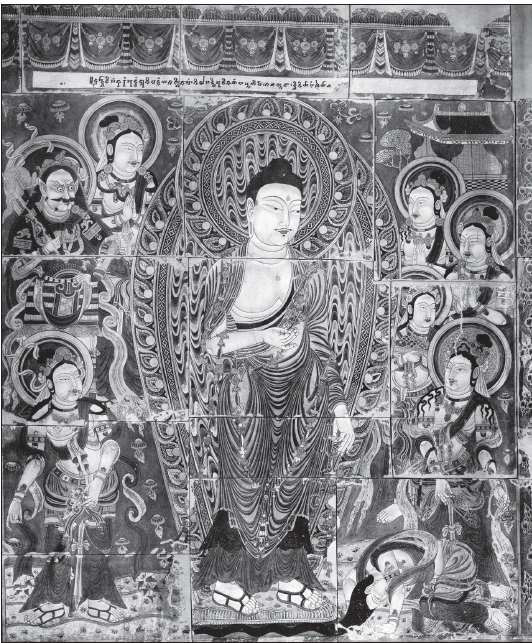
A wall painting of Dipankara and Sumedha. Sumedha lies on the ground before Dipankara Buddha. In Buddhist texts, Sumedha is a previous life of Gotama Siddhartha in which he declares his wish to become a buddha. Bezeklik Cave 9, Turfan, China. Ninth–eleventh centuries.
Wikimedia Commons File: Dīpaṁkara Jātaka. Bezeklik Cave 9, Furfan, China.Wall painting.png
The vivid descriptions of tangible and concrete phenomena in Chapter Sixteen of the Lotus Sutra may initially seem irreconcilable with the doctrine of emptiness. However, the subsequent chapters, which highlight the merits of awakening to the Buddha’s eternal life and recognizing his presence in the world, suggest that realizing emptiness is not only integral to, but also ultimately transcended by, the realization of the Buddha’s eternal life.
I. A Recap
This time, we continue our exploration of emptiness in the Lotus Sutra as part of our broader consideration of its role in Rissho Kosei-kai teachings and practices. “Emptiness,” or śūnyatā in Sanskrit, is a concept frequently encountered in Buddhism, particularly in the traditions of Tibet, Northeast Asia, and Vietnam. Realizing or awakening to the emptiness of all things is often described as a crucial step on the path to buddhahood, especially within the Perfection of Wisdom sutras and their commentaries.
However, as I noted in the previous installment, those who explore Rissho Kosei-kai Buddhism are often surprised to find that emptiness is not a central focus in its teachings. Nor does the realization of emptiness seem to hold the same priority in practice as it does in other Buddhist traditions. This contrast can be puzzling and naturally raises the question: Where is emptiness in Rissho Kosei-kai?
This essay is the second in a three-part series addressing that question—one I have frequently been asked. In the previous piece, we examined the meaning of emptiness in Buddhism and explored its role in the first half of the Lotus Sutra, particularly in relation to the concept of the One Vehicle—the teaching that all sentient beings have the potential to attain buddhahood. This time, as we prepare to understand the place of emptiness in Rissho Kosei-kai, we will turn our attention to its role in the latter half of the Lotus Sutra.
I highly recommend reading the first piece in this series before continuing with this essay (Scarangello 2024). However, in brief, our working definition of emptiness refers to the nature of phenomena: everything that exists arises from causes and conditions and is therefore empty of any inherent, independent existence or fixed nature. Since nothing comes into being ex nihilo or through its own power, all things exist in interdependence—what Thich Nhat Hanh described as interbeing.
When this fundamental nature of phenomena is perceived, all things appear as dreams, mirages, space, reflections in water, echoes, shadows, dewdrops, bubbles, or flashes of lightning (Gethin 1998, 237). Nāgārjuna (c. 2nd century CE) and his later followers in the Mādhyamaka (“Middle Way”) school of Buddhist philosophy synthesized various sutra teachings on emptiness into a rigorous system of thought that carefully avoided reifying emptiness as an absolute. However, as the Japanese scholar Gadjin Nagao notes, the negation of emptiness also implies an affirmation: to see emptiness is to see the true nature of reality (Nagao 1991, 209).
In the previous piece, which focused on the first half of the Lotus Sutra, we examined key passages that seem to critique the doctrine of emptiness, while highlighting others that emphasize its significance. We also explored an often-overlooked passage suggesting that the concept of emptiness is essential to the Lotus Sutra because the universal potential for buddhahood is a direct soteriological consequence of emptiness.
To summarize, in Chapter Two of the sutra, the Buddha explains that all living beings have the potential for buddhahood, precisely because no existence has a fixed nature—they are empty. Given the right conditions, they can therefore be transformed and led to awakening. As the Japanese scholar Kōtatsu Fujita explains, “It can be concluded that the One Vehicle is nothing other than the practical expression of the concept of emptiness” (Fujita 1969, 399). Most of the parables and analogies illustrating the universal potential for buddhahood in the Lotus Sutra align with this perspective, demonstrating that beings attain buddhahood through dependent origination. For these reasons, emptiness is indeed present in the first half of the Lotus Sutra, though it appears in the form of the One Vehicle—the teaching of universal buddhahood.
I concluded the previous essay with the suggestion that realizing buddha-nature—a concept implied by the Lotus Sutra, even though the term itself does not explicitly appear—encompasses the realization of emptiness. This is because, as we saw, what one perceives in seeing buddha-nature is fundamentally tied to the absence of any fixed essence. But rather than merely recognizing an absence, one perceives it as the space of limitless potential.
This is indeed the kind of direction in which the Lotus Sutra moves in its second half, particularly in Chapter Sixteen. Here, Śākyamuni Buddha declares that his imminent parinirvāṇa is, in truth, merely a display—he has always been in this world, continuously expounding the Dharma. He tells the assembly that his lifespan, for all intents and purposes, is infinite. Below, we will examine Śākyamuni Buddha’s profound and startling assertion and explore how it relates to the role of emptiness in the second half of the Lotus Sutra.
II. The Core Narrative of the Second Half of the Lotus Sutra
In Chapter Fifteen of the Lotus Sutra, a vast multitude of “innumerable thousands of millions of bodhisattva-mahāsattvas” suddenly emerges from beneath the earth. These bodhisattvas, adorned with “golden-hued bodies, the thirty-two marks [of sagely beings], and immeasurable radiance,” are clearly highly advanced, having practiced the Way for an inconceivably long time (Rissho Kosei-kai 2019, 262). Yet when Maitreya Bodhisattva asks the Buddha who they are and from whence they came, Śākyamuni replies that he himself had “taught, transformed, instructed, and guided them” (ibid., 270). This response astonishes Maitreya and the assembly, as it seems impossible—after all, Śākyamuni attained awakening only some forty years earlier at the Place of the Way near the town of Gayā. Representing the entire assembly, a confused Maitreya asks how this could be possible.
The next chapter, “The Life Span of the Eternal Tathāgata,” presents the Buddha’s response. Śākyamuni explains that while his disciples assume he attained buddhahood only a few decades earlier, he had, in fact, become a Buddha in the infinite past. He reveals that his lifespan is unfathomable, extending indefinitely into the future. To illustrate this, he offers two extended analogies—condensed here for brevity—which suggest that the Buddha transcends not only time but also space. In other words, he asserts his omnipresence. Śākyamuni further astonishes the assembly by revealing that all other buddhas who have appeared were, in reality, manifestations of himself, responding to the unique needs of sentient beings in countless ways.
The elderly Śākyamuni Buddha also cautions the assembly that his impending parinirvāṇa will not be his ultimate extinction but rather a skillful means to awaken longing for the Buddha in the hearts of living beings, inspiring them to embark on the Buddha Way. He illustrates this with the famous Parable of the Good Physician, in which a doctor, to persuade his poisoned children to take the antidote, feigns his own death. In the verses concluding the chapter, the Buddha assures the assembly that he remains ever present on Divine Eagle Peak and throughout all realms. He describes this world as his pure land—one that is never destroyed, even though, to ordinary beings, it appears to undergo cycles of arising and extinguishing.
These claims may seem startling to those who have learned that Buddhism teaches the impermanence of all things. Chapter Sixteen is undoubtedly the most challenging part of the Lotus Sūtra, particularly in its revelation of the “eternal” or “cosmic” Buddha. I have explored this in detail elsewhere (see Scarangello 2019), but suffice it to say that, despite common assumptions, Buddhism has always affirmed at least one form of permanence—the permanence of the truth to which Śākyamuni Buddha awakened. This is explicitly stated in numerous sūtras, including some of the earliest texts of the tradition. One such example appears in the Nidānasaṃyutta (Connected Discourses on Causation), part of the Saṃyutta Nikāya of the Pāli Canon.
Whether there is an arising of Tathāgatas or no arising of Tathāgatas, that element [dependent origination] still persists, the stableness of the Dhamma, the fixed course of the Dhamma, specific conditionality. (Bodhi 2000, 501)
Without delving too deeply into technicalities, the Buddha teaches his disciples that causation is the fundamental truth of the world, timeless and universal. Phenomena arise in accordance with the process outlined in his exposition of dependent origination. He reiterates this principle in many sūtras, including a variation found in Chapter Two of the Lotus Sutra. This truth is omnipresent—buddhas do not create it; they merely rediscover it and share their realization with humanity.
What I want to emphasize to readers is that while Buddhism indeed teaches that all conditioned phenomena—things that arise through causes and conditions—are impermanent and destined to pass, the truth Śākyamuni Buddha realized through his gnosis is said to transcend time and space. The Buddha’s passing did not mean that the possibility of awakening vanished with him. The Dharma—the fundamental truth of all things—is fixed and permanent. What is new in this chapter is the assertion that this omnipresent truth is, in some way, an enduring presence of Śākyamuni Buddha himself in the world. Whether this represents Śākyamuni in his entirety or merely an aspect of him is not entirely clear. Over time, scholar-monks sought to clarify this question. However, setting aside these doctrinal discussions for the sake of simplicity, I will refer to this ever-abiding dimension of Śākyamuni as the “Eternal Buddha.”
Previously, we saw how the Lotus Sūtra construed a void—the absence of any fixed nature—as the universal capacity of all living beings to become buddhas, a potential awakened when the right conditions, namely the Buddha’s skillful means, are present. Thus, if we speak of this potential as “buddha nature,” then paradoxically, “no-nature” is precisely buddha nature. In Chapter Sixteen, the Lotus Sūtra similarly reinterprets absence—this time, the apparent absence of the Buddha in the world. It reveals that omnipresent truth is an eternal aspect of Śākyamuni Buddha that always remains. In other words, at the most fundamental level, “Buddha” is the omnipresent truth itself.
This idea may not be as strange as it first appears. Those of us who study Buddhism receive its wisdom from our teachers, who, in turn, learned from their teachers, tracing an unbroken lineage back to Śākyamuni Buddha, the teacher of us all. This is why we take refuge in him—he is the source and wellspring of our tradition. But if Śākyamuni is our source, then from whom did he learn? In whom did he take refuge?
Śākyamuni Buddha’s biography recounts that after leaving the palace to seek the Way, he studied under two teachers in succession. However, he eventually parted ways with them to embark on a solitary quest. Shortly after his awakening, Śākyamuni encountered a wandering mendicant named Upaka, who, struck by the serenity of Śākyamuni’s appearance, inquired about his teacher and the teachings he followed. Śākyamuni replied that he was self-awakened and posed the rhetorical question, “Whom shall I regard as my teacher?” (Numata Center for Buddhist Translation and Research 2003, 29). The only teacher and refuge Śākyamuni had was ultimate truth itself—the omnipresent truth he had discovered. Therefore, it is not far-fetched to view this ever-abiding truth as the essence of what is most fundamentally “Buddha”—the source and teaching of all other buddhas, the “Buddha of buddhas.”
However, the chapter goes beyond simply personifying omnipresent truth as Buddha. It presents something affirmative and active in this portrayal. Chapter Sixteen’s Eternal Buddha is not merely a truth that abides silently, waiting to be rediscovered. It is described as an active force, driven by compassion, continually working in the world—always expounding the Dharma and reaching out to liberate beings. Omnipresent truth is portrayed as a subject with will and aspirations, extending itself to respond to living beings by phenomenally manifesting in diverse forms and offering myriad teachings. Furthermore, not only is the Buddha still present in the world, but the chapter also asserts that those who awaken to the Eternal Buddha’s presence perceive it as a pure land—“tranquil and calm,” with “gardens, groves, halls, and pavilions / Adorned with every kind of gem” (Rissho Kosei-kai 2019, 283).
The vivid descriptions of tangible and concrete phenomena in Chapter Sixteen of the Lotus Sutra may initially seem irreconcilable with the doctrine of emptiness. However, the subsequent chapters, which highlight the merits of awakening to the Buddha’s eternal life and recognizing his presence in the world, suggest that realizing emptiness is not only integral to, but also ultimately transcended by, the realization of the Buddha’s eternal life.
III. Emptiness and the Merits of Realizing the Eternal Life of the Buddha
In the opening of Chapter Seventeen, “Specification of Merits,” we learn of the attainments of beings who have awakened to the truth of Śākyamuni’s infinite lifespan—the omnipresence of the Buddha. For example, the Buddha states that bodhisattvas as numerous as the particles of dust in a thousand small worlds will become buddhas after just eight more lifetimes. Others, as numerous as the particles of dust in four worlds, will attain buddhahood after only four lifetimes. Some will even reach buddhahood after just one further lifetime. Awakening to the omnipresence of the Buddha has thus propelled these bodhisattvas to the threshold of buddhahood. The most basic levels of awakening—“basic” in a comparative sense—are described as beings as numerous as “the particles of eight worlds,” who develop the aspiration for Supreme Perfect Awakening, and those “as numerous as sixty-eight hundred thousand million myriad times the sands of the Ganges,” who have attained the “cognition of nonorigination.”
Buddhist traditions offer varying interpretations of both developing the aspiration for Supreme Perfect Awakening and the cognition of nonorigination. Broadly speaking, generating the aspiration for Supreme Perfect Awakening, or bodhicitta, involves cultivating a firm, overarching goal to become a buddha in order to liberate both oneself and others. Many traditions assert that this aspiration becomes genuine and steadfast once one overcomes the influence of delusions—both those stemming from mistaken perceptions of the world and those rooted in deeply ingrained flaws in the way our minds perceive reality. In many accounts, the power of these delusions is broken when one begins to nonconceptually perceive the emptiness of all things. Authentically generating bodhicitta is viewed by many traditions as the starting point of the bodhisattva path, marking a transformative shift in consciousness and the practitioner’s attainment of the first of the “ten bodhisattva grounds” (Williams 2009, 80–81; 201). This transformation is closely linked to acquiring the ability to directly perceive the emptiness of both self and other.
Similarly, the “cognition of nonorigination” (Skt., anutpattika-dharma-kṣānti; Chn., wusheng faren 無生法忍) is fundamentally a realization of emptiness. As described in the Commentary on the Great Perfection of Wisdom, this awakening occurs when the practitioner perceives that all things arise dependent on causes and conditions, and thus lack a fixed, independent self-nature. As a result, their attributes are changeable and impermanent. Since nothing possesses a fixed nature or independent, immutable qualities, nothing in the world manifests as a permanent, unchanging reality (T 25.1509.204a19–22). So far, so good. From this point, however, things become a bit more complex.
Because nothing exists in a “real” or “substantial” way—as a permanent, fixed reality—when things cease, nothing truly permanent or fundamentally existent is lost. Nothing substantial ever truly arises to begin with. Buddhist texts offer a variety of analogies to convey this: when one observes things, they appear devoid of substantiality or permanence—like dreams, reflections, the fleeting foam on churning waters, or the echoes of sound. What we witness is a continuous flow of transformation, extending from the infinite past into the infinite future. To offer a metaphor, the phenomenal world is like a flowing river—constantly moving, changing, and transforming. This river is infinite in both directions: it has no beginning, as it has always existed, and no end. To directly and nonconceptually realize that everything is merely flow—that nothing truly arises in the first place, and thus nothing ever truly extinguishes—is the “cognition of nonorigination.”
When Śākyamuni Buddha tells us that realizing the eternal life of the Buddha allows one to attain the merits of the aspiration for Supreme Perfect Awakening and the cognition of nonorigination, it suggests that perceiving the Eternal Buddha’s presence in the world somehow encompasses an understanding of emptiness. If the Eternal Buddha is omnipresent truth, then it must be synonymous with emptiness, which is the fundamental truth of phenomena, regardless of time or place. It is the way in which all things manifest through causes and conditions—dependent origination—and exist in this world. To perceive the omnipresent truth in this world—the Eternal Buddha—would be to see the emptiness of all things. Furthermore, as the omnipresent truth that has always abided in this world, realizing it would inherently involve an apprehension of nonorigination. It therefore makes perfect sense that one of the merits of realizing the eternal life of the Buddha would be the cognition of nonorigination.
IV. The Eternal Buddha and the “Non-empty”
However, to see the Eternal Buddha is also to glimpse something more. Ordinary phenomena are non-originated because they are “insubstantial.” They never come into existence as substantial entities; instead, they are conditioned phenomena—dependent on causes and conditions. As such, they never truly or substantially exist, and therefore, nothing substantial or “truly” existent passes into extinction. Truth, in contrast, is neither born nor perishes because it simply is. It is not a conditioned phenomenon, as it does not depend on causes and conditions. It just is. Thus, to see the Eternal Buddha is also to see the truly real.
Perhaps this “realness” is connected to the positive and dynamic activity of the Eternal Buddha described in Chapter Sixteen. The verses that conclude the chapter portray the Eternal Buddha not merely as a dormant truth waiting to be discovered, but as a dynamic force actively working in the world to liberate living beings.
I have ceaselessly expounded the Dharma,
Teaching and transforming countless millions of beings
. . . . . . . . . . . .
For I always abide here teaching the Dharma. (Rissho Kosei-kai 2019, 281)
The Eternal Buddha always abides in this world—not as an inert, passive truth, but as a ceaseless force, actively teaching living beings and refining their hearts and minds toward liberation. The will and agency of the Eternal Buddha are further emphasized in the final verses, some of the most renowned in Mahāyāna Buddhism.
I am ever thinking:
“How can I cause living beings to
Embark upon the unsurpassable Way
And quickly accomplish embodiment as buddhas?” (Rissho Kosei-kai 2019, 284)
These passages create a stark contrast between the Lotus Sutra’s earlier portrayal of omnipresent truth in the world and the depiction found in the Connected Discourses, where truth is passive, awaiting revelation. The question then arises: Is this active portrayal merely a result of personifying omnipresent truth, presenting it as a subject, or does it represent a conception of truth that transcends what we have encountered previously?
In the East Asian tradition of the Lotus Sutra, the Eternal Buddha as omnipresent truth is understood not only as the truth of emptiness, or a negation, but as a dynamic, active force. This dynamic aspect of truth is sometimes referred to as the “non-empty” (Chn., bukong 不空). The Lotus Sutra tradition picks up this term from the Mahāyāna Nirvāṇa Sūtra (Chn., Daban niepan jing 大般涅槃経; Skt., Mahāparinirvāṇa Sūtra), where it critiques the four disciples of Śākyamuni—Subhūti, Mahā-Kātyāyana, Mahā-Kāśyapa, and Mahā-Maudgalyāyana—for their hesitation to embrace bodhisattva practice. In the Nirvāṇa Sūtra, they are criticized because they “see all as empty and do not see the non-empty” (T 12.374.523b20). The “non-empty” refers to the active, dynamic workings of truth, as the Lotus Sutra illustrates when recounting the self-critique of these disciples in the “Medicinal Herbs” chapter: “We took no pleasure in considering bodhisattvahood, with its enjoyment of transcendent powers, its purifying of buddha lands, and its bringing of all living beings to perfection” (Rissho Kosei-kai 2019, 121). Resting in the quiescence and tranquility of emptiness and refusing to be conduits for a kinetic energy that transforms individuals and society, the four disciples are archetypes of emptiness as a nihilistic one-sided truth.
Reading Chapter Sixteen of the Lotus Sutra leaves us with the impression that its Eternal Buddha, as omnipresent truth, incorporates or integrates the truth of emptiness while simultaneously representing a dynamic, transformative activity of truth in the world. This kind of dual relationship between emptiness and activity, encapsulated by the Eternal Buddha as omnipresent ultimate truth, is suggested by two passages in Chapter Sixteen. One depicts the dynamic activity of the Eternal Buddha, while the other reveals the truth of the world as nonoriginated, or the “empty.”
Let’s take a look at these two passages:
First, after revealing his infinite life in Chapter Sixteen, Śākyamuni explains how this omnipresent aspect of the Buddha is inherently present and active in the world, manifesting in various forms that reach out to all beings with compassion.
Good children, the sutras expounded by the Tathāgata are all for the purpose of liberating living beings. I may speak of myself. I may speak of someone else. I may appear as myself. I may appear as someone else. I may appear through my own deeds. I may appear through someone else’s deeds. And whatever I teach and whatever I say is valid and never in vain. (Rissho Kosei-kai 2019, 278)
This passage is referred to as “the six ways in which the Tathāgata manifests in the world.” Without delving into complex doctrinal details, Śākyamuni Buddha emphasizes that the Eternal, Original Buddha—omnipresent truth—continually manifests in the world through various forms and situations, all with the noble aim of liberating beings from suffering. In the Lotus Sutra tradition, this passage came to be interpreted as a form of pantheism or panentheism, with “appearing as someone else” suggesting that the Eternal Buddha manifests as countless gods, teachers, and even political leaders, while “someone else’s deeds” is sometimes understood as the Eternal Buddha acting through the environment and events. Compassionately and actively, the Buddha reaches out to us, offering diverse teachings and practices that guide us toward liberation.
However, the Buddha immediately follows this description of the Eternal Buddha’s dynamic activity with another statement that reaffirms the world as “nonoriginating”—essentially empty. Śākyamuni Buddha reminds the assembly that nothing in the world arises as a fixed and independent entity, and thus, nothing truly perishes:
The Tathāgata perceives the character of the threefold world as it really is. Birth and death do not leave it or appear in it. There is no staying in the world or departing from it for extinguishment. It is neither substantial nor insubstantial. And it is neither thus nor otherwise. This is not how the threefold world sees itself, but the Tathāgata sees such things as these clearly and without error. (Ibid)
This, too, is a truth of the world. However, in contrast to the “six ways in which the Tathāgata manifests in the world,” the Buddha’s description of reality here takes on a more philosophical tone, presenting a vision that is essentially net-zero and motionless in substance.
In this way, Chapter Sixteen of the Lotus Sutra presents two perspectives on the ultimate. One is the omnipresence of truth as an imminent, active, and compassionate force in the universe—what I have referred to as the “non-empty.” The other perspective is the truth of things as nonorigination, which is essentially the truth of emptiness. A similar paradox appeared in the first half of the Lotus Sutra, where it expressed “no-nature” as buddha nature, with its activity being the One Vehicle. I believe we can recognize a pattern here, from which we can draw some overall conclusions about the role of emptiness in the Lotus Sutra.
V. Seeing the Eternal Buddha as the Perfection of Wisdom
There is one more passage in the second half of the Lotus Sutra to which I would like to draw the reader’s attention. Later in Chapter Seventeen, “Specification of Merits,” the sutra highlights the profundity of seeing the Eternal Buddha—even if only momentarily or partially—describing it as “a single moment of faith and understanding.” The text then compares this realization to the bodhisattva’s practice of the six perfections (pāramitās), the virtues cultivated on the path to buddhahood. This comparison is particularly noteworthy because, while open to interpretation, it suggests that realizing the Eternal Buddha’s infinite lifespan is either equivalent to, or serves as a substitute for, the bodhisattva’s perfection of wisdom (prajñā-pāramitā).
First, allow me to provide some context. The bodhisattva’s six perfections encompass the cultivation of generosity, discipline, patience, diligence, meditation, and wisdom. Generosity involves giving to others, whether through monetary donations, offering one’s labor, or teaching the Dharma. Discipline refers to adhering to the Buddha’s ethical guidelines. Patience and diligence are self-explanatory. Meditation includes practices that first calm and sharpen the mind and then facilitate analytical contemplation, allowing one to perceive the true nature of reality. This meditative practice, supported by the other perfections, ultimately leads to the perfection of wisdom—the attainment of a buddha’s wisdom and insight into the ultimate nature of all things, often described as their “true characteristics.”
In the Perfection of Wisdom Sutras that teach the bodhisattva perfections, perceiving the ultimate reality of all things is closely associated with the realization of emptiness (Nagao 1991, 210). To give an example, the Commentary on the Great Perfection of Wisdom states: “If a bodhisattva perceives all dharmas as neither permanent nor impermanent, neither suffering nor bliss, neither self nor non-self, neither existence nor nonexistence, and yet does not contrive such conceptualizations—this is called the bodhisattva’s practice of prajñā-pāramitā” (T 25.1509.190b13–15). The reader should recognize this as essentially the cognition of nonorigination, as discussed above.
Returning to the Lotus Sutra, Chapter Seventeen compares the realization of seeing the Eternal Buddha to the practice of the bodhisattva’s perfections. I will quote from Cleary’s translation, as it is the closest to contemporary spoken English and thus the most accessible.
The merit which good men and good women gain by this [that is, faith and understanding in the eternal life of the Buddha,] would be hundreds or thousands or millions of times as much merit as they would gain by cultivating, for the sake of ultimate complete enlightenment, the perfection of generosity, the perfection of discipline, the perfection of patience, the perfection of energy focus [diligence], and the perfection of meditation—that is, five of the six perfections, with the exception of the perfection of wisdom. (Clearly 2016, chapter 17)
To our way of thinking today, this kind of comparison is rather convoluted. The sutra is telling us that seeing the Eternal Buddha is an awakening far more profound than what any bodhisattva could attain through the practice of generosity, discipline, patience, diligence, and meditation for an infinite span of time. But why the curious exemption of the perfection of wisdom?
Many commentators have concluded that the exception of the perfection of wisdom is the sutra’s way of indicating that realizing the eternal life of the Buddha is the perfection of wisdom, or in some way encompasses it. This is a radical assertion, and thus we can appreciate that the sutra would couch it in tentative language. However, the notion that this awakening the sutra has heralded—seeing the Eternal Buddha—would be a truer or more comprehensive vision of the ultimate reality of all things is strongly suggested by our analysis of Chapters Sixteen and Seventeen above.
VI. Emptiness and the Lotus Sutra: More than Meets the Eye
Gene Reeves, the translator of the most widely read English version of the Lotus Sutra, held the view that the Lotus Sutra is not primarily concerned with emptiness, or śūnyatā (Reeves 2010, 190). In our exploration, we have observed that the Lotus Sutra does not present detailed doctrinal discussions on emptiness, such as those found in other Mahāyāna sutras, and that its language is largely positive and cataphatic, emphasizing the universal potential of all living beings to become buddhas. In fact, the text of the sutra contains what could be interpreted as veiled criticism of the doctrine of emptiness. However, I have argued that it would be a superficial reading to conclude that emptiness is absent or irrelevant to the sutra and its teachings.
First, from a pivotal passage in Chapter Two, we saw that the One Vehicle is a practical consequence of the emptiness of phenomena—the absence of any fixed, independent identity or nature. Living beings are changeable, and given the right conditions—the skillful means and guidance of the Buddha—anyone can attain liberation and become a buddha. Thus, from the standpoint of the sutra’s association of emptiness with the One Vehicle, the capacity to become a buddha, or buddha nature, would paradoxically be emptiness—“the nature of no-nature.” Here, we are reminded of Thich Nhat Hanh’s teaching that because phenomena are empty of any fixed, inherent, or independent nature, they are full of “everything else.” Put differently, the other side of emptiness is infinite potential—buddhahood.
Next, we observed that the sutra’s metaphors and analogies predominantly portray the universal capacity to become a buddha as a function of dependent origination, which aligns perfectly with the doctrine of the emptiness of all phenomena. Therefore, even though the sutra hardly discusses the emptiness of phenomena, what it focuses on is the “practical expression of the concept of emptiness” (Fujita 1969, 399). Emptiness is central to the doctrines of the first half of the Lotus Sutra, but the text is more concerned with the soteriological implications of emptiness within a practical framework.
In the second half of the Lotus Sutra, we find no doctrinal discourse related to emptiness; instead, we are confronted with a mythical narrative. Myriads of ancient bodhisattvas arise from beneath the earth, whom Śākyamuni Buddha claims to have personally converted and guided. When Maitreya questions how Śākyamuni could have been the teacher of such ancient beings, the Buddha reveals that he has been in the world since the infinite past and will continue to abide in the world into the infinite future. He further astonishes the assembly by disclosing that, all this time, he has been actively working in the world to liberate living beings, even appearing in the guise of other sages to provide the appropriate teachings.
While I have attempted to address the second half of the sutra on its own terms, rather than immediately turning to the commentarial tradition, since we are dealing with mythos, any interpretation we offer falls within the realm of subjective understanding. I have followed the general consensus that the “Eternal Buddha,” or the timeless aspect of the Buddha presented in Chapter Sixteen, is a cataphatic personification of ultimate truth that is always accessible in the world. If we understand the Eternal Buddha as omnipresent truth, then one way to read it is as a symbolic portrayal of emptiness, since all things arising through causation—what Buddhism maintains as the truth of the world—are empty. The merits of realizing the eternal life of the Buddha, particularly the cultivation of the aspiration for Supreme Perfect Awakening and the cognition of nonorigination, seem to suggest that seeing the Eternal Buddha is, in some way, seeing emptiness.
Unlike older depictions of omnipresent truth in other sutras, in which it is passive, waiting to be discovered, the Eternal Buddha in the second half of the Lotus Sutra is dynamic and active, working in the world to liberate living beings. This portrayal may stem from the anthropomorphizing of omnipresent truth, presenting it as a subject with agency. However, the dynamism of the Eternal Buddha is one of the key aspects of Chapter Sixteen. It suggests that omnipresent truth, as the Eternal Buddha, is something beyond emptiness, though not separate from it. This idea is reflected in the Buddha’s dual statements that characterize reality—one describing a universe where the Eternal Buddha’s manifestations constantly reach out to liberate beings, and another asserting the truth of the world as its nonorigination. These two perspectives, though distinct, appear to be connected. One is dynamic and active, while the other is a net-zero equation, static or inert. Borrowing a term from the Nirvāṇa Sutra, I have referred to the former as the “non-empty” and the latter as the “empty,” suggesting that the former represents the activity of truth, while the latter is truth as such (for an in-depth discussion of the creative, active side of truth, see Ziporyn 2019).
Finally, we saw in Chapter Seventeen that the Lotus Sutra seems to indicate awakening to the eternal life of the Buddha is itself the perfection of wisdom, which is usually associated with seeing the emptiness of all things.
To explore the role of emptiness in the latter half of the Lotus Sutra more deeply, we must inevitably turn to the commentarial tradition. However, even without doing so, it is clear that emptiness is present in this section of the sutra, and that seeing the Eternal Buddha is in some way related to realizing emptiness. Yet, to see the Eternal Buddha seems to be an awakening that transcends emptiness. Emptiness is not the entirety of truth; there is more. While realizing emptiness is crucial, the Lotus Sutra places it within a broader context. Recognizing this helps us better understand how the Lotus Sutra commentarial tradition articulates the role of emptiness in the second half of the sutra.
In general, for the Chinese Tiantai, Japanese Tendai, and Nichiren traditions, the Eternal Buddha represents the ineffable ultimate reality of all things—a holistic, all-embracing truth that integrates both the emptiness of things (the vision of absence or negation of fixed nature and substantiality) and the provisional existence of things (the vision of presence or affirmation of attributes that manifest and impact the world). Thus, the Eternal Buddha is neither separate from nor simply identical to either truth but encompasses both. Awakening fully to the Eternal Buddha involves awakening to a truth that is more than just emptiness. For the monk Zhiyi (538–597), effectively the founder of the Lotus Sutra tradition of Buddhism in East Asia, emptiness was static and quiescent, and thus a one-sided truth, while the dynamic activity was a characteristic of the ultimate, holistic truth (Ng 1993, 60–61). Zhiyi used many terms to describe this ineffable yet dynamic and active truth including the “non-empty” (as discussed above), “real emptiness” (Chn., zhenkong 真空), “wondrous existence” (Chn., miaoyou 妙有), “matrix of the tathāgata” (Chn., rulai zang 如来蔵), “buddha nature” (Chn., foxing 仏性), and “middle-way buddha nature” (Chn., zhongdao foxing 中道仏性) (Ng 1993, 53–58). All of these terms for dynamic truth are essentially synonyms of the omnipresent truth that is the Eternal Buddha.
With a basic understanding of the place of emptiness in the Lotus Sutra, we are ready to consider the place of emptiness in Rissho Kosei-kai doctrine and practice.
References
Bodhi, Bhikkhu. 2000. The Connected Discourses of the Buddha: A Translation of the Samyutta Nikaya.
Wisdom.
Cleary, J. C. 2016. The Lotus Sutra. Self-Published.
Daban niepan jing 大般涅槃経 [The Mahāparinirvāṇa Sūtra]. In vol.12, Taishō shinshū daizōkyō [The Buddhist canon, Taishō-period new edition], edited by Junjirō Takakusu and Kaigyoku Watanabe, 365–74. Issai Kyō Kankōkai, 1924–32.
Da zhidu lun 大智度論 [Commentary on the Great Perfection of Wisdom]. In vol. 25, Taishō shinshū daizōkyō [The Buddhist canon, Taishō period new edition], edited by Junjirō Takakusu and Kaigyoku Watanabe, 57–756. Issai Kyō Kankōkai, 1924–32.
Fujita, Kōtatsu. 1969.“Ichijō to sanjō” 一乗と三乗 [The One Vehicle and the Three Vehicles].”In Hokke shisō 法華思想 [Thought of the Lotus Sutra], edited by Ōchō Enichi, 352–405. Heirakuji.
Gethin, Rupert. 1998. The Foundations of Buddhism. Oxford University Press.
Nagao, Gadjin M. 1991. Mādhyamika and Yogācāra. State University of New York Press.
Ng, Yu-Kwan. 1993. T’ien-T’ai Buddhism and Early Mādhyamika. University of Hawaii.
Numata Center for Buddhist Translation and Research. 2003. Buddha-Dharma. Revised Second Edition. Numata.
Reeves, Gene. 2010. The Stories of the Lotus Sutra. Wisdom.
Rissho Kosei-kai. 2019. The Threefold Lotus Sutra: A Modern Translation for Contemporary Readers. Kosei Publishing.
Scarangello, Dominick. 2019. “Given the Gift of Life and Sustained by the Buddha.” Dharma World 46, Autumn: 24–36.
Scarangello, Dominick. 2024. “What Is the Place of Emptiness (Śūnyatā) in Rissho Kosei-kai Buddhism? Part One: Emptiness and the Lotus Sutra.” Dharma World 51, Autumn: 25–32.
Williams, Paul. 2009. Mahāyāna Buddhism: Doctrinal Foundations. 2nd ed. Routledge.
Ziporyn, Brook. 2019. “Beyond Emptiness.” Dharma World 46, Spring: 3–5.
Dominick Scarangello obtained his PhD from the University of Virginia in 2012. His interests include Lotus Sutra Buddhism in East Asia, Japanese religion, and religion and modernity. Dr. Scarangello has taught at the University of Virginia and was the Postdoctoral Scholar in Japanese Buddhism at the University of California, Berkeley (2013–14). Presently, he is the International Advisor to Rissho Kosei-kai and coordinator of the International Lotus Sutra Seminar.