
This may sound like a self-serving interpretation from those who are devoted to the Lotus Sutra, but that is by no means the case.
In 1975, in a congratulatory speech on the anniversary of the founding of Rissho Kosei-kai, Professor Shoson Miyamoto, who was one of the foremost figures of Japanese Buddhist studies at the time, explained that “The reason the Lotus Sutra is the ‘King of All Sutras’ is because it quotes Shakyamuni Buddha’s ‘Declaration to Transmit the Way’ more than ten times. Other sutras don’t even touch upon it.”
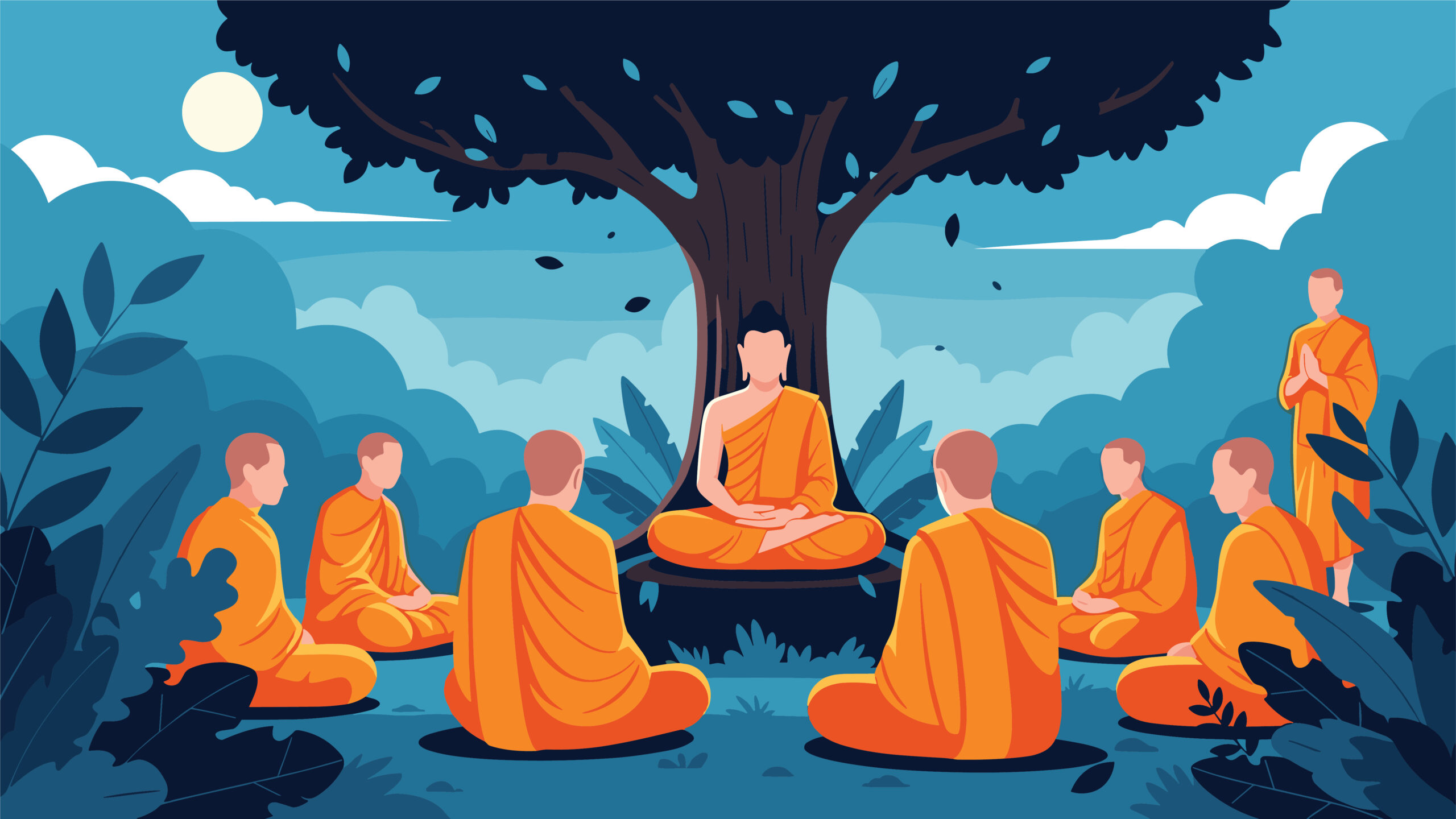
The term “Declaration to Transmit the Way” refers to the proclamation made by Shakyamuni Buddha when, after delivering the first sermon to the five ascetics in Deer Park, the number of his disciples reached sixty. At that time, he expressed his commitment to conveying his teachings and propagating the way, declaring the following:
“Monks! I am liberated from all bonds, and you too are liberated from all bonds. Monks! You should travel around all the countries, propagating the Dharma for the benefit and happiness of the people. None of you should travel the same road together.”
Following his words, the disciples parted ways and set out on journeys to propagate the teachings and transmit the Way. As for Shakyamuni, he too set out alone toward the City of Royal Palaces in Magadha.
Along these lines, the Lotus Sutra repeatedly instructs, “Teach this Dharma for the sake of the people,” and “Teach this sutra and propagate it for the benefit of ages to come.” This is because it is through such bodhisattva practice that the liberation of the world and humanity is realized.
Rissho Kosei-kai inherited the “Declaration to Transmit the Way” and continues to fulfill it exactly as proclaimed by Shakyamuni Buddha. In many religious organizations, professional clerics explain the Dharma and propagate the teachings, but in Rissho Kosei-kai, the motto is “Everyone who joins our organization is a disseminator of the teachings,” and we practice “Each person guiding another.” This is how we faithfully put into practice Shakyamuni Buddha’s instruction that every one of his disciples should travel a different road.
In the early days of Kosei-kai, the main focus was on liberating people from poverty, illness, and conflict. However, at present, as I just mentioned, day in and day out we carry out the great enterprise of saving humanity. I hope you never forget this, even for a moment.
“Each person guiding another” means that every member shares the teachings and extends hands of liberation to those they encounter in their daily lives.
Mahayana Buddhism is a compilation of the numerous teachings expounded by Shakyamuni Buddha throughout his life, organized into a systematic framework by learned monks of later ages. Originally, however, those were teachings for real-life liberation, where Shakyamuni Buddha taught, guided, and liberated each individual he encountered from their suffering on a case-by-case basis.
So we too must not neglect the encounters and interactions we have with people every single day. It would not be an exaggeration to say that every person who appears before our eyes is a potential recipient of liberation.
Bodai no me o okosashimu [Germinating the Seeds of Awakening] (Kosei Publishing, 2018), pp. 44–46
Nikkyo Niwano, the founder of Rissho Kosei-kai, was born in Niigata Prefecture, Japan, in 1906. A longtime advocate of cooperation and dialogue between the world’s religious faiths, Rev. Niwano promoted interreligious understanding as honorary chairman of Shinshuren (Federation of New Religious Organizations of Japan), honorary president of Religions for Peace, and in various other capacities. He is the author of several books on Buddhism, the Lotus Sutra, and spirituality, such as Buddhism for Today, Lifetime Beginner, Buddhism for Everyday Life, and more. Rev. Niwano passed away in 1999 at the age of 92.