
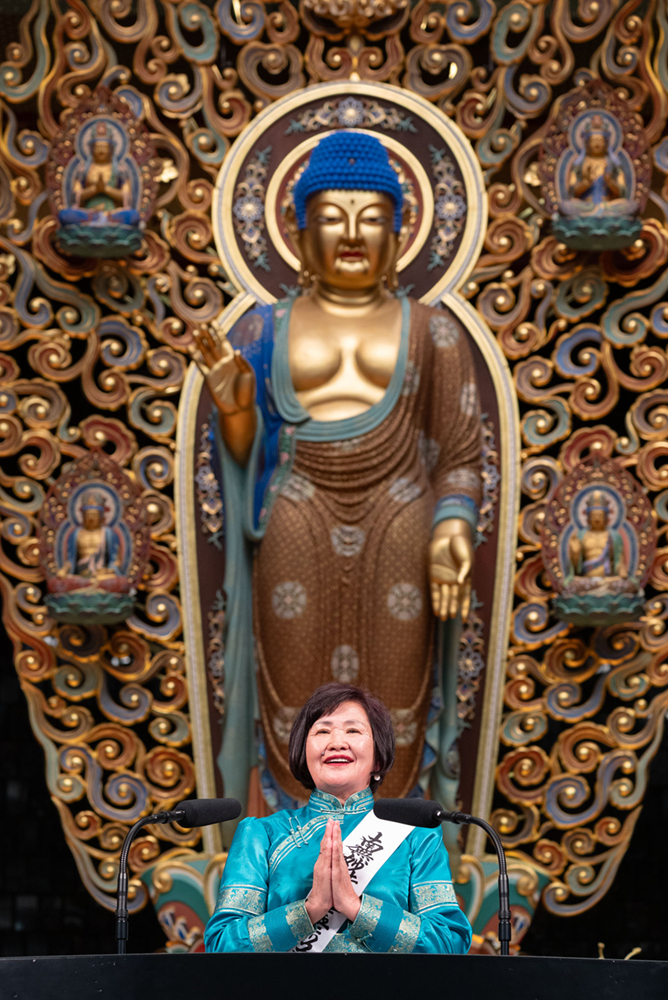
This Dharma Journey was presented in the Great Sacred Hall on March 15, 2025, during the ceremony commemorating Shakyamuni Buddha’s Memorial Day (Uposatha Day).
Hello, everyone. Thank you for this opportunity.
I was born in 1958 as the eldest child of ten brothers and sisters. Because my parents worked at a train station, our family frequently moved between rural stations. My parents worked from early morning until late at night, so I took care of my younger brothers and sisters and helped with housework. Despite these responsibilities, I spent my days happily surrounded by the warmth of a large family. While growing up with many siblings, I developed a dream of working with children. I wanted to become either a schoolteacher or a pediatrician.
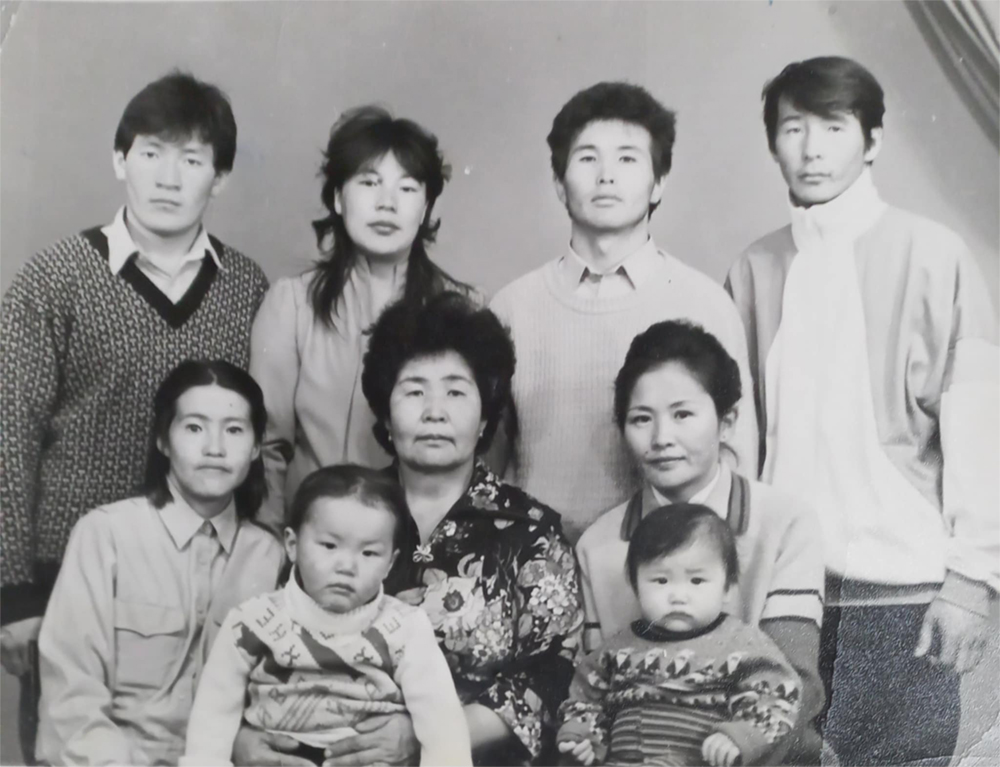
A commemorative family photo taken around 1991. Ms. Gulguu is on the far right in the middle row.
My father was someone who selflessly cared for others without expecting anything in return. My mother had a kind heart and often shared food with others. My father passed away at the young age of forty-five due to a serious illness. My mother is now eighty-seven and still healthy enough to sew traditional Mongolian clothing for her children and grandchildren. When we celebrated her eighty-fifth birthday two years ago, the family that began with just my parents had grown into a large family of 108 members.
In 1982, I graduated from the National Medical University in Ulaanbaatar, the capital of Mongolia, and fulfilled my dream of becoming a pediatrician. Later, I met my husband and gave birth to a daughter in 1985 and a son in 1989. However, my husband and I had different values and perspectives, and eventually, he became physically abusive. Seven years after our wedding, I divorced him and fled with our children to Erdenet, the second-largest city in Mongolia. There, I began working as a physician at a local community medical center. In Erdenet, I met a kind and dependable man and remarried. He was a wonderful stepfather to my children. Life with him was peaceful and filled with happiness.
Around that time, an acquaintance approached me with a real estate business opportunity. Thinking I needed more money for my children’s future, I took out a loan and decided to get involved. However, once I had invested, things didn’t go as expected, and I eventually realized I had been deceived by the acquaintance. In 2005, to make matters worse, my husband passed away from illness. I was left with the burden of raising two children and repaying the debt on my own. I felt as though I had fallen from the peak of happiness into the depths of despair.
Shortly after my husband’s death, I learned about Rissho Kosei-kai of Mongolia from Ms. Enkhtuya, who would later become my Dharma parent. She told me it was a group that recites sutras in Mongolian and teaches people to cherish nature, be filial to their parents, and be considerate of others. These values stayed with me, and I wished to visit someday.
In 2006, I had the opportunity to visit Rissho Kosei-kai of Mongolia in Ulaanbaatar. It was in a small apartment room where five women, including Ms. Shuger Zorigmaa, who now serves as a chapter head, were performing sutra recitation in Mongolian. When I joined the service, a phrase from chapter 3 of the Sutra of Innumerable Meanings, “Make one who commits the ten evils raise the mind of the ten virtues,” caught my eye. At the time, I was struggling to repay my debt, unable to properly raise my children, and tormented by self-reproach. Yet, while reading the sutra, I felt my mind become purified. I thought, “How wonderful it would be if children, whose hearts are still pure, could recite this sacred sutra daily from a young age.” During the next Dharma circle meeting, I expressed my desire for children in Erdenet to recite this sutra.
Two months later, five members, including Ms. Zorigmaa, traveled 220 kilometers to Erdenet to share the Dharma. In a room at my workplace, I hosted a Dharma gathering with six local friends and their twenty children. Later, a Sokaimyo (the posthumous name for all the spirits of ancestors in the family) was enshrined in my home, and many of those who had gathered before joined the enshrinement service.
Ms. Zorigmaa encouraged us by saying, “If you perform sutra recitation for twenty-one days without missing a day, your wishes will come true.” So, every evening at seven in the evening, we all gathered at my home for sutra recitation. Her words left a strong impression on us, and we wholeheartedly continued the practice. Ms. Zorigmaa had used skillful means to direct our hearts toward the Dharma. New participants kept joining, and three months later, the last participant completed the twenty-one-day practice. Through this, everyone’s hearts were purified, and during a Dharma circle, we shared the joyous changes in our lives and the spiritual benefits we were receiving, such as, “a couple on the brink of divorce reconciled” or “a husband who drank heavily stopped drinking.” Thus, the activities of members in Erdenet, which were based in my home, continued for three years.
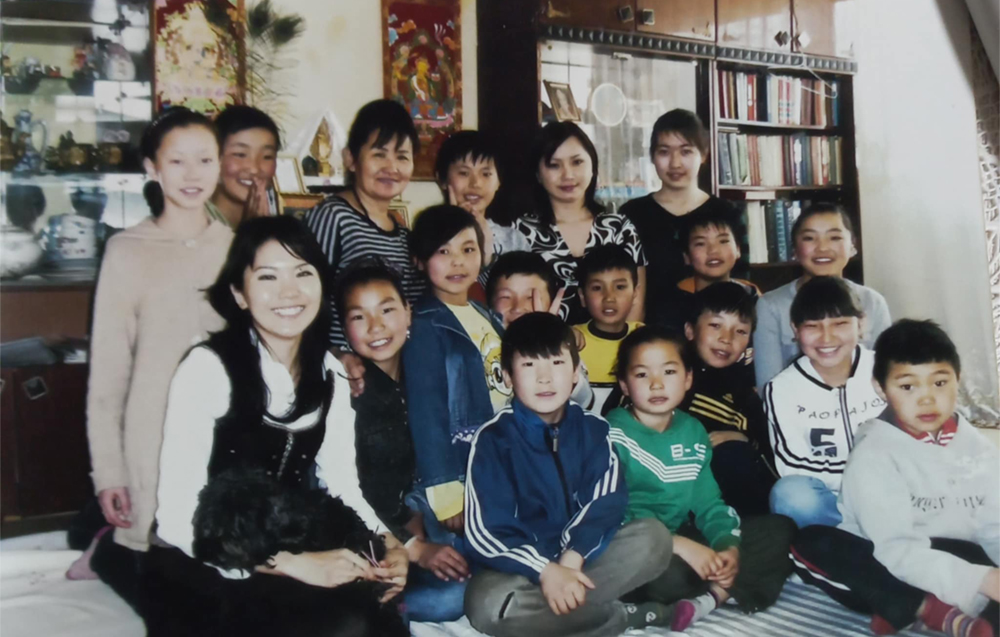
Participants in the twenty-one-day sutra recitation practice held in Ms. Gulguu’s home in 2006. Ms. Gulguu is third from left in the back row.
I, too, received unexpected blessings through the sutra recitation practice. I had long held resentment toward my first husband, but the teachings helped me to reflect and realize that we were meant to meet. Looking back, I recognized that before I met him, I had also caused pain and sadness to others through my actions. I now believe that the Buddha allowed me to meet him so I could awaken to my own faults. This realization made me feel deep sorrow and regret for having hated him for so long. My perspective changed, and with it, my heart changed as well.
In 2008, I was appointed as a group leader. Fortunately, the number of members in Erdenet continued to grow, and we began our activities in a rented apartment room that we used as our Dharma center, located in the heart of the city. Every weekend, I visited the center with excitement to recite the sutra and study the teachings with fellow members. I guided my family, friends, and colleagues to the faith, and the circle of our sangha expanded into surrounding areas.
I now have 240 people whom I have guided to the Dharma. Encountering Rissho Kosei-kai completely transformed my life. The more I recite the sutras and study the teachings, the more I have come to see that all life experiences are expressions of the Buddha’s compassionate wish to help me grow.
However, one more trial awaited me before I could reach this understanding. In 2014, my grandchild was born, and I temporarily moved to Ulaanbaatar to help with childcare, entrusting the Erdenet Dharma Center to Ms. A, one of the members I had guided. However, when I returned to Erdenet and visited the Dharma center a year later, I was shocked to find that Ms. A had become the new group leader without consulting me. I had worked so hard since the center’s founding, and yet no one had said a word to me about this change. I felt hurt and abandoned. I grew despondent and lost my enthusiasm for the Dharma, and I was no longer able to joyfully perform sutra recitation. This state lasted for about three years. My heart was constantly unstable, and the sadness never lifted.
One day, while reciting the Sutra of Repentance [the Sutra of the Method for Contemplating the Bodhisattva Universal Sage], a thought suddenly came to me that I was perhaps the cause of this situation. Reflecting on myself, I realized I had been arrogant, thinking that I was the one who had created the Erdenet Dharma Center. I had clung to the self-centered belief that I was working harder than anyone, and that I was right, and others were wrong. Then, like the line from the Sutra of Innumerable Meanings, “Make one who commits the ten evils raise the mind of the ten virtues,” I came to see that this suffering was the great compassion of the Buddha, who was guiding me to correct my arrogance. When I realized this, I felt joy throughout my body, and everything around me seemed to shine. I immediately visited the Dharma center and expressed my repentance for my self-centeredness during the Dharma circle. I am deeply grateful to the members who warmly welcomed and accepted me as I was.
In 2018, the Erdenet Dharma Center was officially registered with the headquarters, and Rev. Koichi Saito, then director of Rissho Kosei-kai International, and Rev. Ikuyo Hirose, then deputy director, visited our center for the ceremony to install the statue of the Eternal Buddha Shakyamuni as the Gohonzon, or the “focus of devotion.” Rev. Hirose encouraged me to receive the Dharma Teacher qualification, and I gratefully resolved to wholeheartedly devote myself to my role. Through repentance and self-reflection, the Buddha gave me an unimaginable gift.
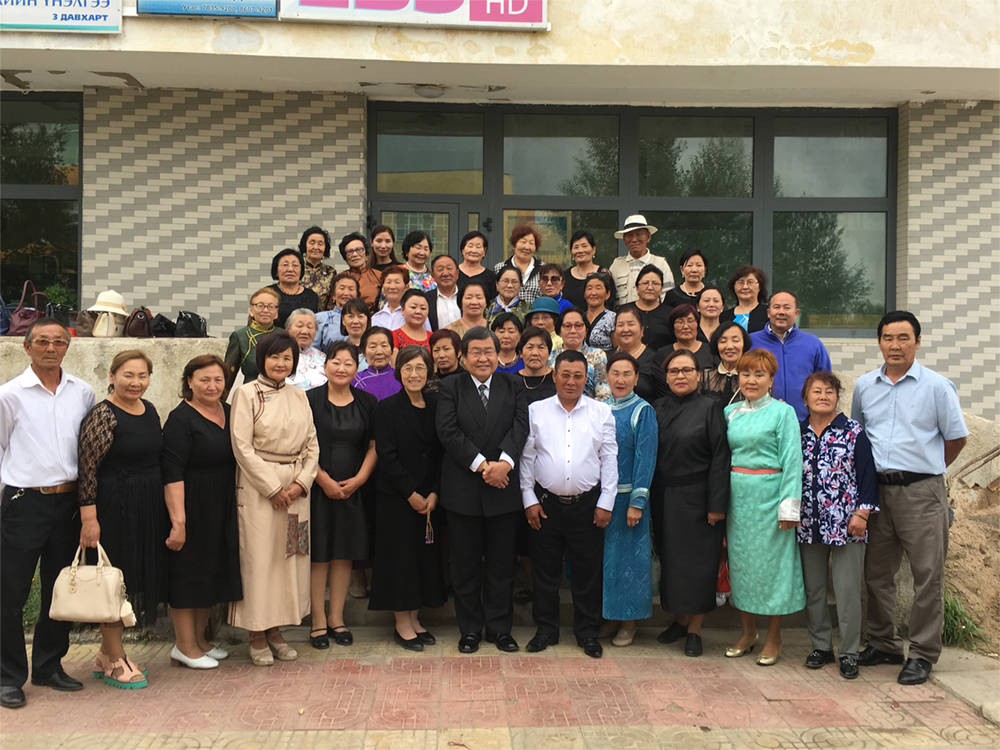
Ms. Gulguu with other participants in the enshrinement ceremony of the Gohonzon at the Erdenet Dharma Center in 2018 (fourth from left in the front row).
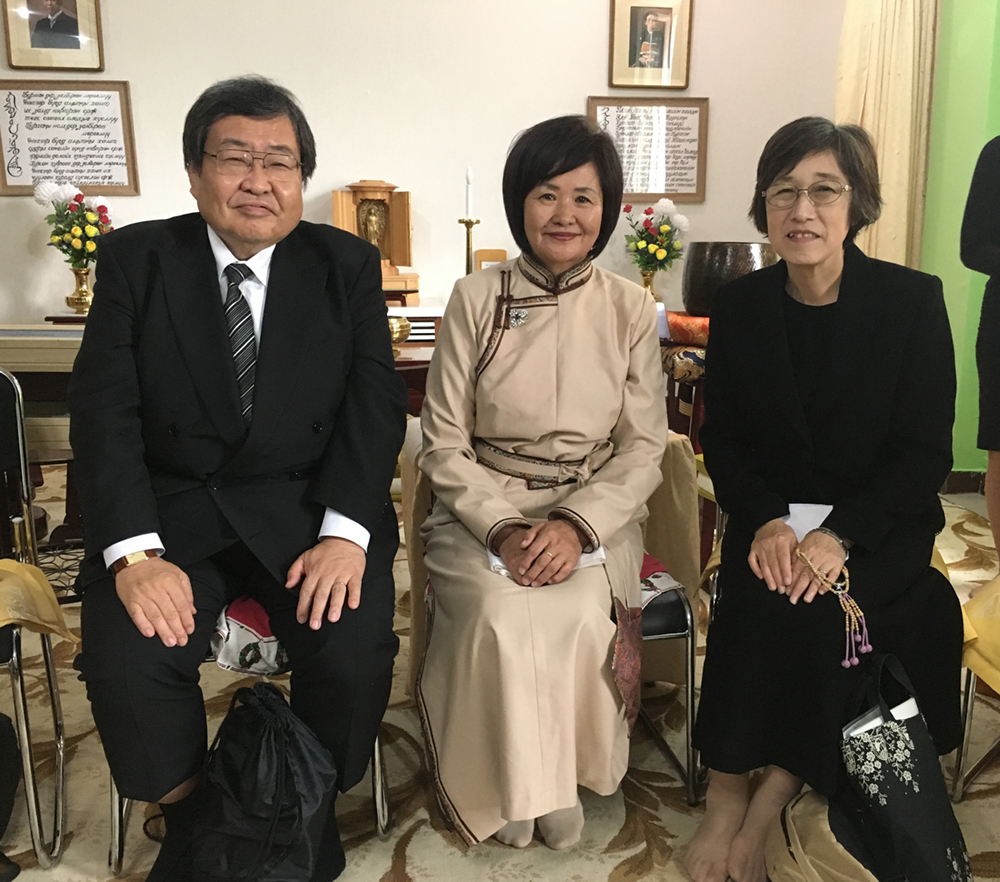
Ms. Gulguu with Rev. Saito (left) and Rev. Hirose (right) after the enshrinement ceremony of the Gohonzon at the Erdenet Dharma Center in 2018.
In 2020, I was diagnosed with liver cancer. Surprisingly, I felt no fear upon hearing the diagnosis. Cancer had been found in four locations on my liver, and a large portion needed to be surgically removed. At that time, the sangha members recited the Threefold Lotus Sutra for a month and prayed for me. Their warmth gave me strength, and I earnestly wished to overcome the illness, live longer, and continue spreading the teachings to many more people. The cancer recurred in 2021 and again in 2023, and each time I underwent surgery. Thanks to the Dharma, I was able to remain calm and composed through it all. Even after another recent recurrence and another surgery, I feel no fear or worry. Had I not encountered the teachings, I might, as a doctor, have focused solely on the results of surgery and treatment and worsened my condition. But now, thanks to my past sufferings, I can face everything peacefully.
I have a dream right now. It is to be of support to as many people as possible. For that, I want to live as long as I can. I will continue to dedicate myself to Dharma dissemination so that the activities of the Erdenet Dharma Center, which stalled due to the COVID-19 pandemic, will flourish again, and everyone connected to the Dharma can live in good health and find peace of mind.
Thank you very much.