
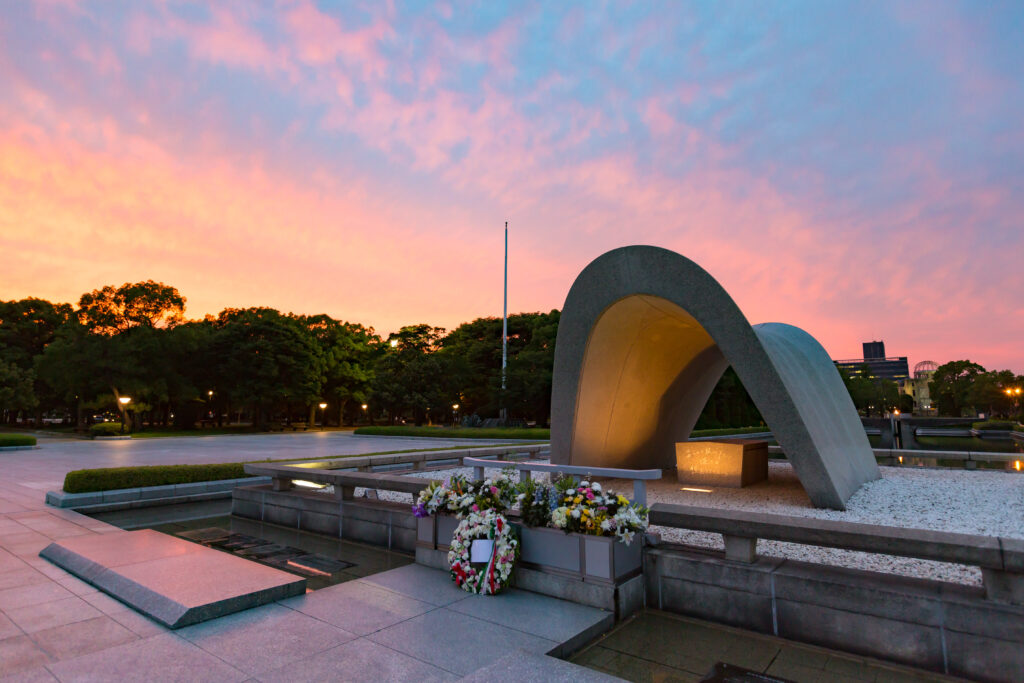
I was with one of the first relief teams to enter Hiroshima on August 6, 1945. The thriving city of just twenty-four hours earlier had been reduced to rubble on which countless dead bodies lay strewn about or piled on top of one another. Here and there we could hear voices crying out plaintively for help. Fires were raging, and the earth was as hot as if it had been baked. A scene terrible beyond description spread before my eyes. It was hell recreated on earth.
Our work began with aid to the injured. As dawn approached, appeals for protection against the cold arose from all sides. We covered people with all the blankets we had, but even so, when morning came at last, we discovered that half were already dead.
All the containers of water for firefighting were crammed with the bodies of those who had sought water in which to escape the encroaching fires. There were many young women, possibly members of the women’s work units. It was impossible to pull out the burned and swollen bodies. Finally we had to break the walls of the containers with mallets. As we did so, the bodies tumbled out.
Smeared with blood and dirt, we picked up the bodies that lay wherever we looked, hoisted them on our backs, and loaded them onto whatever boards we could find that had escaped the fires. The collection of corpses continued until late at night. When we found a suitable vacant lot, we dug a huge hole and lined the bottom with pieces of wood. Onto these we gently lowered about fifty bodies—swollen, stomachs gaping open, eyeballs gone, many the torn bodies of young children—and set fire to them. We stood around them as they burned and did not move until the flames had died away.
We rescued people still trapped under fallen buildings, shouldered corpses out of the river, and treated the maggot-infested wounds of the injured. This work continued for about a week. When people are in extreme circumstances, they seem to lose all feeling. Their minds and bodies grow numb, preventing them from thinking about what they are experiencing. All capacity for tears and grief had vanished from my being.
Night approached at last. I saw someone shuffling along, bathed in the evening sun. As the figure approached, I made out a young woman of twenty-four or twenty-five, her body covered with festering burns, her skin dangling in strips. She was clutching a dead baby to her breast.
“Cure my child,” she begged me. I suggested that I treat her first, since her wounds were very serious, but she continued to plead brokenly for me to do something for the child. I told her I would do as she wanted, and took the dead baby in my arms. The moment she was relieved of her burden, the young woman collapsed at my feet. She was already dead when I bent down to her. To save the life of her child she had wandered through fires and over rubble, spurred by the need to seek help. When she had found that help for her child, her need to continue living was gone.
At the end of March 1945 I had been sent to the Konoura base on the island of Etajima, about ten kilometers from Hiroshima, to receive training in the Kamikaze Special Attack Force. I was awaiting my fate, set for August 18, when I would ram a high-speed plywood boat loaded with a 250-kirogram bomb into an enemy ship. I had absolutely no fear of death as a human torpedo. I was nineteen, and convinced that my death would aid my country. But what I saw in Hiroshima was the cruelty of a war that did not hesitate to kill innocent women and children. Looking at the collapsed woman at my feet, I felt the evil of war. For the first time, tears started in my parched eyes.
I was in Hiroshima a week. I snatched sleep on radioactive rubble and wolfed down handfuls of rice grasped in fingers that had clasped the bodies of victims. Luckily, I escaped radiation contamination as well as the death of a human torpedo, and also survived the turmoil of the postwar period.
Today there are enough nuclear weapons to kill humankind several times over. It is crucial that all know the reality of the destruction that these weapons can cause so that the tragedy of Hiroshima and Nagasaki may never be repeated. Raise your voices louder and louder in the demand that nuclear weapons be banned. By doing so you will create a strong force for the peace of the world.
This essay first appeared in somewhat different form in the monthly magazine Dharma World in April 1984.