
 In August 1945, the atomic bombings of Hiroshima and Nagasaki changed human history, leaving immense loss and enduring suffering. Decades later, the voices of the survivors (hibakusha) still resonate. Through this series, Dharma World shares their testimonies not only as history, but as a call to conscience—urging us toward peace and the protection of all life in a nuclear age.
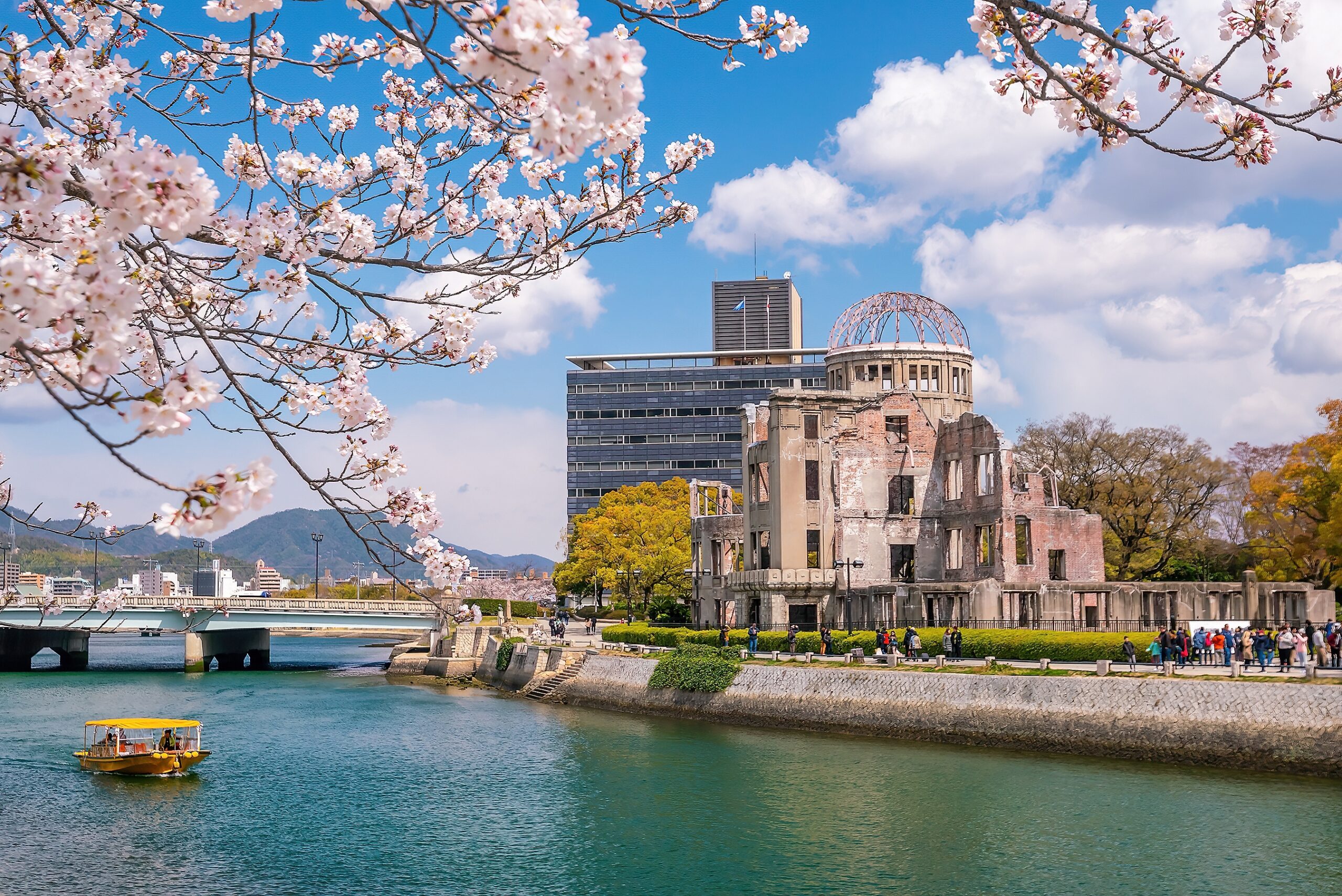
In August 1945 I was in the first grade of primary school. My house was about 1.8 kilometers from the hypocenter, at the approach to Tsurumi Bridge. This bridge spans the Kyobashi River, a tributary of the Ota River that skirts Hijiyama Park. Along the embankment was a road five or six meters wide, which our house faced. From the road the house looked as though it had only one story, but from below it could be seen to have two floors. Our entrance hall was on the second floor, and we usually entered and left by that, going down a staircase in the center of the house to the rooms below. There was a veranda on the first floor and a skylight, so that we could sit in the half-underground living room and look up at the sky. This was where I was sitting that morning when with my own eyes I saw the B-29 drop the bomb.
I should have gone to school on August 6, 1945. Air raids had disrupted our schooling, so we had given up our summer vacation to attend classes. It may have been luck or the grace of God, but that morning I had a stomachache and was nagging my mother to let me stay home. She was telling me to put up with it and go to school, and promised to take me to the Shukkei-en garden afterward as a treat. I had a lot of stomach trouble at that time and missed school quite often, and I think my mother was slightly impatient with me.
My mother was sitting on the edge of the veranda, shelling peas, and I was sitting in the middle of the room with the skylight, having out the question of school with her. One of our neighbors came by with potatoes and onions and seated herself on the veranda to chat with my mother. I was half-listening to their conversation when through the skylight I noticed two planes, small in the clear summer sky. As I watched, fascinated, I saw something white fall from one of them and then was blinded by a brilliant flash. About five seconds passed. Then a great noise exploded, as if to shake the ground itself.
‘‘Katsu, it’s a bomb!” cried my mother and flew in from the veranda to where I was sitting. She threw herself on top of me just as the blast hit us. The house collapsed around us, and we were buried under the debris. The ceiling and the furniture from the second floor fell around us. It seemed like a long time but was probably only ten or fifteen minutes before things stopped falling and everything grew quiet. We were enveloped in darkness.
It seems strange to think of it now, but my mother, pulling me with her, unerringly burrowed out into the open. It is a complete mystery to me how she managed to do it, but it was our one piece of good fortune in all the terrors of that day. If we had not been able to get out, we would have been trapped by the fires from the neighboring houses and would have been burned alive. There had been someone else with us at the time of the blast, the woman with the vegetables, but in the ensuing chaos both my mother and I had completely forgotten about her.
As soon as we got outside, we saw my brother, then four years old. He had been sitting by the roadside at the time of the blast, watching the umbrella mender work. He told us later that the blast had thrown the man four or five meters into the air before he crashed to the ground. He had not moved again. Though my brother had been sitting beside the umbrella mender, he had not been blown into the air but had just continued to sit there alone. He was burned on the right side of his head and on his right arm and still bears the keloids, although he is in perfect health.
The three of us waited for my father and sisters to come home, and we rejoiced when we found that we were all safe and sound. Perhaps it was about two hours after the blast that my mother remembered the neighbor and told my father. He immediately went into the ruins of the house to look for her. He finally discovered her trapped under the lintel of the back door, unable to move. Using all his strength, he pulled it off her. If my mother had remembered even a little later, the woman would probably have been burned alive, since the fires were moving faster now. After that the woman always referred to my father as her savior. What has happened to her, where she is now, I do not know.
There were seven of us living in Hiroshima at the time. My older brother, fourteen years my senior, was serving in the army in China, while an older sister had been sent to our aunt’s in Kumamoto, on the southern island of Kyushu. Still in Hiroshima were my parents, my grandmother, two older sisters, my younger brother, and I. The only one who had not come back home was my eighty-year-old grandmother. That morning she had taken her year-old great-granddaughter, my cousin’s child, to nearby Hijiyama Park to play.
When noon had come and there was still no sign of my grandmother, my father went to the park to look for her. He found her crouching over the dead baby. Since she was exhausted, he put her on his back and sadly returned home. She died two days later.
Whenever I think of what happened next, I can hardly write for emotion. The landscape around me looked like a scene from a medieval painting of hell. There was a woman, her entire body burned and almost completely naked, whose skin was hanging down from her face in strips. A woman was fleeing, still clutching her dead child to her breast. Children were crying for their mothers. A person had toppled over dead while crying for water. I can still see the scene vividly, so deeply was it burned into my seven-year-old eyes.
That evening a soldier came by and distributed rice balls to the people in the neighborhood. Although they were only sprinkled with salt, at the time they were more delicious than the most extravagant banquet fare. My house had already burned down and was now smoldering. Our valuables, which had been placed in a neighbor’s storehouse for safekeeping, were also lost, since neither the owner nor the key could be found before the fire took hold and burned our possessions before our eyes. This was a matter of lasting regret to my mother. We had been unable to rescue many of our household effects before our house went up, either. I spent the night sleeplessly, looking vacantly out over the ruins.
The next day my father made a rough shelter for us. He was very clever at that sort of thing. In a day he had a shack built for us, a crude affair not much bigger than nine square meters. When I look back on it, I feel that to have been able to do such a thing in that wasteland was quite extraordinary. The six of us lived there for about two months.
Those two months seemed unending to me. Day in, day out, I would sit by the road selling household goods—cups, plates, and bowls—that father had dug up from the garden where he had buried them for safety. It seems stupid, thinking about it now, to have set up shop in such conditions, but at the time it was the one thing that I could do.
All day I would sit by the road, but many days I would sell nothing or just one thing. But because my father told me to, I would sit there in the blazing heat every day. I have very little recollection of how my parents and sisters found the food that we ate. Nevertheless, the difficult days went by. The people around us kept dying, and every day the cremation fires burned on the other side of the river. Each evening we could hear the bugles blown by the soldiers and smell the indescribable odor of burning flesh.
Even now I remember the stench of the dead bodies decaying as they remained uncollected for days in the scorching heat. The body of an unidentified man was lying near our house. He had been calling for water repeatedly, and after he died he was just left lying where he had fallen, face upward, with bubbles breaking from his nose and mouth. Why he was just left there I do not know.
In October we went to live with my aunt in Kumamoto. Both my parents died the next year, and after a year in Kumamoto my older brother took us back to Hiroshima, where we lived in a house he had built on the ruins of the previous one.
Being orphans, we did not have an easy life. I was eight, and my younger brother was five. My oldest sister soon married, and my older brother, too. My other sisters helped with the family finances by working as housemaids. In this way the six of us grew up together in poverty on Hiroshima’s tainted soil, hardy weeds in the wasteland.
This essay first appeared in somewhat different form in the monthly magazine Dharma World in February 1984.