
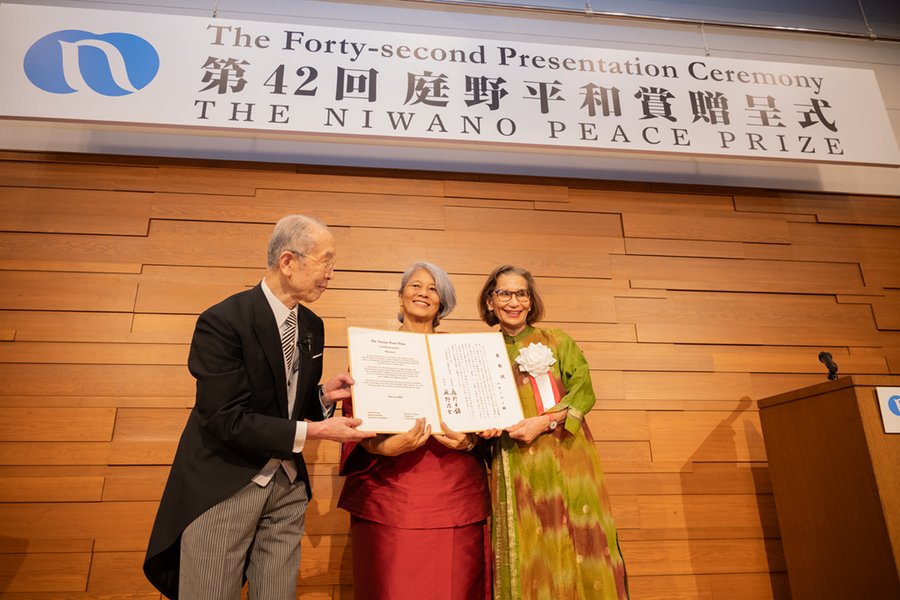
The award ceremony for the forty-second Niwano Peace Prize was held at the International House of Japan in Tokyo on May 14. From left, Rev. Nichiko Niwano, honorary president of the Niwano Peace Foundation and president of Rissho Kosei-kai; Ms. Zainah Anwar, board chair of Musawah; and Dr. Ziba Mir-Hosseini, its board member.
The Niwano Peace Foundation awarded the forty-second Niwano Peace Prize to Musawah, a global movement for equality and justice in the Muslim family that advances human rights for women living in Muslim contexts, in recognition of its immense efforts to strengthen citizenship and peaceful coexistence in diverse societies, and to create contexts and platforms for interfaith dialogue and spiritual solidarity. The award ceremony took place on May 14, 2025, at the International House of Japan, in Tokyo. The recipient’s address follows.
It is an honor for me to represent Musawah to receive the forty-second Niwano Peace Prize for 2025. I would like to express our deepest appreciation to Dr. Hiroshi Niwano, chairperson of the Board of Directors of the Niwano Peace Foundation, and to the Niwano Peace Prize Committee for recognizing Musawah’s body of work as deserving of this honor.
This recognition means a lot to us in Musawah and our partners in the Muslim world, and among Muslims living in minority contexts, given the challenging work that we undertake in standing up for equality and justice in our faith, within very difficult political and social contexts.
Over sixteen years ago, when Musawah was born, I shared the vision of its founding members in my opening speech at the launch in Kuala Lumpur. We wanted to bring to the larger women’s and human rights movement:
- An assertion that Islam can be a source of empowerment, not a source of oppression and discrimination.
- An effort to open new horizons for rethinking the relationship between Islam and human rights, equality and justice.
- An offer to open a new constructive dialogue where religion is no longer an obstacle to equality for women, but a source for liberation.
- A collective strength of conviction and courage to stop governments and patriarchal authorities, and ideological non-state actors from the convenience of using religion and the word of God to silence our demands for equality, and
- A space where activists, scholars, decision makers, working within the human rights or the Islamic framework, or both, can interact and mutually strengthen our common pursuit of equality and justice for Muslim women.
The roots of Musawah go back much further than its official launch. In 1987, I cofounded Sisters in Islam in Malaysia—a group of Muslim women committed to advocating for justice and equality within the Islamic framework. From those pioneering efforts, engaging with Islam from a rights perspective, asking questions based on our lived realities, and demanding the urgent need for change, our work has grown into a global movement. Today, through Musawah, Muslim women around the world are at the forefront of advocating for justice, pushing for legal reforms, and challenging discriminatory understandings of our religion that deny us our rights.
The message is simple and clear: For there to be justice in the twenty-first century, there must be equality.
For too long, Muslim women who demanded reform to discriminatory laws and practices have been told, “This is God’s law” and therefore not open to negotiation and change. They said we cannot question, challenge, nor demand equality as this is against shariah (God’s revealed way). Such actions will weaken our faith, and lead us astray, they alleged. We have been accused of being Westernized elites, anti-Islam, anti-shariah, anti-God, people who have deviated from our faith.
As Muslim feminists, as activists and as believers, we take the position that when our religion is used as a source of law and practice, our lived realities give us the right to speak out on how this religion is misused to inflict harm on us and society at large. This is not about theology that only the religious scholars have the authority and legitimacy to speak on; this is about engaging with religion at the intersection of law and public policy, politics and gender.
In a world where women’s rights are considered part of human rights, where modern constitutions of Muslim countries uphold equality and non-discrimination, where women are also providers and protectors of their families, the relentless discrimination against women in the name of Islam and reflected in many Muslim family laws until today, is unacceptable.
While all Muslims accept the Qur’an as one, it must be recognized that the interpretation of the Qur’an is a human effort that has led to diverse opinions and schools of thought. What Musawah brings to the table is a rich and diverse collection of interpretations, juristic opinions and principles that makes it possible to read equality and justice in Islam.
Musawah is building and sharing at the global level new feminist knowledge in Islam. We unearth the gems within our tafsir (interpretive) and fiqh (jurisprudence) traditions, to open the public space for debate and for a new public discourse to emerge on Islam and women’s rights, and most importantly to build a movement of women’s rights advocates, policy makers, and religious leaders with the courage of conviction that equality and justice for women in Islam is necessary and possible.
Our vision is to build a world in which gender equality, justice and non-discrimination are embraced as inherent in Islam and reflected in laws, policies and daily practices.
And we are doing these through four key initiatives:
- By expanding the public discourse on equality and justice in Islam to break the hegemony of conservative and extremist forces who define what Islam is and what it is not.
- By building a collective force for change, bringing together activists, academics, policy makers and organizations to build a global momentum to end discriminatory laws and practices in the name of Islam, and prevent rollbacks on rights already gained.
- By developing new rights-based knowledge in Islam and facilitating access to knowledge, legal concepts and narratives on the possibility and necessity of reform.
- By building the capacity and courage of activists, decision-makers and rights groups to critically speak out on the harmful impact of discriminatory laws, policies, and practices justified in the name of Islam and to promote an understanding of Islam that upholds equality and justice.
It is this search for justice, equality, beauty and compassion in Islam’s sacred Text that drives us forward. Our work transcends ideological dichotomies such as ‘secular’ versus ‘religious’ feminism, or ‘Islam’ versus ‘human rights,’ or ‘Islam’ versus ‘women’s rights’; we show these dichotomies to be false and arbitrary. Certainly, not at all helpful to deal with the challenges we face living in conservative and patriarchal Muslim contexts.
We point out that the real battleground, as one of our founding members, Dr. Ziba Mir-Hosseini, said, “is not between Islam and secularism, or human rights or women’s rights, but between despotism and patriarchy on the one hand, and democracy and gender justice on the other.”
We are calling out these men in authority who are abusing religion to perpetuate their power and privilege and to silence dissenting voices. We know that it is their authoritarian rule that is under threat. Not Islam. We are challenging their abuse of an authoritative text for authoritarian purposes. Not the word of God.
And in building this new counter narrative of equality and justice for women in Islam, we are empowering women and men with knowledge, language and courage to speak out. We are giving voice and conferring authority on ourselves—on those long silenced, who live in fear of being accused of being a bad Muslim, of being anti-God, anti-Islam, anti-shariah.
Since our launch in 2009, Musawah has gained an international reputation for its groundbreaking work in knowledge building, capacity building and international advocacy.
In knowledge building, we work closely with Islamic scholars and activists to produce two books, Men in Charge: Rethinking Authority in Muslim Legal Tradition, and Justice and Beauty in Muslim Marriage. These groundbreaking books are now used in university courses in law, religion, and gender studies. We produce short knowledge briefs and policy briefs to make our knowledge on equality and justice for women in Islam and the possibilities of law reform more accessible to policy makers and activists advocating for change at the national and global levels.
In capacity building our transformative course on ‘Islam and Gender Equality and Justice’ (I-nGEJ) exposes women’s rights activists and policy makers to how knowledge is produced in the Islamic tradition, by examining the methodology and conceptual tools used to build the rich interpretive and legal traditions in Islam, and how these make reform possible.
This training is critical as we believe that change can only happen if we can build a multiplicity of voices in the public space to break the hegemony of conservative and extremist state and non-state actors over matters of religion. We are now developing the Musawah Institute to offer this training online to reach a larger audience. Knowledge is key to our movement building. It is knowledge that gives us courage to stand up, speak out, and hold our ground when attacked.
In the area of international advocacy, Musawah is engaged deeply with the CEDAW process (Convention on the Elimination of All Forms of Discrimination against Women) and the UN system, amplifying the voices of women living in Muslim contexts on the international stage.
We have intervened in the reporting process of 39 countries, regularly submitting thematic reports and issuing oral statements on Article 16 on marriage and family relations—not surprisingly, the most reserved article of all UN human rights treaties. This has led to a more constructive dialogue between the CEDAW Committee and governments as they are exposed to the examples Musawah provides of good practices from various Muslim countries to show that reform towards equality and justice for women is indeed happening. If indeed these discriminatory laws are divine and cannot be changed, as governments claim, why then do different Muslim countries have different laws and practices on any particular issue—be it age of marriage, polygamy, guardianship, right to divorce, division of marital assets—all on the basis of Islam?
We point out that these discriminatory laws are made by humans, not God. Thus, the difference and diversity. The problem is not with Islam, but the lack of political will to recognize women as human beings of equal worth and dignity.
In 2020, we launched the Campaign for Justice in Muslim Family Laws, working with partners at the national level in Asia, the Arab world, and Sub-Saharan Africa to organize, mobilize, and build support to advocate for reform. We also initiated the Global Campaign for Equality in Family Law across all faiths and traditions, with several regional women’s rights groups, an ecumenical global organization, and with support from UN Women, to make family law reform a global priority issue.
As we build our Campaign for Justice, we will be using the Peace Prize money to enhance the capacities of advocates globally through digital and face-to-face trainings and make our knowledge more accessible by expanding our online presence and digital reach to engage with a wider audience.
Given the focus of the Niwano Peace Foundation, I want to take this opportunity to draw your attention to the work of Valerie Hudson and her colleagues on Women, Peace and Security, and make the case why gender equality is critical to world peace. In her book Sex and World Peace, she and her team found, the larger the gender-gap between the treatment of men and women in a society, the more likely a country is to be involved in intra- and interstate conflict, to be the first to resort to force in such conflicts, and to resort to higher levels of violence. On issues of national health, economic growth, corruption, and social welfare, the best predictors are those that reflect the situation of women. They found women’s disempowerment in the household affects the security, stability, prosperity, bellicosity, corruption, health, regime type, and the power of the state. The data is robust based on 161 outcome variables within nine dimensions of nation-state outcomes—political stability and governance, security and conflict, economic performance, economic rentierism, health and well-being, demographic security, education, social progress, and environmental protection. These findings, they assert, are clear, consistent and statistically robust across the board. And yet because they relate to women, political leaders and decision-makers are not paying attention.
Dr. Hiroshi Niwano echoes the view that peace is not simply a state without war. But he also said something more profound—the conviction that peace will only be achieved when it inhabits the heart of every single person. And for this to happen we need to nurture peace on the inside of each person. This begins with peace in the family, the basic unit of society, for there can be no true peace without justice.
As Valerie Hudson asked, WHEN is peacetime for women? WHERE is peacetime for women? The physical insecurity of women, at home and in public; the gross inequity in family law in many parts of the world, not least the Muslim world; and the relative absence of women in decision-making platforms make gender inequality the overwhelming injustice of our day—the most profound and most difficult challenge. The treatment of women informs human interaction at all levels of society.
The struggle for gender equality is not getting any easier, as we all know. The hopeful world of Beijing 1995, the Fourth World Conference on Women—which adopted the Declaration and Platform for Action to end discrimination against women in 12 critical areas—that period of excitement over transitions towards democracy and real progress towards gender equality is gone. Much of our world today is dominated by a gender backlash in the midst of democratic backsliding.
But as activists, we cannot give up. We have the knowledge to make the case why change is possible, why it is necessary. We need to spread that knowledge, build the courage, amplify the voices demanding change, and build multigenerational and collective power. We need to stand our ground and build our resilience in the face of growing anti-rights forces that promote hate and cruelty, that are against diversity, equity, and inclusion, and most threateningly, legitimized by the President of the richest and most powerful country in the world and funded by the richest man in the world. The voice of resistance is critical. Our work in the women’s rights movement, our place in the larger human rights and democracy movement, must be supported and strengthened, and be well-resourced.
It is our knowledge, our conviction, our courage and our solidarity that will enable us to stand up every time we are attacked, dust off the battle scars, build new allies and champion a vision of positive social change towards a better world for all— a more peaceful and just world. We are not giving up no matter how difficult. Because we believe, in the end, that justice will prevail, must prevail.
Let me say it again: In the twenty-first century, there cannot be justice without equality. It is as simple as that. And without justice and equality within the basic unit of society—the family—there cannot be peace.
Thank you.
Zainah Anwar cofounded Sisters in Islam in 1987 in Malaysia and was its founding Executive Director from 1999 to 2008. In 2009, she also cofounded Musawah, the global movement for equality and justice in the Muslim family, and became its founding Executive Director. She stepped down in 2021, and now chairs the Musawah Board.