
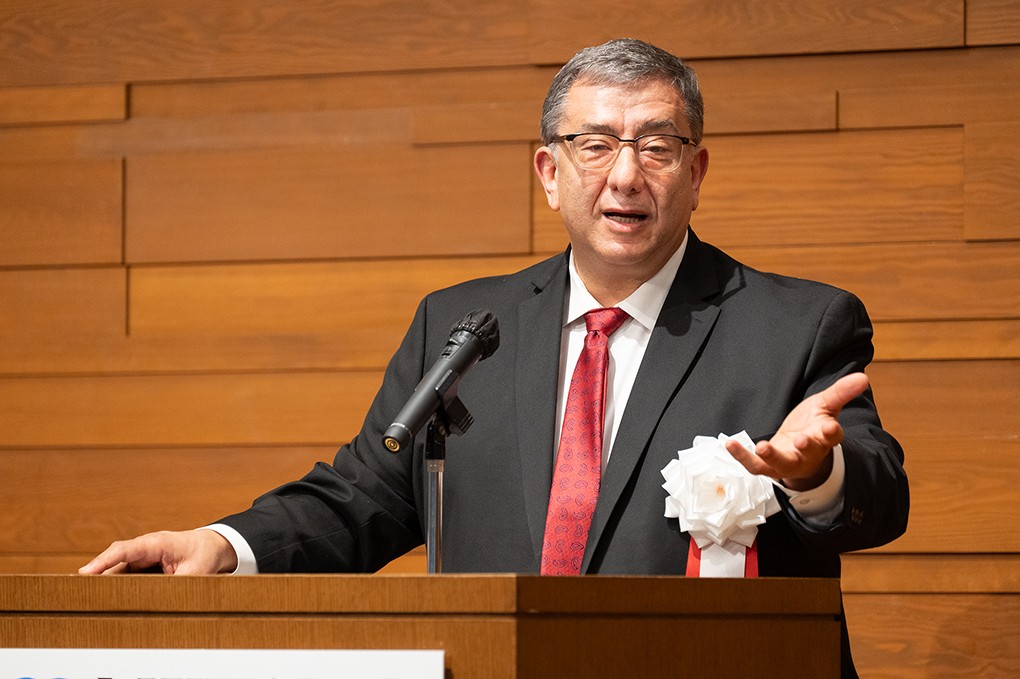
The Niwano Peace Foundation awarded the forty-first Niwano Peace Prize to Dr. Mohammed Abu-Nimer, in recognition of his lifelong commitment to peace and interfaith dialogue. The award ceremony took place on May 14, 2024, at the International House of Japan, Tokyo. The recipient’s address follows.
Al Salam Alikum and Warm Greetings,
Dear honorable guests and our honorable host Dr. Hiroshi Niwano, the Chairperson of the Niwano Peace Foundation.
I am honored and humbled by the Niwano Peace Prize Committee selection and your endorsement of me as the 41st Niwano Peace Prize holder. It is with great honor and humility that I accept this prize for the year 2024.
By receiving this award, I am recognizing the thousands of peacemakers I have worked and collaborated with around the world, especially in Sri Lanka, Mindanao, Palestine, Nigeria, the Arab region, Europe and the United States, and many others where I worked on interreligious peacebuilding. This award is to recognize all our work together. On a personal level, Ilham Nasser, my life partner and my children, are the one who also deserve recognition for their patience and consistent support of my work and career.
“When you do things from your soul, you feel a river moving in you, a joy.”
—Jalaluddin Rumi*
I start my greetings to you all with Al Salam Alikum, “Peace Be Upon You,” which is the most common greeting among Muslims and Arabic speakers in general. The term peace or Salam is used on a daily basis in Muslim prayers. Like many other cultures and societies, the term and desire to have peace is not strange to Muslims.
I have been raised with a family narrative of seeking peace and mediating conflicts. I lived in a very ethnically and religiously diverse community that coexisted peacefully, until certain governmental policies and internal sectarian dynamics tore it apart in 1978. During those events, I was a teenager, and I realized that if we do not understand and respect our differences, we will not be able to celebrate our commonalities. I have carried this lesson with me since then, and for the past 40 years of my work.
The ethos of the Niwano Peace Prize—supporting peace through interreligious dialogue and cooperation—is a core part of my personal and professional commitment for the past 40 years. Having worked in many violent conflict areas, I have witnessed the destruction that wars can bring on the lives of innocent civilians and on our environment. Establishing a path for peace and justice through faith is certainly a challenging mission that not many people are willing to take. However, in our current global reality, supporting this through interfaith dialogue is much needed to counter the consistent manipulation of religious identity and symbols by certain politicians and religious actors to justify wars and violence against the “other.”
I believe that supporting narratives and discourses of peace and justice through interfaith peacebuilding should be an integral part of the mission of politicians, religious leaders, and institutions involved in peacebuilding. Such a mission can effectively confront the weaponization of religious identities, which has caused a great deal of suffering among humans throughout history, and unfortunately this continues today.
Across many conflict situations around the globe, we face similar dynamics, in which the majority of people are caught in a cycle of violence that perpetuates injustice and deprives them and others of the basic rights of freedom and security. Spirituality and interfaith solidarity have offered many peacemakers a path to break away from the cycles of revenge and dehumanization of the other.
We (humans) are still struggling to learn from the wisdom of our great peacemakers, such as Martin Luther King Jr., the Dalai Lama, Mahatma Gandhi, and Abdul Ghaffar “Badshah” Khan, who adopted faith-based nonviolent and peacemaking philosophies and strategies. Yet here we are in 2024, failing to learn the basic lesson that militarization and weaponization will not solve deep-rooted conflicts, such as the current Israeli-Palestinian and Ukraine-Russia wars. On the contrary, they are creating more religious, ethnic, racial, and national divides between people and leaving no winners.
Our way to further advance and promote genuine peace on all levels (global, national, local, and interpersonal) is by returning to the basic values of common humanity, equality, compassion, empathy, witnessing truth, deeper listening, and understanding each other’s pain and needs. Integrating this basic principle of peacemaking in our education, media, art, and all other cultural and political agencies is a crucial step toward the prevention of further structural and social forms of violence. It is the cornerstone of building local, national, and global cultures of peace.
Although receiving this honor is a happy and joyful occasion, and I much appreciate the acknowledgement and recognition of the Niwano Peace Foundation, I must speak up about the recent mass killing and genocidal campaign carried out by Israeli military and settler forces in Gaza and the West Bank. The Palestinian people have been subject to displacement and denial of the human right to live in freedom and dignity. The Israeli government, endorsed by the United States, Germany, the United Kingdom, and several other governments, have used starvation to ethnically cleanse Palestinians from Gaza. The scale of destruction is unprecedented in this conflict and in many other conflicts around the world. The Israeli military has destroyed two-thirds of Gaza’s homes, schools, and universities, which as a result have been declared uninhabitable. Over one thousand mosques have been destroyed. Even during Ramadan, Muslims in Gaza could not find places to worship or even food. The killing of thirty-two thousand people, of which two-thirds are women and children, with over eighty thousand injured, has left everyone in the region wondering about the value of international law or international treaties—and even the roles and functions of the UN—if they are unable to provide basic protection for Palestinian civilians.
I am also aware of and stand against the killing of Israeli Jewish civilians on October 7 and I stand against holding any hostages, be they Palestinian, Israeli, or foreign.
This war has illustrated the influence and power of the military industries around the world, especially in Europe and the US. It also revealed the extent and scale of anti-Arab/Palestinian racism and the deep islamophobia in such societies and around the world. The hate speech and dehumanization against Palestinians and Muslims became more visible in the social media and traditional media that supported this genocidal war.
Yes, we live in a dark age and in a period where a genocide is being live-streamed like a reality show, except it does not have a happy ending for the Palestinian people of Gaza and elsewhere.
It is hard to sustain faith in humanity when you see starving children and airplanes dropping little food on the heads of Gazans as if the war were caused by an earthquake or tsunami.
In these past six months, like many other peacemakers who are committed to justice and nonviolent resistance, I have struggled and felt the pain, helplessness, and hopelessness of many people around the world who wanted to stop the war but could not persuade their politicians or influence decision makers to intervene. I have been in many organizations and communities that struggle to deal with the genocidal campaign on Gaza.
Despite this cruel reality, I still believe that we peacemakers ought to be extra active and invest more intensive efforts to stand up against the atrocities and hate speech that are carried in the name of self-defense, or to fulfill certain false messianic religious prophecies of destruction and expulsion.
Unfortunately not all those who define themselves as peacemakers speak up or stand up against oppression. They also join the silent and are in some cases complacent. Many interfaith dialogue and interreligious peacemaking initiatives affected by the conflict have become silent. Their silence is the toughest for me and many other colleagues who expected solidarity and human compassion instead of silence or the “neutrality” of the conflict resolvers.
In his poem, Rumi has also guided us to seek hope to escape and avoid darkness:
“If you are seeking, seek us with joy
For we live in the kingdom of joy.
Do not give your heart to anything else
But to the love of those who are clear joy,
Do not stray into the neighborhood of despair.
For there are hopes: they are real, they exist—
Do not go in the direction of darkness—
I tell you: suns exist.”
On the other hand, this conflict has also brought hope and a spirit of resilience to many interreligious peacemakers who have appreciated and taken part in the global solidarity for justice for Palestine. Globally, millions of people have spoken up and firmly stood and protested in the streets every week. Also, courageous people of faith and their constituencies have advocated for justice and an immediate ceasefire. Social media outlets have transmitted billions of messages and images of solidarity. We’ve seen human creativity producing words and images in support of humanity.
This wave of creative protest and solidarity has renewed my belief in humanity and in our capacity to reiterate our faith and beliefs to restore our common humanity. No matter how small our actions are, their cumulative effect is significant in the lives of those who are in need of our assistance and sympathy. I saw a simple drawing calling for a ceasefire by a young American artist being circulated among Palestinians and their solidarity movement.
The hope for peace, freedom and dignity for Palestinians and all indigenous people, and all human beings who feel oppression and injustice was rekindled by the interfaith and interreligious agencies who have stood their ground in the past six months. So I felt that I must recognize them in this award ceremony.
I have been working on interreligious peacebuilding with five principles that I would like to reiterate here. They have helped me and others in sustaining our energy for peace during these hard times:
- Recognizing and celebrating the beauty of human diversity
- Bringing the heart into the process of building peace and solving conflicts
- Standing for the marginalized and voiceless anywhere and everywhere
- Promoting the art of imagining peace in the darkest moments
- Making space in our work for spirituality and faith to do their magic in unlocking the poisoned hearts
Finally, allow me to again acknowledge that the commitment of the Niwano Peace Foundation in supporting peace work around the world and insisting on peaceful means in achieving our visions and needs is a source of hope and encouragement, too. I am grateful for your recognition and support. It inspires me to further continue and invest in supporting peacebuilding within and across religious and national divides.
Allow me to finish with a poem by the Sufi master Ibn Arabi about the beauty of religious diversity:
A garden amidst fires!
My heart has become receptive of every form:
it is a pasture for gazelles, a monastery for Christian monks,
a temple for idols, the Ka’bah of the pilgrim,
the tables of the Torah, and the book of the Qur’an.
I follow the religion of love. Wherever its camel mounts turn,
that is my religion and my faith.
Al Salam Alikum
Sincerely
Prof. Mohammed Abu-Nimer,
Professor and Chair of Said Abdul Aziz for Peace and Conflict Resolution,
American University & Salam Institute for Peace and Justice, President
* Coleman Barks’ translations, The Essential Rumi, The Book of Love, and The Big Red Book.