
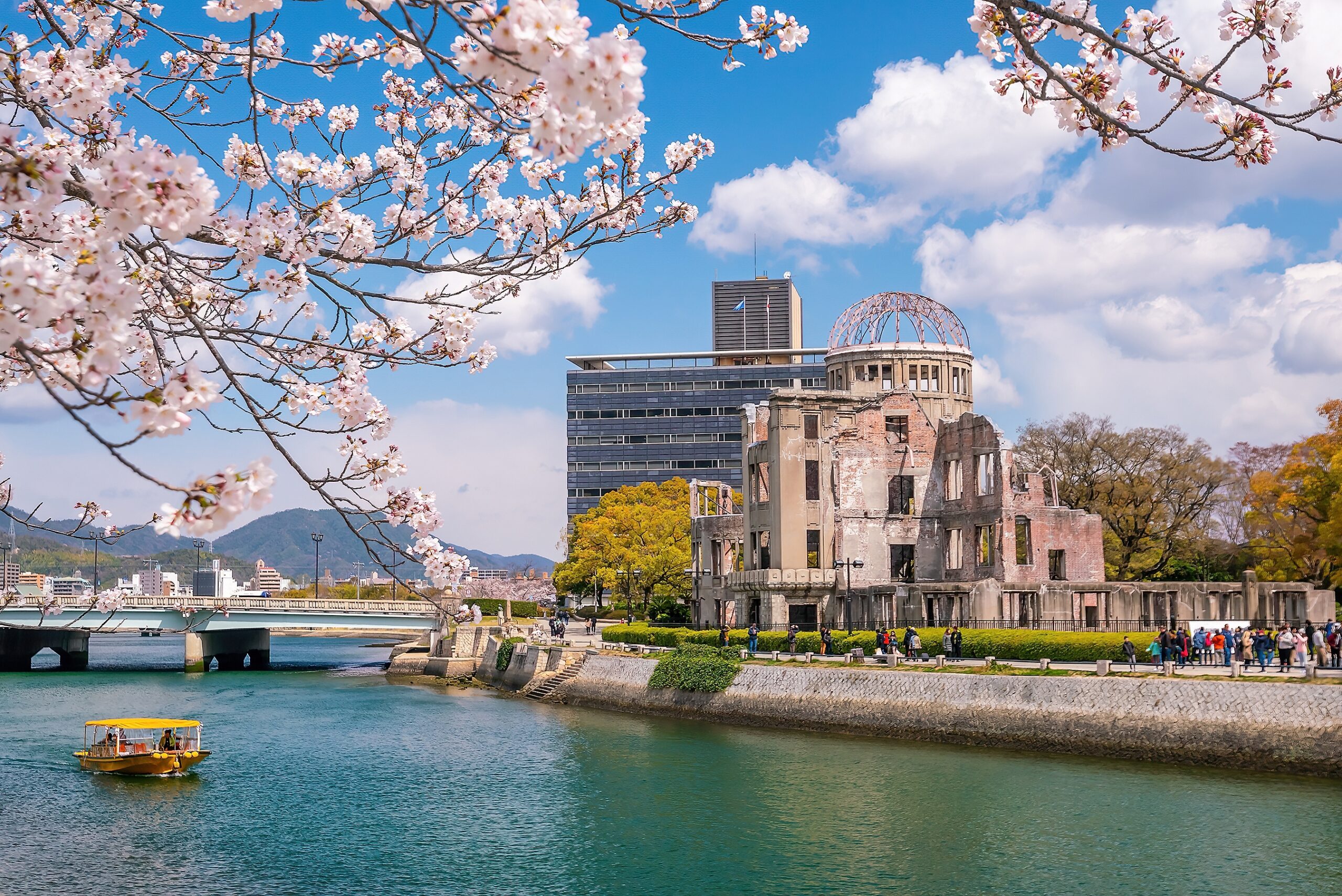
f11photo/Shutterstock.com
In August 1945, the atomic bombings of Hiroshima and Nagasaki forever altered the course of human history, claiming hundreds of thousands of lives and leaving a legacy of profound suffering. Decades later, the physical and spiritual echoes of those events continue to resonate in the lives of the survivors (hibakusha). In this series, Dharma World shares these personal testimonies not merely as historical records, but as an urgent call to the heart. In an era still shadowed by the threat of nuclear arms, these voices serve as a bridge between the pain of the past and our collective hope for a future defined by peace, wisdom, and the preservation of all life.
“No trains from here on. All passengers please alight.” Following the conductor’s instructions, we all got out at Koi Station, on the outskirts of Hiroshima. No one had the slightest idea what it was all about. On that hot, bright summer day my uniform was soaked with sweat.
There was talk going around that some hours previously a large bomb had been dropped on Hiroshima. I talked with a superior officer and decided to walk on into Hiroshima. In the immediate vicinity the damage did not appear too serious: roofs tilted slightly, broken or displaced roof tiles. However, as I walked on I realized why the train could go no farther. The lines were twisted like strings of jelly, and the ties, torn from their beds, lay upside down.
At that time I was so desensitized by the war that I was living each day with the sole purpose of killing more and more people. My feelings were so paralyzed that I was more like a demon than a human being. I hardly thought about what I saw, but just kept on walking.
As I approached the first river and looked down at the riverbed, I saw two large cows lying together with their horns sunk in the sand, and nearby, three pigs. In front of me, smoke still overhung the city, and there was increasing confusion as the people leaving the city met those trying to enter it. I began to come across people with tattered clothing and injuries of a kind I had never seen before.
By now the area around me was a burned-out wasteland, with no houses standing. It was when I crossed what I think was the Ota River, though, that I really seemed to step into hell. In places the railing of the bridge had been completely blown away. Dead bodies lay where they had fallen. The great cherry trees that had lined the embankment were stripped of their branches, which were now hanging down in shreds from the trunks.
Looking downstream to the river mouth, I saw strange black shapes almost obliterating the sparkling sandbars. At that time people made turpentine from pine roots, and I assumed that these shapes were piles of roots. However, as I drew nearer I realized that in reality they were dead bodies, possibly deposited there by the river. Many strong impressions from that day are still with me, but this remains one of the most vivid. Perhaps the people had fled to the sandbar to escape the fierce heat of the flames as their houses burned around them. Perhaps they had run here, forcing their injured bodies along, their throats parched. There was a flurry of footprints leading to the water’s edge. Farther on, in the water, floated countless bodies of men, women, and children. The misery was indescribable.
It was then that I first began to understand the brutality of war. Burned into my memory is the sight of a young mother, probably in her twenties, a baby on her back and a three- or four-year-old child clasped tightly in her arms. Caught against a girder of the bridge, her body bobbed idly in the gentle current.
The stench of the dead bodies was already overpowering in the heat of the midsummer sun. It was a living hell. But compared with what I saw as I approached the area around Hiroshima Station, those who had died were fortunate. In a moment houses had been shattered and their inhabitants buried in a welter of tiles and plaster, their naked bodies covered in ashes. Here and there an arm or a leg protruded. Other bodies lay strewn about, their stomachs torn open and their entrails pouring into the ashes. Often I only realized there was a dead body in the ashes when I stepped on it. The expressions on the dead faces as they gazed emptily into space were more contorted and agonized than those of the fierce gate-guardian deities of Japanese temples.
It was utterly impossible to think of these dead people as peacefully at rest. Some of the bodies made me think that even being in hell itself, your tongue being pulled out, your eyes gouged out, and your ears chopped off, was preferable. But it was worse for those who remained alive for several hours, or even two or three days. When I saw people dying in such pain that they no longer even knew who they were, I could only think that those who had died immediately were far better off.
Most people had been wearing light summer shirts that morning. But most of the dead were bare chested, and many were completely naked, perhaps because their clothes had been burned off them. The parts of the body that had been exposed to the flash had suffered great burns, and the skin was turning purple and trailing from the body in strips.
In every case, the eyeballs of the dead were either protruding from their sockets or hanging out completely. Blood bad gushed from the mouth, ears, and nose. The tongue had swelled to the size of a golf ball and had pushed its way out of the mouth, gripped tightly by the teeth. The whole anatomy seemed to have been destroyed. Most bodies were bloated, and it was often impossible to tell whether they were male or female. As friends and relatives began to flock to the scene to search for their loved ones, they were rarely able to identify the bodies just by looking at them.
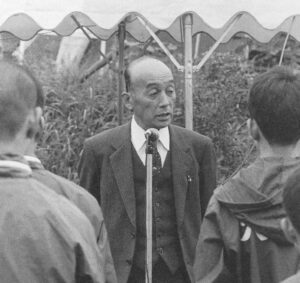
Kosaku Okabe, superintendent of education in the town of Miwa, Kyoto Prefecture, addresses schoolchildren.
Hundreds of those still alive were wandering around vacantly. Some were half-dead, writhing in their misery. Others were shuffling along like forlorn ghosts, terrible burns covering more than half the body, the skin of face and arms peeling off and flapping around them. Some were roaming around lost, crying out for water; but when someone called out to them, they seemed not to hear, perhaps because their eardrums had burst. They were no more than living corpses.
Wherever a puddle of water had collected from burst water pipes, people had gathered like ants around a honey pot. Many had died where they lay at the water’s edge, their strength gone. Others had clambered over the dead bodies to get at the water, only to die in the same way, their bodies piling one on top of another. There was no medicine and no doctors, nothing but the fierce summer heat.
Even today, so many years later, it gives me a chill to think about what happened. On the second day, relief trucks came into the city, distributing white potatoes and sweet potatoes in the area around Hiroshima Station. When the trucks arrived, a great crowd of people gathered instantaneously. People wolfed the food down as soon as they received it, not stopping even to wash the dirt off. I remember thinking then that I had had enough of war.
In all the wide plaza in front of the station only one three-story building was still standing, though not a pane of glass was left in its windows. The station was a hollow space, the roof completely gone, all the platforms burned, and only two or three pillars still standing. The area to the north was completely burned out, and near the point of impact to the south, I was told, everything had melted; nothing at all remained. The mountains to the north, with their mantle of pines, were a deep brown, as if a brush fire had swept through them.
I climbed to the roof of a remaining building. On all sides the only buildings left were those built in the Western style. As I looked around, the extent of the destruction came home to me. The ruin was as bad as the terrible damage caused by the air raids in the Osaka-Kobe area. There was an air-raid warden’s post nearby, and I talked to three firefighters. They told me that some of their crew who had been on duty that morning had been blown right across the expanse of railway lines to the north side of the station by the blast. I noticed that pieces of scalp were sticking to the sides of the parapet.
I met some people who had come from Okayama to search for their relatives. ‘‘We searched and searched but couldn’t find where my brother’s house used to be. We decided it must be around here and started digging away the ash and plaster. We discovered the bodies of four people, parents and children, sitting as if gathered around a table. They were completely burned, just skeletons. It was only by the cups and other objects in the house that we remembered that we could identify them.’’ The memory of the relatives collecting the bones and putting them into a cloth bag still fills me with pain and pity.
One of my most precious keepsakes is the pair of army-issue shoes I wore that day as I walked through the ashes, stepping on the dead. While giving thanks that I am still alive, I pray for the souls of the tens of thousands who were sacrificed.
This essay first appeared in somewhat different form in the monthly magazine Dharma World in January 1984.