
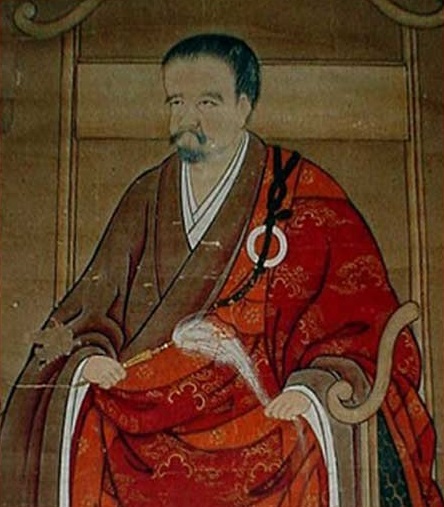
A painting of Zen monk Bankei Yotaku (1622–1693). The author writes, “That ‘all things are perfectly resolved in the Unborn’ was the great realization and the central teaching of Zen master Bankei: ‘When you dwell in the Unborn itself, you’re dwelling at the very well head of Buddhas and patriarchs.’ The Unborn is the Buddha-mind, which is beyond living and dying.” Wikimedia Commons File: BankeiYotaku.jpg.
Buddhist teachings about “nonself” (anattā) imply that humans’ fundamental repression is not sex (as Freud thought), or even death (as existential psychologists think). Our root problem is the delusion that the self is real. We are normally ignorant of the fact that our sense of self is “empty,” an insubstantial and impermanent psychological construct which often feels insecure and is preoccupied with trying to secure itself—a goal that cannot be achieved because there is nothing that can be secured.
The Buddhist critique of the ego-self gives us a unique perspective on our basic problem, quite different from what psychotherapy offers. Buddhism also suggests a different way to resolve it.
Freud emphasized that repression is the key phenomenon underlying all psychoanalysis. When something (usually a thought or feeling) makes me uncomfortable, I may ignore or “forget” (repress) it, but what I have repressed usually returns to consciousness. On return, it has been transformed into a symptom that is symbolic, i.e., that symptom represents the repressed phenomenon in distorted form. Freud understood the hysterias of his middle-class Viennese patients to be symptoms of repressed sexuality, but existential psychologists such as Norman O. Brown and Ernest Becker have shifted the focus to the more fundamental issue of life and death.
The dilemma is that, although fear of death is necessary for self-preservation, it must be repressed if we are to function with any degree of psychological comfort. According to Becker’s The Denial of Death, to acknowledge our mortality is “devastating and terrifying . . . it makes routine, automatic, secure, self-confident activity impossible. . . . It places a trembling animal at the mercy of the entire cosmos and the problem of the meaning of it.”
From a Buddhist perspective, however, the self that is so afraid of death has no objective reality. It is not only ungrounded but ungroundable, because it is merely a mental construct, composed of interacting perceptions, thoughts, feelings, and actions. The problem is that such a conditioned self is naturally insecure: It wants to secure itself, to feel more real.
Consequently, our sense of self is haunted by a sense of inadequacy or lack. It is here that the psychoanalytic concept of repression becomes helpful, for the idea of “the return of the repressed” distorted into a symptom links our sense of lack with the symbolic ways we try to make ourselves more real. We experience this lack as the feeling that “there is something wrong with me. . . . I’m not good enough.” We understand that feeling in any number of different ways: “My problem is that I don’t have enough money/fame/power/beauty.” We are eager to objectify our anxiety into some specific lack, because once we know our problem then we know how to respond.
The tragedy of such objectifications, however, is that no amount of money, for example, can ever be enough if it is not really money that we need. When we do not understand what is actually motivating us—because what we want is only a symptom of something else (our desire to feel more real)—it tends to make us compulsive. A Buddhist approach implies that the best solution is found not in psychotherapy but in a transformative spiritual practice (such as meditation) that puts an end to the sense of lack, by helping us “wake up” from the delusion of a separate, independent self.
According to Buddhist teachings, when the sense of a separate self disappears, we become aware of something that cannot die because it was never born. Nonself is the middle way between the extremes of eternalism (a self that survives death) and annihilationism (a self that is destroyed at death). Buddhism resolves the problem of life and death by deconstructing it. The evaporation of this dualistic way of thinking reveals what is prior to it: the Unborn.
In the Pali canon of Theravada Buddhism, the two most famous descriptions of nibbāna both refer to the Unborn, where “neither this world nor the other, nor coming, going nor standing, neither death nor birth, nor sense-objects are to be found.” Similar claims are common in Mahayana. The “Song of Enlightenment” of Yung-chia, a disciple of the sixth Ch’an (Zen) patriarch, says: “Since I abruptly realized the unborn, I have had no reason for joy or sorrow at any honor or disgrace.” That “all things are perfectly resolved in the Unborn” was the great realization and the central teaching of Zen master Bankei: “When you dwell in the Unborn itself, you’re dwelling at the very well head of Buddhas and patriarchs.” The Unborn is the Buddha-mind, which is beyond living and dying.
Experiencing the Unborn resolves the problem at its source. The ego-self that has been trying to make itself real—securing itself by achieving something in the objective world—forecloses on its greatest anxiety by letting go, which Dōgen (in the Genjo-koan) calls “forgetting the self.” “Die before you die, so that when you come to die you are already dead,” as a Sufi aphorism puts it. Of course, such letting go is not usually easy: It means giving up my most cherished ways of thinking about myself—what I think I am (notice the reflexivity). No wonder it is sometimes called the Great Death.
If becoming aware of the Unborn cannot save the body from aging and deteriorating, does such ego-death really solve our problem? Yes, because Buddhist deconstruction of the empty ego-self implies that death is not our deepest fear, and the desire to become immortal is not our deepest hope, for even they are symptoms that represent something else. They symbolize the desire of the sense of self to transform its anguished lack of being into genuine being. Even the terror of death represses something: It allows us to project our fundamental problem into the future, so that we can avoid facing what we are (or are not) right now.
But why do we need to project ourselves indefinitely into the future, unless something is felt to be lacking here and now? If it is nothingness we are afraid of, the solution is to let go now and become nothing. Meditation is learning to forget the self by becoming absorbed into one’s contemplative practice. If the sense of self is a result of consciousness attempting to reflect back upon itself in order to grasp itself, meditation is an exercise in de-reflection. Enlightenment occurs when that reflexivity ceases because one lets go. “Men are afraid to forget their minds, fearing to fall through the Void with nothing to stay their fall. They do not know that the Void is not really void, but the realm of the real Dharma” (Huang-po).
What we fear as nothingness is not really nothingness, for that is the perspective of an insecure sense of self haunted by the fear of losing its grip on itself. When consciousness stops trying to catch its own tail, we become nothing, our sense of lack disappears, and we realize the great freedom to be and do anything, according to the possibilities provided by the situation.
Note: For the source of all quotations, see David R. Loy, Lack and Transcendence: The Problem of Death and Life in Psychotherapy, Existentialism, and Buddhism 2nd ed. (Wisdom Publications), 2018, chap. 1.
David R. Loy is a professor, a writer, and a Zen teacher in the Sanbo Zen tradition of Japanese Zen Buddhism. He is a prolific author whose essays and books have been translated into many languages. He teaches nationally and internationally on various topics, focusing primarily on the encounter between Buddhism and modernity and what each can learn from the other. See www.davidloy.org.