
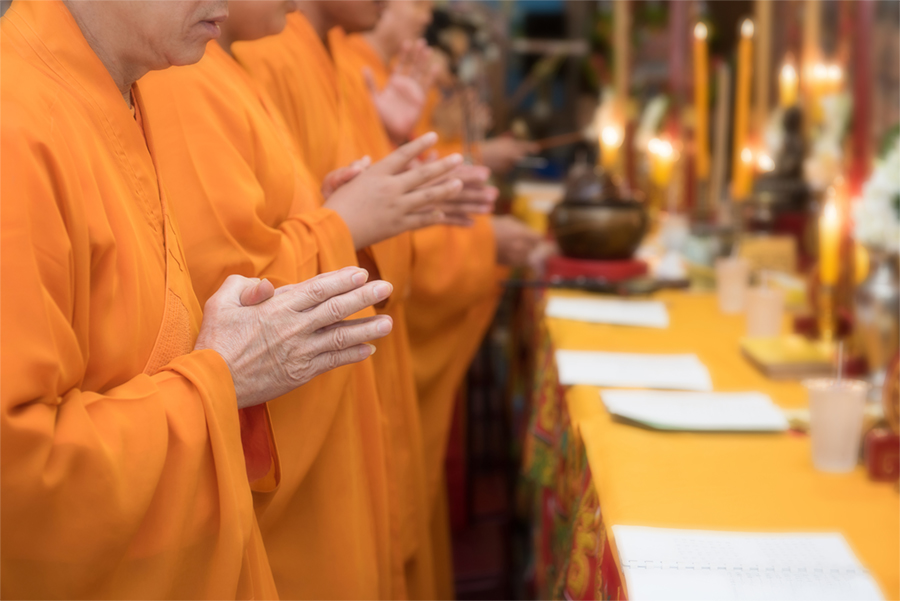
Venerating ancestors and their attainment of buddhahood is inextricably linked to the perfection and the liberation of the individual.
Ancient Indian Brahmanism performed rites honoring deceased kin and blood relatives (peta). These are called śrāddha in Sanskrit and saddha in Pāli, and are an important part of Brahmanic family rituals. Ceremonies to make offerings to ancestors are performed three times a year, when three Brahmins are invited for treat, and rice balls (piṇḍa) are offered to the spirits of deceased fathers, grandfathers, and great grandfathers. In traditional Brahmanism, when a person dies, he is greeted in the vault of heaven according to the efficacy of the rituals and offerings that were made during his lifetime, in the company of Yama (the lord of the dead) and the forefathers (pitri), with whom the deceased is regarded as being merged. The Jāṇussoṇi sutta in the Pāli Canon (Aṅguttara-nikāya, vol. 5, pp. 269–273) relates that a Brahmin called Jāṇussoṇi visited the Buddha and asked him if the departed receive any benefit from the offerings made in those rituals, and if they partake of them. The Buddha did not deny this, but said that such offerings benefited only those who had been reborn in the realm of the hungry ghosts (P., peta; Jpn., gaki) among the five destinations of rebirth (the realm of the ashura is not mentioned here). They are enabled to live on by means of what their friends, relatives, and kindred send to them from this world.
On the other hand, in the East Asian cultural sphere dominated by the use of Chinese characters, the soul (Jpn., tamashii) as a spiritual existence is expressed by a compound of two characters (Chn., hunpo; Jpn., konpaku) meaning “soul” and “spirit.” These are considered to separate when a person dies. “Soul” is the “yang soul” (hun), received from Heaven, and is understood to be an immortal existence that returns to Heaven. “Spirit” is the “yin soul” that is received from the earth and is thought to linger around coffins and graves, eventually either being burned out or expiring. The American anthropologist David K. Jordan, who made a study of folk religion in a Taiwanese village, reported the view held by villagers that hun “continue life in the realm of the shades, a ghostly sphere, invisible to mortals, yet interpenetrating the world of the living in time and space. Their existence can be comfortable if they are well provided by their descendants with food offerings, clothing, housing, and above all with money.” This is why Chinese communities around the world offer sumptuous clothing, large quantities of paper money and food, and paper houses of great complexity at funerals, the Ghost (Yulanpen) Festival, and other occasions. Failure to do so causes the spirits of the dead to gradually transform into ghosts (Chn., gui) that bring trouble to the living.
Similarly, Japanese folklore understands that the spirits of the dead are initially polluted and unruly. Gradually, as they pass back and forth between this world and the next, receiving offerings from relatives near and far, they shed their pollution and individuality, and, becoming purified, merge with all the family and village ancestral spirits. Having now become ancestral spirits without any individual personality, they visit this world at particular times to watch over their descendants and the villagers as a whole.
As we have seen in the Jāṇussoṇi sutta, Buddhism also recognized a realm of hungry ghosts (peta) that could interact with the human world. Although this sutta does not say much about hungry ghosts, the Petavatthu in the Khuddaka-nikāya, as if by compensation, contains fifty-one stories about their relief. Such relief does not take the form of making offerings directly to the hungry ghosts, but rather of making them to recipients such as monks (bhikkhus). The merits of such actions are then directed to the hungry ghosts.
In Buddhism, the principles of the theory of karma—that meritorious acts result in good and evil acts result in suffering—are (1) the inevitable effects of karmic causes, and (2) receiving upon oneself the reward or retribution of one’s own acts. However, there are two ways these may be breached: mitigating karmic obstacles through repentance and transferring merit from the one performing the good action to another (Skt., pariṇāmanā < pari-√ṇam). The basic meaning of pariṇāmanā (Jpn., ekō) is “turn” or “convert,” that is, to turn the merit of one’s own good actions toward one’s own enlightenment (buddhahood), or to turn it to benefit others toward their enlightenment. However, there was another word in the early Buddhist Canon meaning the transference of one’s own merit to others, derived from ā-√diś (ud-√diś, anv-ā-√diś). According to Dr. Hajime Sakurabe, this word means “to direct the merit of one’s good actions for the benefit of another.” Dr. Akira Fujimoto, in his study of the Petavatthu, translates it as “designate.”
A naked women—a hungry ghost—said to merchants who pitied her, “What is given by your hand into mine does not help me. Give it to this lay disciple of the enlightened Buddha. Having dressed him, transfer the merit to me. By doing so you will give me what I want.” As soon as the merchants had done so, the “fruit” immediately materialized, as she appeared before them clad in beautiful clothes (Petavatthu 10). What is common to all stories about the hungry ghosts is that they cannot enjoy the food, drink, and clothing directly offered to them by human beings. An elder among the Arhats was no exception. In order to bring relief to his blood relatives, he had the alms collected by his twelve followers given to him to make a meal for the Sangha, and the shreds of cloth picked out from a rubbish heap converted into a garment and offered to the Sangha. He then designated the merit of these actions to his relatives (Petavatthu 27). This seems to reflect a sort of hierarchy in Buddhism—the offering being made to the Sangha or someone of higher status than the donor. According to Dr. Fujimoto, they all nonetheless fall into the category of principle (2) above: that a person’s actions bring about corresponding results. What brings the donor the reward for his or her offering is not the physical donation itself but the intention (cetanā) for good that rises in the mind of the donor. The hungry ghost feels gratitude (anumodanā) that the donor has designated him or her as recipient. In other words, it gains comfort through the good karma in its own mind, rejoicing in the good actions of the other, and so attains relief from hunger and thirst. The hungry ghost also praises the donor who has designated the offering not simply for the karmic connection but as the cause of its relief. According to the Sutra of the Original Vow of the Bodhisattva Kṣitigarbha (Jpn., Jizō bosatsu hongankyō) forebears receive one-seventh of the merit from offerings and the donor receives the remaining six-sevenths. The Petavatthu says that both receive the full amount of merit for the offering, with no reduction at all.
The Sōkaimyō—the symbol of faith received by members of Rissho Kosei-kai overseas (very slightly different from the Japanese version)—states as its purpose “bringing mutual awakening to the families and ancestors of both husband and wife through the bodhisattva way.” The subject of the Sōkaimyō is understood to be the ancestors of both maternal and paternal families, as well as members of both families presently living. I have already looked at the implications of the “mutual nature” of the two. According to “Nyukai no tebiki” (A guide for new members) in the January 1954 issue of Kosei, one’s ancestors are the shape of one’s previous life, and their veneration is itself the key to knowing the happenings in the past that explain one’s present state. Among our forebears, there would have been those who performed both good and unwholesome actions. We direct merit toward them by passing along the merits of the good actions amassed by our innumerable forebears and accumulating them, and dealing with the guilt over unwholesome actions by living a life based upon the teachings of the Lotus Sutra. In other words, we reflect and repent through practice of the bodhisattva way, and make an offering of our unremitting effort to attain the perfection of character to the Eternal Original Buddha (kuon honbutsu), its recipient, and designate the merit gained from it to be transferred to our ancestors. Venerating ancestors and their attainment of buddhahood is inextricably linked to the perfection and the liberation of the individual.
There was once a senior minister of Rissho Kosei-kai who, dedicated to the liberation of others, was famous for his mastery of musubi (guidance). Based on his experience of a huge number of cases in which personal suffering was linked to ancestor veneration, he instructed that there could be no resolution unless ancestor veneration was directed and designated with pinpoint precision. Seen from the study of the Petavatthu, this was a way of guidance that makes good sense.
Masashi Hashimoto is the director of the Chuo Academic Research Institute of Rissho Kosei-kai in Tokyo.