
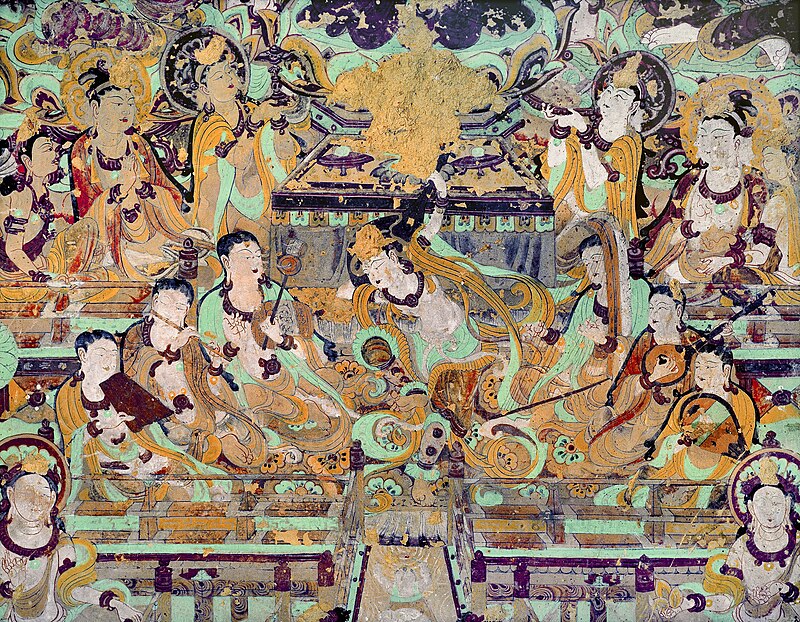
A wall painting of a Buddhist musical performance. Mogao Caves (cave 112), c. mid-Tang dynasty (618–907).
Wikimedia Commons File: Sogdian whirl with large pipa.jpg
With the emergence of Mahayana, the arts of music and dance and such came to be regarded as practices to attain our own enlightenment—a substantial development.
Though it is not easy to talk in any uniform way about how the use of music in Buddhism changed, I would like here to offer a few introductory remarks. As Buddhism developed from Early Buddhism to Mahayana, by way of Sectarian Buddhism, music came to be assessed very differently, in what might seem to be a contradictory way. I will concentrate here on looking at Buddhist sutras to see how the way music was understood in Indian Buddhism changed, until by the time of the Lotus Sutra, it was considered a meritorious practice that enabled people to attain their own enlightenment.
In the Sakkapañha-sutta (DN. 21), Sakka, the ruler of the devas, seeking an audience with the Buddha, sent the heavenly musician Pañcasikha, a renowned lutist, to go ahead to announce him. Standing at the head of the devas of the thirty-three heavens, Pañcasikha appeared on the Vediyaka hill and approached the Indasāla Cave where the Buddha was staying. Then, plucking his lute, he sang about the Three Treasures of the Buddha, the Dhamma, and the Sangha, about the arahats, and about love.
At the end of his song, the Buddha praised him saying, “The music from your strings harmonizes with your voice, and your voice harmonizes with the music from your strings. The music from your strings is balanced with your voice, and your voice is balanced with the music from your strings.” Later commentators said that of course the Buddha holds himself aloof from any attachment to music, but by praising it he granted Sakka and the devas the opportunity to ask him questions.
Sakka, in the Cūḷataṅhāsaṅkhaya-sutta (MN. 37), possessed five hundred heavenly musical instruments for his enjoyment. The commentators understood this to imply that Sakka savored the glory of heaven and that all his senses were activated by music. The fivefold (and five hundred) heavenly musical instruments (pañcaṅgika-turiya) refer to a drum with one surface covered in skin (atata), a double-headed drum (vitata), an instrument with a head and strings, like a lute (atata-vitata), wind instruments (susira), and cymbals, gongs (ghana) and so forth. When Sakka saw the venerable Mahāmoggallāna approaching, he dismissed the music, and welcomed the visitor. According to the commentators, Sakka was following the example of devout kings, who, on seeing a bhikkhu, dismissed performers on the grounds of the precept of “no singing, no playing musical instruments, no dancing.” This mirrors a passage in the Cūla-sīla (Ten Precepts) of the Brahmajāla (DN. 1) in the section “When an ordinary, ignorant being praises the Tathāgata”: “The monk Gotama holds himself aloof from being a spectator of shows with dancing, singing and music.” This was the exemplary image of religious mendicants held by people in India at the time. Even before it was put into writing in the Vinaya, which laid out the norms of behavior to be followed by monks and nuns, a kind of customary law existed for the religious, not just within Buddhism. This may explain why there was unexpectedly no specific injunction against music, and so forth. in the Pāṭimokka, the 251 monastic precepts in the Vinaya.
Lay followers would observe the eight uposatha precepts for a whole day and night on ritual cleansing (uposatha) days. The first mention of these precepts seems to have been in the Dhammika-sutta (Suttanipāta 14). No. 7 forbids wearing garlands (mālā) and using perfumes (gandha). Generally this is incorporated into a set to “refrain from dancing, singing, playing musical instruments and watching entertainments;” but this addition was yet to appear. It was added to garlands and perfumes in the Uposatha-Vagga (AN. Vol. IV, p. 250), which sets out in detail what people should refrain from on uposatha days: “Refrain from singing (gītā) and dancing (nacca), the playing of musical instruments (vādita), and the watching of entertainments (visūka-dassana).”
Novices received the ten sāmaṇera precepts, and No. 7 repeats the above: “Abstain from dancing, singing, playing musical instruments and watching entertainments.” In the Pāciṭtiyā 10 of the precepts for nuns (bhikkhunī), violating the precept against singing and dancing, and so forth is regarded as a misdemeanor that calls for confession and repentance. The systems around novices and nuns were only gradually put into place within early Buddhist monasticism and so it is not clear how seriously the precept against singing and dancing was regarded within it. It is more than likely that its importance grew with the development of monastic Buddhism. The Mūlasarvāstivāda vinaya speaks of the “seven treasures that cannot be touched by monks,” and, defining them, adds “musical instruments, drums and fifes” (T 23, 846c). Thus performance was indirectly banned.
In early Buddhist sutras, which preserve the monastic stance, music may possibly have been played in the course of missionary work, where the lay (human beings and devas) and the ordained (the emancipated) interacted. In the Pali Maha-parinibbanna-sutta, the Buddha told Ananda, “Do not worry yourselves about the funeral arrangements . . . There are wise Khattiyas, Brahmins and householders who are devoted to the Tathagata: they will take care of the funeral.” And so, “the deities and the Mallas of Kusinara paid homage to the body of the World-Honored One with dance, song, music, flower-garlands, and perfume, showing respect, honor and veneration” (DN. Vol. II, pp. 159–161). The Buddha’s relics received the same homage (p.164).
However, as far as we can tell from the various Vinayas, veneration of stupas employing song and dance and music did not begin at the time of the Buddha’s parinibbana. In the Mahīśāsaka-vinaya it is stated that stupas should be erected for “the Tathagata, arahants, pratyeka-buddhas and universal monarchs” (T 22, 173a). Since bhikkhus would be censured by laypeople if they themselves venerated the stupas with song and dance, the Buddha forbade them to do so. However it was alright to let the people do so. On the other hand, bhikkhus themselves could “praise the Buddha and venerate stupas with flowers, perfumes, banners and flags” (173a). The Dharmaguptaka-vinaya, referring to the depositing of relics in a stupa, says that the Buddha forbade bhikkhus “to pay homage by playing music or sounding conch shells themselves” (T 22, 956c–957a).
In the Mahāsāṅghika-vinaya (Vol 33) the Buddha permitted a layman, King Pasenadi of Kosala, to perform veneration employing music. He gave the precedent of King Kiki of Kāsi, who did so at the parinibbana of Kassapa, the sixth Buddha of the past, saying, “During the life of that Buddha and after his pari-nibbana, veneration could be performed in all cases offering flowers, perfumes, music, various kinds of robes, and food and drink.” He explained, “This enables living beings to produce wholesome deeds and gain peace in the long night of spiritual darkness” (T 22, 498c).
In the environment of early Buddhist monasticism where attachment to “play” simply led to continuing transmigration, it would have been difficult to develop song and dance as artistic forms. However, when the lay-centered Mahayana took hold, sutras spoke of the merit of venerating stupas with song and dance, and this allowed their development as art. In the “Skillful Means” chapter of the Lotus Sutra, it is said that all those who pay homage to the stupas of Tathagatas with the mystic sounds of music and song have attained the path of the buddhas.
All kinds of instruments are listed here: kettle drums (bherī), conches (śaṅkha), small drums (paṭaha), large drums (dundubhi), lutes (vīṇā), cymbals (tāḍa), tabor drums (paṇava), elongated barrel-shaped drums (mṛdaṅga), flutes (vaṃśa), a kind of drum/cymbal (jhallarī), and the unidentified ekotsava. Relics could also be venerated by pouring water, clapping hands, and melodious singing. Those who did so have also all attained the path of the buddhas. By offering veneration by however small an action (such as plucking just one string of an instrument), those with even a distracted mind will gradually see innumerable buddhas. Such is the merit of venerating stupas and relics through music, as a practice leading to the perfection of self.
And so, with the emergence of Mahayana, the arts of music and dance and such came to be regarded as practices to attain our own enlightenment, a substantial development.
References
Hirakawa, Akira. Hirakawa Akira zenshū (Complete works of Akira Hirakawa) Vol. 4, Shoki daijō Bukkyō no kenkyū II (Study of Early Mahayana Buddhism II). Shunjusha, 1990.
Nakamura, Zuiryū (trans). Gendaigoyaku Hokekyō I (Lotus Sutra, Modern translation I). Shunjusha 1995.
Sasaki, Shizuka. “Bukkyō to gigaku” (Monastic worship of stupas with music and dance in Vinaya texts), Bukkyō shigaku kenkyū 34:1 (1991): 1–24.
Masashi Hashimoto is the director of the Chuo Academic Research Institute of Rissho Kosei-kai in Tokyo.