
In the opening section of the “Introductory” chapter of the Lotus Sutra, we find the following astonishing reference to the Buddha’s preaching of the Dharma to a multitude of bodhisattvas: “Having preached this sutra, the Buddha sat cross-legged and entered the contemplation termed ‘the station of innumerable meanings,’ in which his body and mind were motionless. At this time the sky rained mandārava, mahā-mandārava, mañjūshaka, and mahā-mañjūshaka flowers over the Buddha and all the great assembly, while the universal buddha-world shook in six ways.”
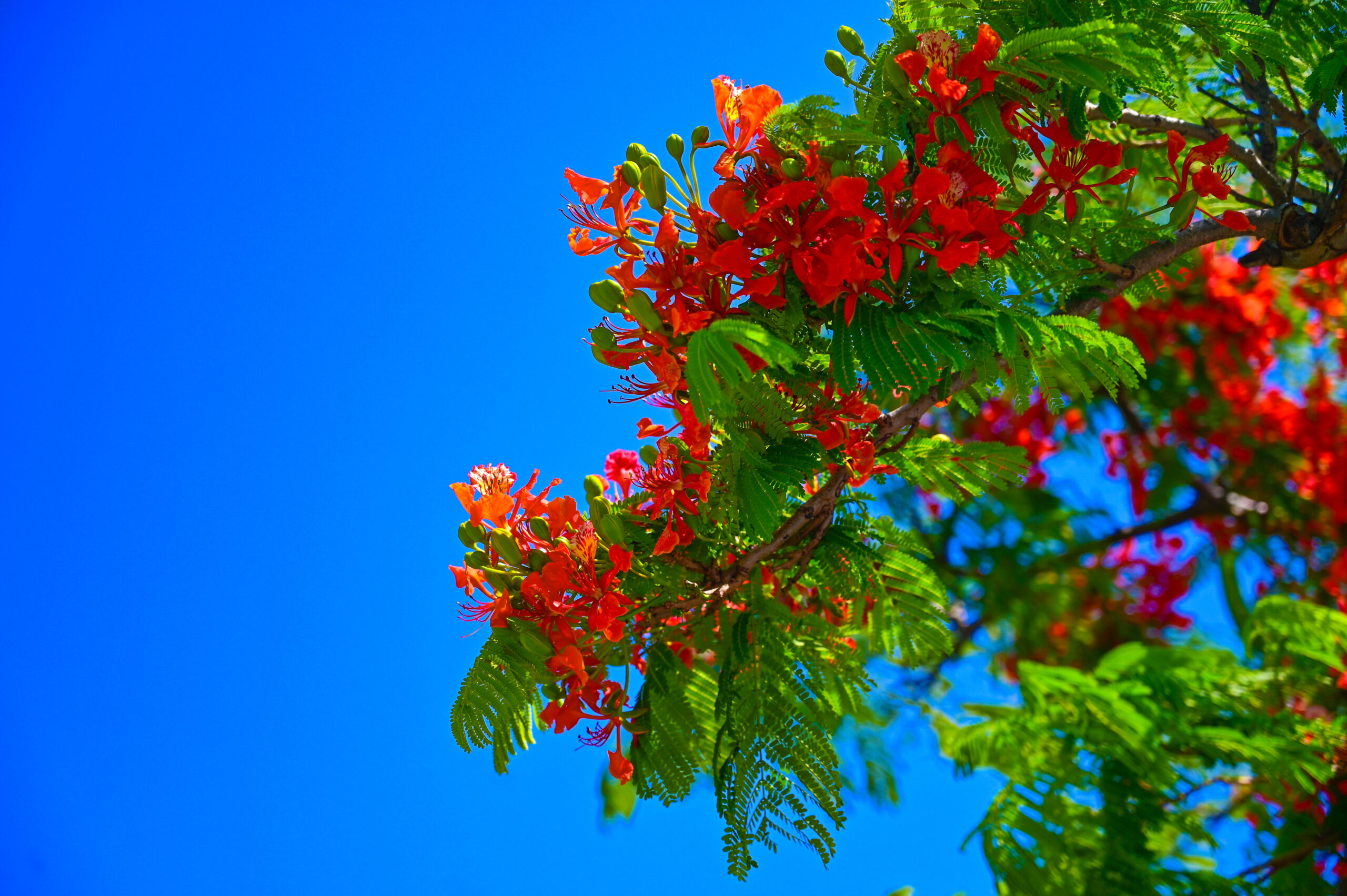
The four kinds of flowers mentioned here, starting with the mandārava, are known as the Four Flowers of Heaven, and we should regard them as an expression of the felicitations of gods living in celestial realms when an auspicious event occurs in the world of human beings in which the Buddha is active. This is what is implied by references in Buddhist scriptures to the strewing of flowers. For the moment, let us focus on the mandārava flower, the first of the four flowers listed in the quotation above. In Japan it is usually equated with the datura, but it is actually the Indian coral tree, which is also the prefectural flower of Okinawa.
A tree of medium to great height belonging to the Fabaceae, or pea, family, the coral tree (Erythrina) produces clusters of bright red flowers with butterfly-shaped corollas, distinctive of the pea family, in spikes on the tips of its bare branches, from which the leaves have fallen. When a joyful event blessedly occurs, these red flowers are miraculously created by the gods and rain down from the heavens thick and fast, regardless of the season.
It could just as well be the American coral tree of the same genus. Regardless, let us savor day by day the good fortune of being able to live as Buddhists as we visualize these beautiful mandārava flowers raining down from the blue sky.
Atsushi Kanazawa is a professor emeritus in the Faculty of Buddhism at Komazawa University, Tokyo. He specializes in the Indian philosophy of language and the history of Indian philosophy and culture.