
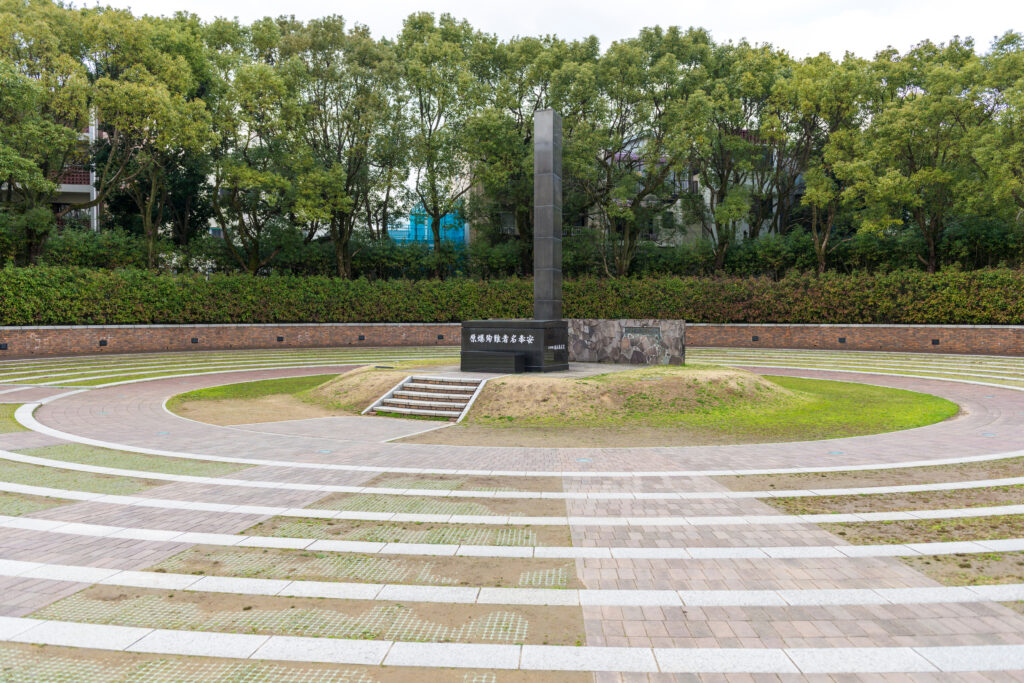
 When the bomb fell on Nagasaki, I was living with my mother and nine-year-old nephew at Oka-machi in the Urakami district, near Urakami Cathedral and about two hundred meters from the hypocenter. Sixteen at the time and an avid patriot, I had been mobilized as a student-worker.
There had been an air-raid warning on the morning of August 9, and all movement had been temporarily stopped. My mother urged me to stay home that day, but, brushing off her suggestion, I set off for the Kami Nagasaki Primary School, where my work unit was based. The school, located on the east side of a range of low hills that divided Nagasaki into two, was being used by Mitsubishi Steel Works as a branch factory.
At two minutes past eleven there was a blinding flash from all sides, and the glass blew out of all the windows. Everyone fled to the air-raid trenches for shelter, but after about ten minutes we ventured out and looked up at the sky. Over the hills a great ash-colored cloud was rising into the sky as if in slow motion. Our boss surmised that the main factory had been hit, and several dozen workers made their way over the hills to see. The sight that confronted us when we reached the top pulled us up short. Below us was a sea of flame. We could hear the sounds of explosions and the whoosh of the fiery winds that were blowing upward. We were told we could leave, and I set off alone along the ridge that led to my home.
All the trees on the hillside had been uprooted and were lying flat on the ground facing in the same direction. I picked my way through the fallen trees in a daze, compelled by the thought that I had to find my mother. I was about a hundred meters beyond the Nagasaki Medical College Hospital when I suddenly heard a voice at my feet crying out for water. Surprised, I swung around and saw a sight that made me stand transfixed. A woman, probably in her mid-thirties, was lying on the ground, her hair wild, her clothes in tatters, her face red with blood. She was putting all the strength that remained in her to raise her head and murmur, “Water, water.”
When I had gathered my wits about me, I scooped some dirty water out of a nearby ditch and gave it to her. She drank it as if it were the most delicious thing ever to pass her lips, but most of it merely trickled down her chin onto her breast. ‘‘More, please,’’ she begged, but she could do no more than gasp for breath when I brought it, having no strength left to drink.
A few moments passed in silence. Then she looked up at me and asked me to take her home. I did not know what to do. I desperately wanted to find my mother, to discover what had happened to her and my nephew. I did not see how I could cope with an unknown woman on my back. I spun around and ran away. As I fled, I told myself that there was nothing else I could do.
The area around Urakami Cathedral was completely burned out, and the heat prevented me from approaching. It was not until early the next morning that I made my way to what appeared to be the ruins of our house. The whole area was a fire-blackened desolation. There was not even a charred remnant of the huge camphor tree that had stood behind our house. All around me were strewn skeletons, scattered bones, and torsos of ebony ash. I sank down, exhausted. When I had recovered somewhat, I began looking for my mother, or rather, her bones. All I had to go by was the fact that she had had gold teeth. I held skull after skull in my hands and peered into the jaw area. I wonder how many people’s skulls I picked up during my search. I continued searching frantically. There were times when, squatting, I even raised fire-blackened heads to look at the teeth. I spent that whole day, the tenth, picking up skulls and putting them down again.
My search continued in the same way for two or three more days. After that, I saw more and more people searching the ruins like me, and relief teams arrived to clear away the bodies. As I was making the rounds of the aid stations in the faint hope that my mother had been accommodated in one, I noticed a newspaper posted on a bulletin board near the Katsuyama Primary School. I read that Nagasaki had been hit by a new type of bomb and had suffered ‘‘a little damage.” I was shocked. A little damage? My blood rose in anger. All around me as far as the eye could see were ruins, and all who had been living were now dead. My mother and my nephew were nowhere to be found. And this was “a little damage’’? What kinds of lies were the newspapers reporting?
Until then I had never doubted the veracity of the authorities. I was desperate to be allowed to die for the Emperor. Now I realized that the military and the cabinet, those who had the trust of the Emperor, were openly propagating lies. I yelled, ‘‘Liars!’’ and kicked the bulletin board with all my strength. It was a futile gesture and did nothing to relieve the emptiness that overwhelmed me.
That day and the next I continued searching for my mother’s bones, taking up skull after skull, but in vain. Meanwhile, the clearing away of bodies continued. I wandered around, often crying aloud as I walked.
My father had died when I was six, and my mother had reared my brothers and me single-handedly. Maybe because I was the youngest child, she lavished extra affection on me. In March 1944, after my brothers had all gone off to war, I came down with meningitis, which left me with a bad leg. Her love and concern for me grew even greater. On August 9, when we had all been warned to stay indoors, she had wanted me to remain at home for the day out of concern for my health. And now I could not even find her teeth. She had died that day, worrying about me; and I, who had shrugged off her concern, remained alive. My mother and nephew had been killed just because they happened to be in Urakami. Their bodies had probably vaporized in the seven-thousand-degree heat.
After the war I was taken in by the family of a close friend who lived in the Mogi-machi district. There I found work as a substitute teacher. I was drawn to study, however, and in 1948 I took myself off to Tokyo. My scholarship money was not enough to cover my school fees and living expenses, and I worked day in, day out doing manual labor. I even sold my blood to help make ends meet.
Eventually I found work as a teacher in Itabashi Ward, Tokyo, in 1951, but my life had no real stability. Nevertheless, I married and had children. One day I happened to learn that the Stockholm Appeal of 1950 had played a major role in the antinuclear movement. I began to feel that I had a duty to discharge, for the sake of my children, as a living witness to the cruelty of the atomic bomb.
What pained me most was the memory of the unknown woman I had abandoned. I reproached myself for not having taken her with me, and however much I tried to reason with myself that she would have died anyway from the radiation, I continued to suffer from guilt. There are times even now when an unguarded look at my hands brings memories rushing back into my mind of that day in hell when I took up skull after skull in the search for my mother’s gold teeth, and when I abandoned the woman with the blood-covered face.
Gradually, however, I began to feel that I could make a true memorial to that unknown woman by speaking of the pain and suffering that she had gone through. I began to campaign for a ban on nuclear weapons. The conviction that atomic weapons were unforgivable grew ever stronger as I watched children of atomic bomb survivors die, first a six-year-old girl in my neighborhood from a brain tumor, then a favorite student, seventeen years old, from cancer of the liver.
The situation in Japan today is dubious. Articles and photographs concerning peace have been withdrawn from publicly funded textbooks, and literary materials designed to deepen the awareness of these things have been unjustifiably attacked. F-16 jet fighters capable of carrying nuclear missiles have been based at Misawa at America’s request, and Japan is steadily rearming. I find little difference between this and the government’s attitude in 1945 when it deceived the people of Japan about ‘‘a little damage’’ to Nagasaki on that day of fire and desolation and urged that we continue fighting. I wonder how the government, whose duty it is to protect citizens’ lives and property, regards the damage that nuclear weapons can cause?
I will continue to cry out against all nuclear weapons while I have any life in me, for the sake of the mother and nephew whose bones I never found and for the sake of that woman who died alone.
This essay first appeared in somewhat different form in the monthly magazine Dharma World in April 1984.