
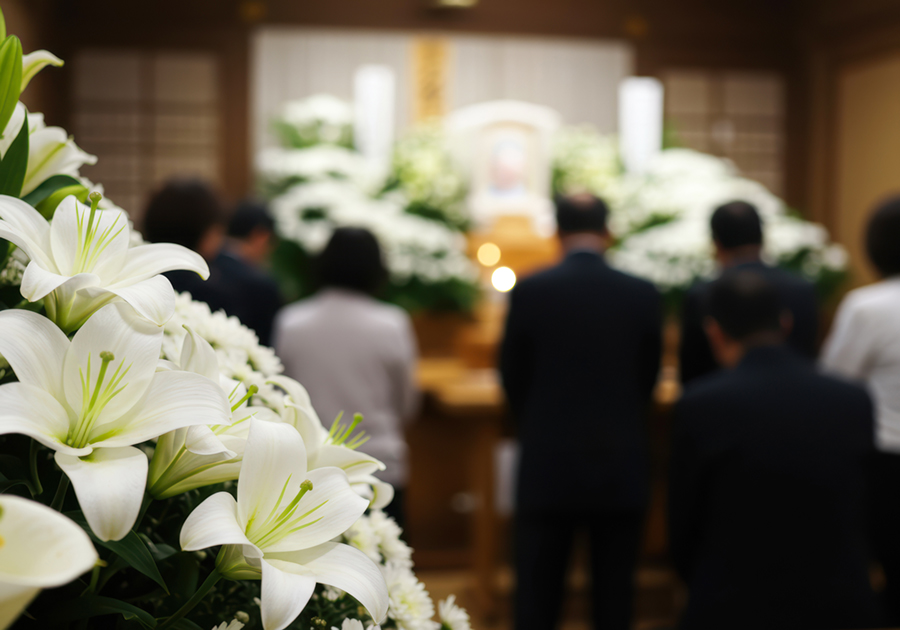
Funeral rites are very powerful because they develop one’s self-cultivation or self-awareness.
In the early morning of Sunday, June 16, 2024, I landed at Haneda Airport from New York City to spend the summer in Japan. I took a taxi to my temple in Tokyo before 6 a.m. On the way, what caught my eye through the window was a cloudless sky of vivid blue. As that boundlessness and vividness penetrated me somehow, I got a feeling that something was going to happen. It was an unusual experience with a presentiment of foreboding. But, of course, there was no way I could know that my ominous premonition would prove right.
That night I received a phone call telling me that Mrs. Hatsue Takanashi had passed away at the age of 102. A voice on the phone said that she had peacefully closed her eyes surrounded by her two sons, two daughters, and seven grandchildren. As soon as I heard that deeply sad news, many of my conversations with her came and went in my mind. She was an important factor in my decision to come to America in 1999. Since then, I have been a Zen priest, a scholar of Japanese religions, and the dad of two daughters. In other words, it is not an exaggeration to say that my tremendous thanks go to her for being who I am today in America.
The next morning, Mrs. Takanashi’s family members and a representative from the funeral home came to my temple and we decided on the dates for her funeral. Considering the availability of a crematorium in a busy season of the year, and also considering the hot weather, we were able to set her funeral for three days later. Traditionally, a Japanese funeral usually consists of a two-day service, the first of which is a wake (tsuya 通夜: a ceremony held the night before the day of the funeral for the purpose of spending the last night with the deceased). We set the date for the tsuya on June 19, and for the funeral (sōgi 葬儀) on June 20. Also, because the body of the deceased cannot be cremated for 24 hours after death, her family made an earnest request to place her body at my temple, which is her family temple (bodaiji 菩提寺). This is where we were hoping to keep her until the wake.
After the funeral home brought her body to my temple, she was bathed, her hair was groomed, and makeup was applied. A guardian sword, which is a small blade, was placed on her chest on top of the futon cover with the tip of the blade pointing to her feet. This guardian sword is meant to be a talisman to help the deceased safely enter nirvana—in Buddhist contexts, crossing over to the Pure Land (jōdo 浄土) or the Other Shore (higan 彼岸). She looked peaceful, beautiful, and relaxed, and it seemed to me that she was smiling. I put my palms together to express my deep gratitude from the bottom of my heart. It was in this one-way and silent (but somehow very warm) setting that she and I met and had our last conversation face-to-face. During this vigil at the temple, Mrs. Takanashi’s family members cherished their last moments with her in person, privately, without others and without interruptions. This special private time was not only a time to mourn for the dead, but also a time for the remaining family members to accept the difficult reality of her death.
Approximately two hours before the tsuya ceremony began, Mrs. Takanashi’s entire extended family gathered at the temple as instructed by the funeral director. This meeting of all of the family members turned out to be a family reunion, with a lot of nostalgic catching up going on, but in a sad setting. As the funeral director started to explain to Mrs. Takanashi’s sons and daughters (among them, the chief mourner was the oldest one) the flow of the ceremony in detail, they were busy greeting the other attendees. It seemed they didn’t even have time to sit down together to mourn and rest before the ceremony started at 7 p.m.
After the closing of the service, food and alcohol (sake and beer) were served to the mourners who attended and helped with the service. The purpose of a tsuya ceremony is to express gratitude to the mourners and to remember the deceased by sharing memories. It is also an opportunity to share a last meal with the deceased. After this offering service ended, some of the family members stayed at the temple, spending the last time with the deceased; the others went home.
The sun was very strong outside on the day of the sōgi funeral ceremony for Mrs. Takanashi. I was introduced as the officiating priest during the opening remarks made by the funeral director, after which I entered the temple’s main hall where the sōgi ceremony was held. As I stood in front of the ceremonial altar, my eyes met her eyes in her portrait, which was placed in the center of the altar, along with a wooden tablet where her posthumous Buddhist name was written and candles and offerings of flowers and fruit. I was ready to conduct the funeral rites. One of the features of a Japanese Rinzai Zen funeral feature is a shout (katsu 喝), which the officiant performs while saying a requiem for the deceased in the latter half of the funeral. It is considered to be the main ritual of the ceremony. This ritual of the shout, also considered to be “the last ritual” for the deceased, is meant to sever the deceased’s bond (including attachment) to this life. In this sense, the ritual of the shout has the meaning of guiding the deceased on the right path, the path to the other world. It also plays an important role as an opportunity or moment of catharsis for the mourners attending the ceremony. After the ritual was finished, the funeral concluded with cremation of the deceased’s body.
People find many different meanings behind funeral rites, from social as well as personal points of view. Some think the purpose of the rite is to send the deceased to the afterlife; others consider it a way to bid farewell to the deceased and comfort bereaved family members. In this sense, there is room to argue that funeral rites serve less as religious events than as social rituals centering on human relations. While I agree that the rite can serve both of these purposes, I contend that the Rinzai Zen funeral traditions help the dead, the remaining family members and their loved ones let go and move on.
For example, the Zen ritual of the shout is symbolic of not only severing the deceased’s ties to this world but also of directing the deceased to the beyond. In this way, the ritual of the shout marks a funeral as a new beginning rather than an end and symbolizes the rite of passage in which the deceased’s status is transformed from one to another. At the same time, it offers comfort, solemnity, and the opportunity of awareness to the surviving family and the attendees that the deceased has gone to the next world or the other world. In this sense, the officiating priest is a spiritual guide for both the deceased and the remaining family.
Another important point is the nature of the rite of cremation. The cremation rite reminds me of a devotional practice categorized as the “cult of the book” in the context of the Lotus Sutra. The cult of the book comprises the rituals in which sutras are enshrined and worshiped similarly to worshiping the Buddha relics enshrined in stūpas. Simply put, a sutra has power, and the practice is a text-centered act of reverence and devotion for the sutra in question. This cult of the book has eventually influenced the shaping of the Buddhist ritual and devotional culture of East Asia.
The rite of cremation, especially the presence of the cremation urn, serves as the cult of the book in terms of the shared proclamation that the centered object itself—that is to say, the cremation urn or the scripture here—becomes the teacher; there is no need to have an officiating priest as the main teacher in the rite of cremation, and now the main teacher is the cremation urn. Given the reality that the deceased has gone, the cremation urn as the ritual object reveals its ritual transformation as a vital embodiment of a new locus of authority: the transformation that identifies the spiritual source that the deceased has been entering enlightenment in which he or she is completely free of all karma, attachment, defilements, and suffering.
The presence of the cremation urn also makes a new awareness of the same spiritual transformation in the minds of the remaining family, friends, and loved ones: the awareness that the deceased has gone and is entering the enlightened land, the Land of Ultimate Bliss (pure land), Heaven, or whatever we call it, that transcends time and space, freed from all realities. This is a critical moment of transformation where one can let go and move on. Furthermore, it is through this moment of realizing that one has to let go and move on so that one may also realize that, without exception, everything is impermanent. In Japanese Rinzai Zen Buddhism, even death is not an end but a new beginning, and therefore, the officiating priest gives guidance to the deceased in the rites of funerals. By the impermanent nature of all realities, which is the important thing to remember in times of death, one can find meaning in the funeral rites—that is, a reminder to fully appreciate the meaning of this life. I believe that to understand the meaning of death is to understand the meaning of life.
Whether from a social or personal perspective, one of the fundamental meanings of funeral rites can be found in the rite of passage that transforms one’s status from one to another. What I learned from the funeral rite for Mrs. Takanashi was that it is very powerful—not simply because it is a rite of passage, but also because it develops one’s self-cultivation or self-awareness. From the point of view of Rinzai Zen, it is through this self-awareness that the deceased (and we ourselves) can be saved from accepting the difficult realities of modern life. Zen master Hakuin Ekaku (1686–1769) once wrote, in Orategama zokushū, “It is an unparalleled ignorance to believe that one can become a Buddha without seeing into one’s own nature, or that there is a Pure Land outside of one’s own nature.”* Hakuin teaches us that what makes us aware is nothing but ourselves and thus what saves us is nothing but ourselves. I think that funeral rites are a chance for one’s self-cultivation, which is the source of inner salvation.
When all the funeral events for Mrs. Takanashi ended, I talked with her family about my memories of her, including stories they had not heard before, to remember that she was gentle and kind and that she listened. She was inspiring, determined, open-minded, and global in her thinking. My memory of her will remain as something warm in me, and her energetic and positive voice will resonate in me during difficult circumstances in my life. A funeral is a sad occasion, but at the same time, this one has given me a sense of rebirth. This is a miracle. A funeral rite has the everyday power to create miracles.
* Philip Yampolsky, trans., “Orategama Zokushū,” in The Zen Master Hakuin: Selected Writings (New York: Columbia University Press, 1971), p. 136.
Masaki Matsubara (PhD, Asian Religions, Cornell University) has taught at the Department of Religious Studies at UC Berkeley and was a fellow at the Ho Center for Buddhist Studies at Stanford University. He is now a Contemplative Mentor in Residence in the Contemplative Studies Initiative at Brown University and also a Visiting Professor at Interfaculty Initiative in Information Studies at the University of Tokyo. He is the abbot of the Zen temple Butsumoji in Chiba Prefecture, Japan, and travels between the United States and Japan to lead seminars and retreats.