
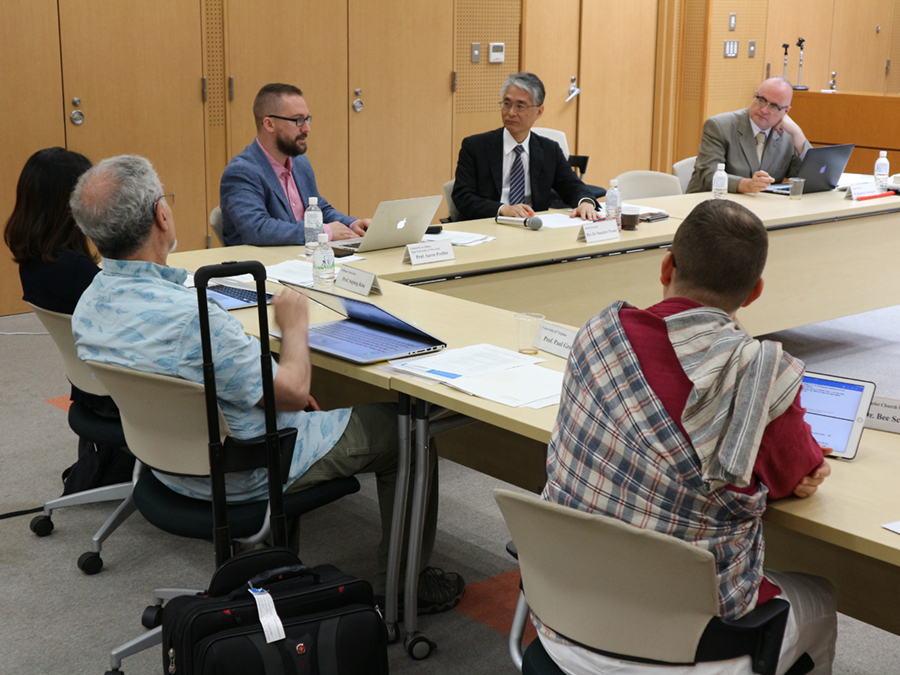
This is a report on the International Lotus Sutra Seminar held June 13–16, 2018, at Rissho Kosei-kai’s headquarters in Tokyo.
Introduction
The 2018 International Lotus Sutra Seminar (ILSS) was held June 13 to June 16 at the Rissho Kosei-kai headquarters in Suginami-ku, Tokyo. The theme, “‘Found in Translation’: Transpositions of the Lotus Sutra,” invited an esteemed international group of scholars to discuss the various ways in which the Lotus Sutra is “translated,” not only in terms of a linguistic transfer between two unlike languages but also as transposition between sociocultural contexts and across temporal and spatial boundaries. In this way participants also had occasion to discuss the Lotus Sutra’s lasting impact as it took and continues to take shape in various, sometimes surprising new configurations.
As in previous years, presenters and interlocutors were encouraged not to simply read and respond to the papers as one might be expected to do at a standard academic conference but to take the opportunity to add extra depth in an open-discussion format. As lead organizer Dr. Dominick Scarangello emphasized, the goal of the paper sessions was to pursue the plus alpha: the additional complexities, layers, and possibilities suggested by all of this year’s uniformly intriguing papers. The resulting discussions raised important questions about not only translation proper but also the difficulties and problems presented in transposing the teachings of the Lotus Sutra across contexts that sometimes differed greatly from the original historical context of the text’s compilation. At the same time, papers also considered the positive and productive potential of translation, which continues to allow the Lotus Sutra to act on and in the contemporary world.
During the latter half of the second day of proceedings, this year’s ILSS also included a visit to the Shibamata Taishakuten, which houses a honzon purportedly crafted by the hand of Nichiren himself, as well as stunning reliefs of scenes from the Lotus Sutra carved into the walls of the main hall. As in previous years, participants were also invited to take part in both a Dharma assembly and a subsequent hōza held at Rissho Kosei-kai’s Suginami Dharma Center during the third day of proceedings. Through these excursions, participants were able to interact with living Lotus traditions in their everyday manifestations, which in many ways exemplified and encapsulated the thematic focus of this year’s event.
Summary of Papers (in order of presentation)
“On Teaching the Lotus Sutra: Translating the Lotus Sutra in the Classroom”
Aaron P. Proffitt, University at Albany–State University of New York (SUNY), New York, New York, USA
Dr. Proffitt’s paper kicked off this year’s ILSS by asking an essential question for scholars and educators of Buddhism: how do we responsibly address the challenges of teaching the Lotus Sutra in the modern university classroom? For many of us at this year’s seminar, Dr. Proffitt’s paper also posed an even more urgent question about pedagogy in the humanities more broadly speaking: how do we negotiate the demands of students who encounter historical texts already filtered through processes of transposition that do not always produce “accurate” understandings of such works, including processes of modernization (e.g., mindfulness), commodification (e.g., the ever-growing market for “Barnes and Noble Buddhists”), and Westernization (among other issues, the colonial origins of the discipline of Buddhist studies).
Drawing from his experiences teaching an undergraduate course on the Lotus Sutra, Dr. Proffitt introduced his various approaches to these questions from the perspective of in-class pedagogy as well as to larger problems bearing upon methodological and disciplinary divides in the field, particularly between “theology,” on the one hand, and historical-critical approaches on the other. In Dr. Proffitt’s final analysis, scholars and educators should view such divides as false binaries, leaving room for charitable readings that simultaneously take seriously the work of traditional Buddhist studies methodologies, while also contextualizing and historicizing the discipline itself in a way that acknowledges its colonial legacy. At the same time, Dr. Proffitt took the convincing and important position that situating our readings of Buddhist texts within the context of the lived experiences of Buddhist practitioners, both past and present, did not fundamentally preclude historical-critical work, and that the fullest treatment of Buddhist texts comes when we take care to address both. Finally, Dr. Proffitt made the timely argument that such a comportment was not only the most suited for the fullest academic treatment of Buddhist textual sources but also the pedagogical imperative of educators in Buddhist studies (and for that matter, in the whole of humanities).
“Thought of Impartiality in the Lotus Sutra: Translation of Kumarajiva and Influence on Practitioners”
Hiroshi Munehiro Niwano, Rissho Kosei-kai Gakurin Seminary, Suginami, Tokyo, Japan
Where Dr. Proffitt’s paper left us with the quintessentially Mahayana position of taking a middle way between the false binary of theology and historical-critical studies, Dr. Niwano’s paper seamlessly picked up by presenting a careful analysis of the role of the concept of impartiality in Kumarajiva’s translation of the Lotus Sutra, especially as it was adopted and deployed in the life and work of the modern Buddhist thinker and founder of Bussho Gonen-kai, Mugaku Nishida.
Dr. Niwano’s paper proceeded by giving an overview of impartiality through a reading of the phrase “great impartial wisdom” and a discussion of the related concept of equality as they appear in Kumarajiva’s translation of the Lotus Sutra. Dr. Niwano further argued that the importance of equality can be found in its embodiment and realization of the most basic of Mahayana virtues: compassion for all sentient beings. Mugaku Nishida’s own practice, especially his practice of memorial services for the members of Bussho Gonen-kai, therefore takes this notion of “great impartial wisdom” from Kumarajiva’s translation as the axis of great compassion and demonstrates not only the complex shifts from interlingual translation to intersemiotic translation (or more concretely in this case, from text to ritual and social practice) but also what can be gained in such shifts from the perspective of Buddhist practice. Dr. Niwano argued that Nishida could envision his practice of memorial dedication as one not of individual salvation but of the salvation of the many—a scale that, thanks to its use of impartiality, not only included the individual but was also infinitely extendable to collective units, from the family to the nation to the cosmos comprising all sentient beings. Finally, Dr. Niwano shared with us a model example of a Rissho Kosei-kai sōkaimyō (the posthumous name for all the spirits of ancestors in the family) and its unique inclusion of families from both the paternal and maternal sides in one comprehensive schematic. Dr. Niwano used the sōkaimyō to highlight the resonances of Nishida’s practice with that of Rissho Kosei-kai’s founder, Nikkyō Niwano, as well with the wider rubric of contemporary Nichiren traditions.
“Translating the Lotus Sutra into Social Action: Hermeneutics and Public Dharmology”
Bee Scherer, INCISE research center, Canterbury Christ Church University, Canterbury, Kent, England
Continuing the thread of discussion regarding the translation of the Lotus Sutra into differing sociohistorical and cultural contexts launched by Dr. Proffitt and Dr. Niwano’s papers, Dr. Scherer’s paper investigated the possibility of a dharmic foundation for social action or, in Dr. Scherer’s words, a “Public Dharmology.” Beginning from a discussion of the importance of hermeneutics in the study of religious traditions, Dr. Scherer’s paper sought to provide a provisional prolegomenon to a methodology of public dharmic action, which negotiates not only public but also scholarly considerations. To this degree, the paper dovetailed with the issue of the disciplinary division of labor addressed in Dr. Proffitt’s paper, particularly in its reflection on the fraught category of “theology” in the field of Buddhist studies, and in religious studies more broadly speaking.
Dr. Scherer’s treatment of hermeneutics emphasized that a given text encounters a reader or translator with various layers of negotiation, ranging from the text in itself (as an always historically contingent object of inquiry) to the linguistic dimensions of a text to the wide and ever-expanding horizons of understanding that ground the reading of a text. Such an understanding of the hermeneutic enterprise therefore lends itself to the necessary critical position that reading and translation constitute contingent interpretive exercises that demand that all layers of a text be treated seriously in our attempts to decode and make sense of them. Dr. Scherer argued, however, that rather than placing restrictions on readings, this process of hermeneutic negotiation creates openings wherein texts can be treated in the very moment of their transposition. For the context of this paper, Dr. Scherer argued that in the case of Buddhist texts, where translation also requires that we be attentive to the transference of ideal modes of practice between differing contexts, there also arises a need to continually recontextualize these ideal configurations. It is to this degree then that “theology,” so often dismissed as a space for articulating the vicissitudes of the “religious experience” of practitioners, actually helps to open up a space for putting Buddhism to work in the contemporary social world.
As Dr. Scherer showed, this type of theological or dharmological hermeneutics can provide a space for inclusivity in contemporary Buddhist communities that still follow the teachings of texts that sometimes appear to exclude a variety of groups. This can take the form of using methodologies from queer studies, critical race theory, gender studies, liberation theology, disability studies, and so on, in conjunction with traditional philological analysis. For example, as Dr. Scherer noted, many Buddhist scriptures, including the third chapter of the Lotus Sutra, seem to suggest a karmic determinism that implies that differently-abled bodies are the result of karmic punishment. However, by reading from the vantage point of a “dharmology of crip liberation,” while also comparing various recensions of such textual moments, Dr. Scherer found instead that such bodily afflictions were simply poetically overextended metaphors of spiritual affliction that passed no judgment about actual bodies, at least in the language they used. To this end, the onus for inclusion lies not with the text but with its interpreters.
“Translating the Iconography of Skanda in East Asian Buddhism”
Sujung Kim, DePauw University, Greencastle, Indiana, USA
Dr. Kim’s paper shifted the focus of discussions from modes of intersemiotic translation to intermedial translation through her case study of Skanda iconography across traditions of East Asian Buddhist art. Examining the shifting modes of Skanda’s iconographic and textual representation in Indic, Japanese, Chinese, and Korean Buddhist art and literature, Dr. Kim not only provided a riveting historical account of how one Buddhist deity came to occupy a range of significations through various meaning-making practices but also took the opportunity to reconsider the enterprise of translation in Buddhist studies, particularly its fundamentally textual biases.
In contrast to a commonsense view of translation, Dr. Kim argued that the translational enterprise, especially of iconographic translation, not only provided a means by which universalized traditions became localized but also served as a vector through which multiple negotiations (indigenous and “foreign,” Buddha/bodhisattva and deva, tradition and innovation) took place. To these ends, while Skanda iconography played a critical role in fulfilling the demands of localized cults of worship as a Pan-Asian deity emblematic of a specific kind of (Mahayana) cultural order, this very same nexus of significations also provided opportunities for the generation of new and constantly transforming meaning in ever-shifting cultural and religious landscapes. Dr. Kim’s contention that Skanda iconography reflected this productive tension between the universal and the particular also played well with the broader discussion as a whole. Dr. Kim’s emphasis on the constantly shifting and constantly negotiated stakes of this productive tension was particularly resonant with the previous three papers, especially in their attention to the shifts and turns that cultural transposition demands of us, as well as to the need to be constantly attentive to the processes of negotiation that inform them.
“The Lotus Sūtra in Inner Asia”
Kaie Mochizuki, Minobusan University, Minobu, Yamanashi, Japan
The final paper session for the first day of proceedings featured that of Dr. Mochizuki, whose presentation focused on a persistent blind spot in the contemporary study of the Lotus Sutra, namely, its textual legacy in Inner Asia. When imagining the translation of the Lotus Sutra (or any canonical scripture for that matter) into Chinese, it is very easy to imagine a clean transference of meaning from an original Sanskrit manuscript, but as Dr. Mochizuki stressed, this vastly oversimplifies the process by which Buddhist texts and tradition were actually transmitted. Stressing the need to move beyond a presumption of the supremacy of Indo-Iranian languages, Dr. Mochizuki directed our attention toward a rich sampling of textual examples produced in Ural-Altaic and other languages that represent the transmission of the Lotus Sutra through Inner Asia, including various Tibetan sources, Mongolian and Tangut translations, fragments in Uyghur, and a Khotanese commentary.
Dr. Mochizuki’s paper also provided inroads into an issue of critical importance, not only for specialists of East Asian Buddhism but for specialists in East Asian literature and history as well. That is, he stressed that the use of Chinese characters and Sinitic script does not always represent writing in the Chinese language and that we must therefore understand the ways in which Chinese characters function as a kind of interlinguistic system of signs that frequently represent languages other than Chinese on the written page. As Dr. Mochizuki mentioned, for example, the script of the Tangut translation is Chinese, but the language represented is that of Tangut, and therefore of a non-
Sinitic Tibeto-Burman language. While this is, of course, familiar territory for premodernists focusing on Japan, Dr. Mochizuki’s insights in the case of Lotus Sutra translation were highly illuminating. Additionally, through closely reading citations and other intertextual hints, Dr. Mochizuki showed that Chinese recensions and commentaries were read in Inner Asia and therefore represented a situation of mutual illumination rather than a simple Eastward transmission.
In later disucssions on ritual, such as those instigated by Dr. Paul Groner’s paper, the question of the gap between reading texts and their actual implementation, as well as what exactly that meant for cultures in which the vast majority of people were only semiliterate, if not completely incapable of reading, became a point of consideration. Dr. Mochizuki’s observations about the gap between systems of writing and practices of reading in many ways set the tone for these later disucssions.
“Ritually Embodying the Lotus Sutra: An Interpretation of the Japanese Kurodani Lineage Consecrated Ordination (kai kanjō, 戒潅頂)”
Paul Groner, Professor Emeritus, University of Virginia, Charlottesville, Virginia, USA
The second day of proceedings began with Dr. Groner’s paper. In his presentation, Dr. Groner walked us through his thick description of a ritual manual of the Kurodani lineage, the Kaikan denju shidai, 戒潅伝授次第, which leaves us with one of the clearest and most systematic outlines to the Consecrated Ordination, or kai kanjō, in the Tendai tradition. As in much of his scholarship, Dr. Groner’s focus was on letting the text speak for itself, thus giving as much credence as possible to the intentions of those who compiled it and shedding light on the religious and historical contexts that animated them.
One of Dr. Groner’s main contentions was that the almost automatic presupposition that anything in any way related to the abhiṣeka (consecration) necessarily equates to Esotericism overextends the scope of Esoteric Buddhism and therefore carries the risk of veiling the significance, meaning, and possibilities of texts and the language they actually deploy. In this case, Dr. Groner showed that when one proceeds from the text’s own descriptions of the ritual, the Kaikan denju shidai was almost certainly based on the Lotus Sutra, citing and referencing it in order to structure the ritual space and protocol it describes. Similarly, it clearly takes the Lotus Sutra, rather than the Brahma’s Net Sutra, as the primary source of the Perfect-Sudden precepts. Coupled with its lack of reference to the three mysteries or any Esoteric deities, these observations indicate that for the Kurodani lineage, the Consecrated Ordination was neither primarily nor exclusively an Esoteric initiation. On the other hand, the manual’s description of a gasshō in which student and teacher intertwine their hands, as well as the standard call for keeping the protocols a secret, certainly reflects a distinctly Esoteric flavor. Nevertheless, Dr. Groner cautioned that the same standards appear not just in manuals for Esoteric practice but also in hongaku (original enlightenment) thought, pointing toward the vague lines separating the two traditions. With these observations in mind, Dr. Groner resituated his discussion within the positionality of the Kurodani lineage’s own contentions and suggested that this manual perhaps constituted a part of the refutation that the Kurodani lineage had stolen or, more generously, repurposed the Consecrated Ordination.
Dr. Groner’s paper also set the tone for later discussions by introducing a series of issues that were revisited again in later paper sessions. First, his paper instructively pointed toward a perennial question in Buddhist studies, namely, how and in what ways did Buddhist practitioners conceive of their own sectarian practices and affiliations, and in what ways do modern scholars of Buddhism overextend their own understandings of such practices and affiliations? This question would be an important issue in Dr. Dominick Scarangello’s and Dr. Takahiko Kameyama’s papers as well. Second, his paper paved the way for discussions regarding the embodiment of the Lotus Sutra (ritual and otherwise) that would be key points of analysis in both Dr. Kameyama’s and Dr. Pamela Winfield’s papers.
“Memes, Foreign Dissemination, and Retroactivity: Translation in Rissho Kosei-kai”
Dominick Scarangello, International Advisor, Rissho Kosei-kai, Tokyo, Japan
Dr. Scarangello’s presentation closed the second day of paper sessions and focused on the critical role that translation played in the formation of Rissho Kosei-kai doctrine and in the thought of its founder Nikkyō Niwano, as well as the methodological and hermeneutic considerations required of translators of Niwano’s works and those working on the currently ongoing update of the Rissho Kosei-kai (RK) translation of the Lotus Sutra. The key contention of Dr. Scarangello’s paper and presentation was that translation frequently neccesitates that the translator act on and change the “original” text. In the case of RK translation projects, especially those of the Lotus Sutra and Niwano’s commentaries on it, the process of translation cannot simply entail a transference of meaning between a static “original” and the target language (in this case English) but must also contend with the ways in which the “original” has already been filtered through the intercessions of Niwano’s own exegetical and translational aspirations.
The Lotus Sutra that the team of RK translators encounters is therefore already a “different” Lotus Sutra, one that comes prenegotiated by way of Niwano’s readings. Dr. Scarangello’s paper therefore showed how these factors could be actively engaged in the work of translation and proceeded by first giving a close reading and historical treatment of Niwano’s exegesis of the Lotus Sutra. Dr. Scarangello’s observations focused on how Niwano’s interpretations, which would become key aspects of RK doctrine, centered on the translation of Buddhist doctrine into intelligible Japanese, which over time took the form of idiomatic expressions and maxims: “memes” intended to serve as focal points on which practitioners could center their actualization of Lotus Sutra teachings in daily life. As Dr. Scarangello also noted, the exegetical work involved in formulating these maxims was informed not only by Niwano’s own brand of autodidactic interpretations of Nichiren thought, as is often explained, but also by the work of Zhiyi and Tiantai thought. To this degree, the paper dovetailed nicely with Dr. Groner’s observations concerning the fluidity of so-called sectarian practice.
Finally, Dr. Scarangello described how these considerations of Niwano’s translational and exegetical work could, with a healthy dose of caution, be factored into the translation of RK’s Lotus-centered teachings. Specifically, Dr. Scarangello suggested that in the context of “foreign dissemination,” the translator encounters the problem of “good” and “bad,” or perhaps “faithful,” translation, insofar as form and content need to be recontextualized in order to become fully intelligble in the target language. This is doubly the case in the context of maxims, which deliver highly contextual meanings that do not always translate. Dr. Scarangello argued that in such cases, translation involves an aspect of “retroactivity,” or in other words, the need to account for and reflect how the “original” text has changed. In the case of RK translation, this process of retroactivity presents the dual demand to be faithful not only to the original text but to Niwano’s maxims, which have already acted on and changed it. If Niwano’s own work was based on circumventing the arduous textual and doctrinal exegesis of Buddhist scripture so as to be rendered intelligible to practitioners, the work of translating such teachings into English today should reflect the same aspirations. Dr. Scarangello ended his presentation by leaving open the question of whether such translational considerations were ultimately faithful, and instead paved the way for further discussion by reiterating the importance of being attentive to the ways—whether for better or worse—that translation shifts rather than fixes the position of the original.
“Stupas and Buddhas: Dōgen’s Rhetorical and Material Translations of the Lotus Sūtra”
Pamela Winfield, Elon University, Elon, North Carolina, USA
The third and final day of paper sessions began with Dr. Winfield’s presentation, which focused on the many ways that the Lotus Sutra is embodied and materialized in Dōgen’s writings in the Shōbōgenzō that coincide with the building and construction of Eiheiji in 1244. By paying close attention to moments of citation and intertextual reference to the Lotus Sutra in such writings, Dr. Winfield provided a vivid picture of the ways in which Dōgen’s deployment of the text in both his rhetorical repertoire and his concrete activities as the founder of Eiheiji display his use of the Lotus Sutra in both of his roles as a celebrated exegete as well as a savvy builder of institutions. In this way, Dr. Winfield showed how the Lotus Sutra itself becomes materialized in Dōgen’s work and, at the same time, how the Lotus Sutra provided a basis for Dōgen’s own rhetoric of materiality, especially in the context of building up the sangha at Eiheiji.
Dr. Winfield’s analysis proceeded by focusing on three fascicles of the Shōbōgenzō that were composed and delivered to audiences across a two-day span from the fourteenth to the fifteenth days of the second month in 1244, just before the building campaign to construct Eiheiji that spring began in earnest. In the first of the three fascicles, Dōgen uses the Lotus Sutra as a basis for his discussion of “building stupas and making Buddhas” and also integrates Sinitic theories of the “five phases” as a means of describing the integrity of the natural resources needed to build his temple to an audience of lay patrons. In the next fascicle, the Lotus Sutra is deployed as a means of calling the audience of monks to “attain a Buddha’s body.” Dr. Winfield showed how Dōgen also gestures toward the five aggregates and four elements in order to describe the human resources required to constitute a sangha at Eiheiji that embodies the Buddha Dharma. Finally, in the last of the three fascicles discussed, Dr. Winfield showed how the types of somatic metaphors for the Three Jewels that appear in the first two fascicles (the bones of buddhas, the sutras as embodiments of the Dharma, and the physical localities and activities of the sangha) are revisited in a comprehensive and summative manner, providing the rhetorical foundation for Dōgen’s building campaign. In these ways, Dr. Winfield also showed how Dōgen’s use of the Lotus Sutra and its material metaphors reflects a quintessentially Zen conviction, recast in the context of temple construction (or of “building stupas and making Buddhas”) in medieval Japan, namely, that the whole of the monastic structure, including—or perhaps especially—the embodied practices of monks, could relay the message of the Dharma just as effectively as the sutras. Dr. Winfield’s analysis of such modes of embodiment continued the ongoing conversation about the various material manifestations of the Lotus Sutra. Her talk was also quite nicely foreshadowed by the previous day’s visit to the Shibamata Taishakuten, which literally materializes the Lotus Sutra in its temple architecture.
“Shingon Esotericism in the ‘Identity of the Purport of the Perfect and Esoteric Teachings’ (enmitsu icchi): Annen’s Exegesis of ‘Attaining Buddhahood within This Very Body’ (sokushin jōbutsu)”
Takahiko Kameyama, Ryukoku University, Kyoto, Japan
Dr. Kameyama’s paper focused on the “identity of the purport of the Perfect and Esoteric teachings,” or enmitsu icchi, as it was reflected in Annen’s exegetical treatise on sokushin jōbutsu (enlightenment in this very body), with special attention toward the ways in which Kūkai’s Shingon-based Esoteric teachings (tōmitsu) are mixed with the Perfect teachings, or engyō (namely, the teachings of the Lotus Sutra and the Tiantai/Tendai teachings based primarily upon it). Dr. Kameyama showed that in presenting a set of doctrines in which Esoteric and Perfect teachings were interpenetrated, Annen provided one of the crucial pillars for enmitsu icchi thought, itself a key to understanding the complex Tendai system of the Heian era wherein Tendai Esotericism (taimitsu) and the Perfect teachings were dynamically imbricated. On a more concrete level, Dr. Kameyama argued that the ideological connection between Shingon Esoteric thought and Tendai teachings in Annen’s work lies in his deployment of Kūkai’s interpretation of Esoteric yoga (literally, “interpenetration”) as a means of clarifying the Tendai notion of the “six levels of identity,” which Annen recasts as the “six levels of interpenetration.”
As with Dr. Groner and Dr. Scarangello’s papers, Dr. Kameyama’s paper also raised the important question of how the hard boundaries of sectarian division that modern-day scholars often assume were much more fluid than they might appear. As Dr. Kameyama took great care in clarifying, while enmitsu icchi is often understood as a key factor that set Tendai Esotericism apart from that of Shingon in the religious landscape of Heian Japan, Annen, one of the great exegetes and systematizers of enmitsu icchi, drew liberally from Kūkai throughout his treatise and especially in the formulation of his “six levels of interpenetration.” Perhaps, by extension, it might be possible to say that such fluidity also marks one of the critical aspects of the Lotus Sutra’s persistent and enduring appeal, that is, the Lotus Sutra’s wide-ranging and multivalent formulations of Mahayana doctrine, and at the same time, the ways in which the authority that such formulations have bestowed upon the Lotus can be deployed to legitimate new and burgeoning models of Buddhist thought. Dr. Kameyama’s paper showed how this fluidity was a key aspect in the formation of a comprehensive Tendai system that would in time come to dominate the ideological and religious landscape of Japan. In many ways, then, Annen stood at the precipice of a coming sea change that would leave the unmistakable mark of Tendai’s influence on the face of Medieval Japanese Buddhism.
“Translating the Buddhist Canon in the 21st Century: Experiences from the Perspective of Editing and Managing Large Translation Projects”
A. Charles Muller, Center for Evolving Humanities, University of Tokyo, Tokyo, Japan
The final paper of the last day of proceedings was that of Dr. Muller, who discussed his involvement as an editor in large-scale translation projects, such as those of the Bukkyō Dendō Kyōkai (BDK). Dr. Muller’s discussion touched on important issues in the profession of Buddhist studies scholarship; the work of translation; and at the level of graduate training, shedding light on persistent problems that remain in the translation of Buddhist canonical texts. These included graduate training geared more toward producing quality peer-reviewed articles than mastering translation; the difficulty of finding appropriate translators among the pool of available scholars, who are either senior academics unable to fully commit to translation owing to their many responsibilities or junior scholars for whom translations do not count toward tenure; the reliance on modern meanings of Chinese words and characters; the breaking up of compound words into two; and so on.
Dr. Muller not only highlighted these problems through examples from his own service as an editor and manager of large-scale translation projects but also provided critical suggestions for improving the overall quality of translations. For example, Dr. Muller highlighted the use of digital resources as a potential corrective, including his Digital Dictionary of Buddhism (DDB) and the CJKV-English Dictionary of Confucian, Daoist, and Intellectual Historical Terms (CJKV-E), as well as the recently developed DDB Access tool, emphasizing their efficiency and accessibility while cautioning nevertheless that these very same boons could also lead to uncritical application of such resources. One key aspect in his discussion of these resources was their ongoing expansion, in which scholars can submit alternative meanings to terms or even suggest improvements. As more scholars contribute, the available pool of resources increases in quality, a fact that Dr. Muller noted mirrors the very act of producing translations: as more translations appear, new possibilities for rendering difficult passages into readable and accurate English emerge, giving hints to new translators to draw from as they proceed in their work. In this sense, the BDK and other projects like it provide “first drafts” for scholars undertaking the difficult work of translating canonical Buddhist texts. Dr. Muller’s paper drew the proceedings to a close by asking participants to critically evaluate their own responsibilities when faced with the arduous task of reading, interpreting, and making accessible texts like the Lotus Sutra, and provided a perfect means of capping the four days of rich, dynamic, and productive discussion.
Concluding Remarks
As highlighted throughout this report, while this year’s papers approached the question of the Lotus Sutra’s translation from a variety of methodologies and thematic concerns, paper sessions included animated and involved conversation about issues that bridged across all of the paper sessions. Broadly categorized and resummarized, these included (1) the division of labor between theological and critical historical approaches to Buddhist scripture (and by extension, between theory and practice); (2) the negotiation of sociocultural difference and spatiotemporal distance in the act of translation; (3) the material and embodied aspects of translation (including the ritual, visual, and architectural registers, the latter of which was also reflected in our viewing of the Lotus Sutra reliefs at the Shibamata Taishakuten); (4) the role of translation in negotiating the place of the Lotus Sutra in everyday life (something participants were able to experience firsthand during the visit to the Suginami Dharma Center and the tour of Rissho Kosai-kai headquarters); (5) the distance between idealized textual configurations (including the issue of linguistic determinism) and historical and lived experience; (6) the fluidity of Lotus-centered teachings and their sectarian affiliations; and (7) the capacity of translation to both obscure and open up the possibilities that inhere in Buddhist texts.
Beyond this list of shared concerns, this year’s ILSS reflected an even more fundamental concern, namely, that the translation of the Lotus Sutra is emblematic of the variety of challenges as well as possibilities that fall to the responsibility of academics and practitioners alike in their work of studying, teaching, and in some cases, living the Lotus Sutra. The many rich discussions that this year’s theme gave occasion for wonderfully encapsulated the mission of the ILSS as it was imagined by its founder, Dr. Gene Reeves, which is continued today by Dr. Dominick Scarangello: the conviction that a productive space of engagment can exist for scholars and practitioners to come together in their mutual appreciation of the Lotus Sutra. If the reader would permit of the author a moment of loftiness here, it is perhaps possible to say that in bringing together such groups, so often regarded as clashing fundamentally in their concerns, this year’s ILSS was in itself another moment in the long history of the Lotus Sutra’s translation.