
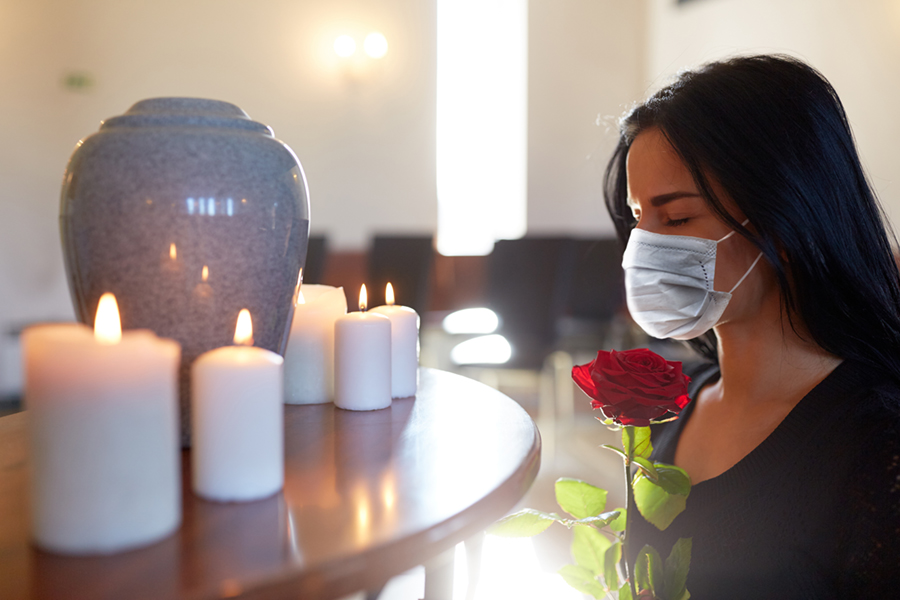
The period of COVID-19 will hopefully be a lesson on the important role funerary and other death rituals have in healing.
Grief and death are fundamental to being human. Based on archaeological evidence, we know our early hominid ancestors were practicing burials for the dead as early as 120,000 years ago. While the details of the rituals surrounding these burials remain unknown to us, the careful placement of the bodies and the inclusion of grave items underscore a communal expression of grief over a member’s passing.
From our earliest ancestors through today, therefore, funerary rituals have remained a central element to our mourning. However, COVID-19 fundamentally disrupted our grief rituals. During the pandemic, our time was measured not just in hours and days, but in the ever-increasing death counts that scrolled across the bottom of news screens. To date, over 7 million people have died from the novel coronavirus. According to a study published in The Lancet, global life expectancy fell by 1.6 years between 2019 and 2020 and remains depressed today. Across the world, funeral homes, cemeteries, and crematoriums became overwhelmed trying to care for the influx of the dead, leading to the widespread deployment of national disaster preparations, including refrigerated trucks for storing bodies, emergency guardsmen, and disaster-relief medical staff.
But this confrontation with death was not the only trauma faced during the pandemic. COVID-19 halted the funerary rituals that have been central to human grief for hundreds of thousands of years—victims to the public health measures many governments put in place to prevent further infection. While our funerary rituals have become more diverse in recent years, gathering together with friends and family to honor and remember the departed remains a central component of virtually all rituals surrounding death. But during the pandemic, in many cases, those grieving their dead loved ones were unable to gather together and mourn. Families and friends of the departed lost the opportunity to collectively express their grief and heal from their loss.
The fundamental need for grief and funerary rituals—and the trauma caused by their absence—transcended religious boundaries. As a scholar of religious rituals surrounding death, I began interviewing Americans during the pandemic about their experiences of grieving. The United States remains one of the most religiously diverse countries in the world, and the people I spoke with reflected that diversity. I interviewed Indian-American Sikhs, Native American Christians, Egyptian and Pakistani-American Muslims, Texan Jews, African-American veterans, Catholic widowers mourning Jewish wives, Chinese immigrant Buddhists, members of The Church of Jesus Christ of Latter-day Saints, Bahá’í community organizers, Episcopal bishops, Chinese-American Evangelicals, Hindu meditation leaders, Parsi Zoroastrian ritual specialists, and a whole host of individuals expressing other religious and ethnic identities. Virtually everyone I spoke with agreed that the experience of funerary rites during the pandemic was unfulfilling. If turning to religious rituals in the face of death transcends religious differences, so too did the experience of unfulfilled grief when those rituals could not be performed.
The COVID-19 period, therefore, served as an important case study in thinking about what makes rituals successful. At a time when those grieving a COVID death felt that the traditional funerary ceremonies from their religious traditions no longer worked, many tried to innovate and create their own rituals. But without the widespread recognition of a larger community and that community’s public acknowledgment of their pain, such rituals often proved ineffective. It was only when such innovation was combined with the support of a larger community that new grieving rituals became effective for combatting grief. In considering this insight, I will highlight the voices from my conversations below to explore the experience of grief during the pandemic. These words from the traumatic COVID-19 period remain powerful beacons of human emotion in a time of crisis.
The Failure of COVID Funerals
Virtually everyone I spoke with described the COVID-period funerary rituals as unfulfilling. Everyone has an idea about how a funeral is going to progress, but when churches and temples were closed during the pandemic and gathering sizes limited to ten or fewer, the bereaved were forced to organize funerals for loved ones that did not resemble the ones they had imagined. A pastor at an American Baptist Church in Houston, Texas explained that many of his parishioners were unsatisfied. “You have this expectation for what a service should be and who should be there because you have been going to funerals your whole life. But the rhythm of grieving was disrupted and so many of the families I worked with felt that. You expect your loved one’s funeral to look a certain way; you expect sympathy and comfort to look a certain way, and it just doesn’t.”
This particular insight was reflected in my interview with Yoon Tae,* a Korean American man who had to organize his father’s funeral after the latter’s death from COVID-19. He described looking out onto the small crowd gathered there and feeling as if he had let his father down: “We had to limit attendance for everyone’s health and safety. When I got up to give the eulogy, it was really heartbreaking. I was able to look out at this small gathering of people and know that it would have been a packed room if it weren’t for COVID. I felt like my father deserved better.” Indeed, for many of those who lost loved ones during COVID-19, this disconnect made the virtual funeral feel unreal. Another bereaved individual explained to me, “I knew my grandmother would pass away sometime, but I always imagined I would be there; I never imagined I would be watching it virtually on Facebook. It felt like a parody of a funeral.”
Beyond the fact that our grieving and gathering looked different, important religious aspects of the rituals were often unable to be performed during the COVID period. Sabila is a Pakistani American woman living in New Jersey. She described how the influx of dead in her area made it impossible to follow the Muslim practice of quick burials: “In the Muslim tradition, we’re supposed to bury our dead right away, but the funeral homes were so crowded in April 2020 that we were told it would be at least two weeks until they could bury my father. For us, this was simply another trauma.” While a cousin was eventually able to find a Muslim organization able to take care of her father’s body, it was almost an hour away and family members were not allowed to attend the burial. Sabila described watching her father’s ceremony virtually on her computer as a “horror for our family” and stated that she might never feel whole again. Sabila’s pain was echoed in my conversation with Julia, a Filipino American Catholic woman mourning the death of her younger brother John:
The worst part of the funeral—I guess there were so many worst parts of it—but the worst part I am thinking of right now is that we can usually stand close by when they lower the casket into the ground. However, because of COVID restrictions, we had to stand more than ten feet away. I just remember my mom crying out “Bye, John! Bye, John!” As they lowered the casket into the ground from so far away. He was developmentally challenged, so we had been next to him for every moment of his life—except this one; it was a crushing blow.
Julia and Sabila’s experiences speak to the ways in which the alienation from traditional religious rituals in a time of crisis further traumatized those grieving a COVID-19 death.
Invented Rituals in a Disinterested Nation
While many individuals were unable to perform fulfilling grieving rituals during the COVID-19 period, the need for such rituals did not go away, nor did human ingenuity. Reflecting this fundamental need for ritual, some people I spoke with tried to invent new grief rituals when they were unable to perform traditional ones. Amanda, an Apache Indian woman who identifies as Christian, lost her mother to COVID-19 in January 2021. She explained that she was prohibited from performing certain important religious rituals expected within Apache culture due to COVID-19 restrictions:
In my Apache Indian culture, you are supposed to mourn by cutting your arms and hair with an ancestral knife. The blood flowing down is meant to symbolize your loss and grief and how important this person was to you. I spoke with my elders and they said I shouldn’t do that unless I was living on the reservation [and surrounded by my larger tribal community], as people might misunderstand it and react to it poorly. What I ended up doing was getting a very large tattoo; if I can’t cut myself, I can at least bleed somewhere else. It stretches across my shoulder. But it doesn’t really feel like enough; it doesn’t atone.
When unable to join with her cultural community, Amanda attempted to create a novel grieving ritual. Despite these efforts, however, this invented ritual proved ineffective in ameliorating her grief.
Amanda’s experience reveals what is lost when those surrounding a loved one do not share or otherwise ignore the grief of the bereaved. It is common to imagine that ritual is used to express an internal feeling and, therefore, inventing a ritual for oneself functions in ways similar to performing a more traditional ritual. However, scholars of ritual like Adam Seligman, Catherine M. Bell, and others highlight ritual as activity, which actually shapes feeling itself through its performance as part of a larger community. One’s invented ritual, therefore, requires the scaffolding of community involvement to nurture feeling and create a community-recognized identity as a mourner.
If one is unable to perform a ritual with wider community support and acknowledgment, one’s grief remains unabated. Reverend Rich Andre, who at the time of our conversation was associate pastor at St. Austin Catholic Church in Austin, Texas, hypothesized that it was a lack of community or national recognition that made rituals—even invented ones—ineffective during the pandemic:
We have not grieved as a nation; we have not acknowledged these deaths. This was made so much worse by the political situation, where there was a real effort to downplay how many people were suffering. It stopped us from having any type of public grieving. There is a really strong denial of what is happening and wanting to deal with it.
Without public recognition of their pain or acknowledgment of invented rituals, the period of COVID-19 left many Americans stuck in a transitional phase of grief—one where they were neither recognized as mourners nor absolved of the responsibility to be one. Human ingenuity could invent meaningful rituals, but these were only successful at ameliorating grief when performed in the context of a larger community.
Innovation in Crisis Supported by Communities
While the examples above demonstrate the difficulty of grieving during COVID-19, when religious traditions innovated with mechanisms to reflect the support of a larger community, fulfilling death rites could be created. In my interview with Venerable Jue Ji, who leads the Fo Guang Shan Xiang Yun Buddhist temple in Austin, Texas, she noted how she and the other nuns who lead the temple had to quickly make dramatic changes at the start of the pandemic:
Before COVID-19, we monastics would go to their house for chanting when a person was near death or right after they passed away. We would chant the Buddhist scriptures and the holy name of the Buddha so that they would get good karma and have a good rebirth. Normally, these moments are very touching, as the whole community can share their condolences. But during COVID, we couldn’t do that when a community member passed away. I told the daughter of one person who died that I would do the chanting for her father via Zoom and give Dharma blessings directly to the dying person. Even though I was not there in person, he was able to put his palms together and receive the blessing at the end, which made his family feel better.
Acknowledging both that rituals must change in the COVID period, but also that creating connection with a larger community was necessary for a successful ritual, Ven. Jue Ji and the Buddhist nuns she leads were able to innovate and create funerary rituals that many in her community found compelling.
Ven. Jue Ji later described that the innovative rituals created for COVID could be used not only to connect the dying to their local Buddhist community but also to reflect transnational Buddhist support. When a loved one would die overseas, Buddhist family members would usually travel home to perform important death rituals; however, the pandemic paused such travel for several years. As a result, individuals had to work closely with Ven. Jue Ji during the COVID pandemic to arrange for such rituals while they remained in America:
The family members of people in our communities who live in Asian countries—Taiwan, Hong Kong, Singapore—many of them passed away from COVID. One gentleman just recently, his father and mother died of COVID in Beijing. He can’t fly back to China, and was just so heartbroken. Even though he wasn’t a close member of our [Buddhist] temple, we were able to do 49 days of chanting service for his parents in Beijing. We believe that no matter where they live in the world, the chanting service and reciting the Buddha’s name will transfer the merit to the deceased.
The experience of Venerable Jue Ji and the Austin Fo Guang Shan Buddhist temple demonstrates that the new funerary rituals created during the pandemic became most effective when they existed in a scaffolding of support from local religious and cultural communities.
Concluding Thoughts
The advent of COVID-19 was not the first time the world faced a deadly pandemic that disrupted our grieving rituals. Scholars like myself have seen comparisons in the 1918–1919 flu epidemic and the early years of the HIV/AIDS crisis, in which the traditional rituals surrounding death were also unable to proceed as anticipated. COVID-19 is just another pandemic in the long line of human struggles, and it will certainly not be the last pandemic we face. But, for many, the inability to perform traditional grieving rituals and the lack of community support in inventing new ones produced trauma that will have lasting effects worldwide. Martha B. Heymann, a certified grief coach and end-of-life doula based in Corpus Christi, Texas, works closely with those dying and their families to arrange a peaceful transition. In her estimation, “I anticipate there’s going to be a lot of trauma coming out of this [COVID] period—just the trauma of rituals and feelings and goodbyes not able to be fulfilled, not able to be spoken.”
The period of COVID-19 will hopefully be a lesson on the important role funerary and other death rituals have in healing—and the trauma that results when they cannot be adequately performed. If being human fundamentally involves the experience of death, grief, and loss, then religious communities have important roles in supporting rituals to address that pain, as well as in creating innovative responses to a novel environment. While such rituals will certainly continue to change and transform, they remain an important reminder of our humanity in the face of death.
* The bereaved are referred to by their first name alone or not specifically named to respect the privacy of their grief.
Natasha L. Mikles is an assistant professor at Texas State University, where she teaches courses in the Religious Studies program on Buddhism, Chinese Religions, and comparative ideas of hell and death. Her most recent book, Shattered Grief: How the Pandemic Transformed the Spirituality of Death in America (Columbia University Press, 2024) examines the diverse ways that COVID-19 changed how Americans approach, understand, and mourn death. Her current research project examines the important role the Tibetan Gesar epic and other popular narratives play in Buddhist doctrinal thinking and identity.