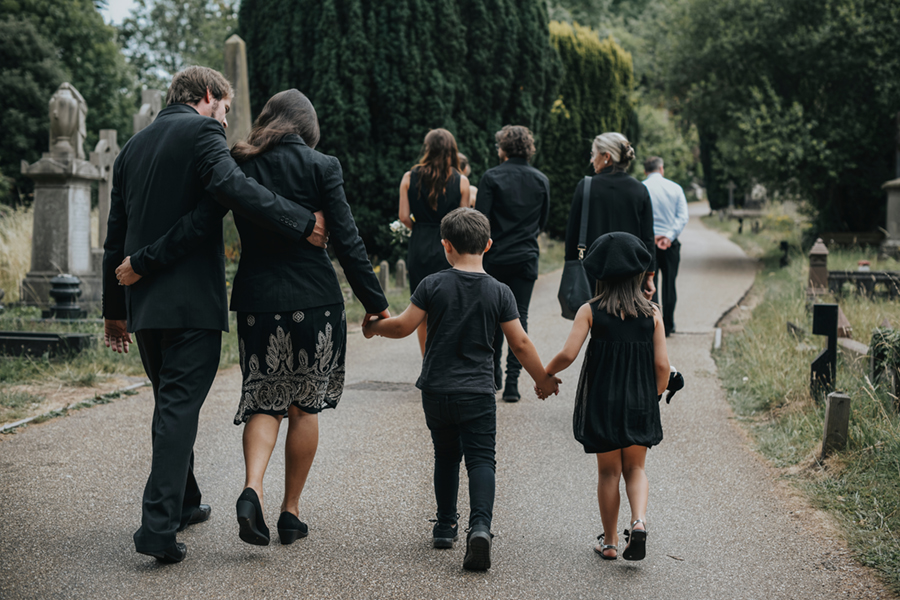
Rituals change at the public and cultural level, just as individual awareness changes over time.
Introduction and Background
The death of the body is a universal fact, but the way it is physically treated carries many forms and interpretations uniting physical and philosophical-religious aspects of our human condition. Worldwide, cremation and burial are the commonest forms of funeral rites, though they are often interpreted in different ways. For many Indian-originating traditions, including Hindu and Buddhist, the life force is widely believed to leave the physical body and undergo a variety of post-death experiences before assuming new bodily forms or ultimately attaining its own freedom and release from worldly constraints. In this, cremation provides an appropriate mode of ritual-symbolism marking the end of one physical existence while leaving open any account of the ultimate destiny of the life force. The Middle Eastern traditions that generated Judaism, Christianity, and Islam, tend to prefer burial, linking it in ritual-symbolic terms with a future, miracle-like, resurrection of a transformed body.
However, ethical issues frequently frame these traditions, as in an ultimate scheme of karma or in divine judgment of the moral life lived on earth. Zoroastrians provide their own ancient tradition pinpointing moral judgment, and so did the ancient Egyptians. In social scientific terms, the facts of life described by anthropology in reciprocity or gift theory stress ideas of mutual obligation that make social-cultural existence possible. This is reflected in religious traditions in which ideas of merit or demerit, flowing from good and bad behavior, influence a person’s status in life and in the afterlife. A few traditions also embrace a less transactional approach to life, merit, and post-mortem identity through ideas of compassion, grace, and love. I detail all these themes in my Christianity-focused Theology of Death (2008) and more comparatively in Death, Ritual, and Belief (2017) which also includes accounts of local traditions dealing with spirits and the ancestors. From these familiar accounts of formal funeral and memorial rituals, I will now sketch a variety of factors complementing and extending them. This includes both imaginative and economic resources, dreams and family resemblances between the living and the dead, bonding with “ancestral” traditions, digital innovations affecting death, and the nature of human personhood.
Imagination, Money, and Memory
It is easy to highlight this imaginative creativity when we think of the beliefs and philosophical schemes developed by the great religious traditions of the world to frame the identity and destiny of the dead while also creating an account of the meaning of life for the living. Rooted in our human capacity for survival and its associated emotion of hope, imagination constitutes both its own internal resource for life and external, communal, accounts of existence. Cultural narratives exist as dynamic sources available for adoption by individuals as they develop their own view of the world. Such narratives come to life through rituals, ceremonies, festivals, myths, doctrines, and ethical codes, but the degree to which their values are embodied varies according to personal circumstances, temperament, and the availability of physical and economic resources.
Scholarly links with the dead
In many cultures, religious elites and ritual specialists manage the ways in which people relate to their dead, with monks and priests funded, thus allowing time to study, meditate, and engage in practices not easily available to the laity. Money influences both the religious life and the relationship between the living and the dead. Literacy, scholarship, and extensive interpretations of texts link devotees with their intellectual, philosophical, and religious founders and reformers. In Christianity, for example, early Christian leaders and saints are venerated by Orthodox and Catholic traditions and are often associated with prayers for the dead and their well-being in the afterlife. Apart from customary funerals, many Protestants largely oppose ritual relationships with “the dead,” but still focus on historical leaders such as Luther and Calvin and their theological interpretations of doctrine. Such “schools” partly resemble what happens in “secular” traditions of literature, philosophy, and science. Our relationship with the dead reveals just such a variety of interactions with past leaders, teachings, and customs, whether for Buddhists and Hindus or Jews, Christians, and Muslims. In most religious traditions the rich financially resource impressive tombs and funeral sites, with ritual leaders also praying for the dead to assist their spiritual progress in their afterlife. The poor and socially insignificant frequently pass unmarked upon.
Cultural and personal alignments with the dead
Despite enormous cultural changes over the millennia, kinship and the bonding of family members remains significant. Some theories of grief focus on both attachment and loss, and in recent decades also on the maintenance of “continuing bonds” between the living and the dead reflect these relationships. Practically speaking, most societies have long understood links with ancestors through family or community shrines and festive memorial days, whether in the well-known Mexican Day of the Dead and its folk-Catholic Christianity or in local Buddhist traditions of Nepal, with rites inviting the departed to return to the earth and receive veneration and be asked for gifts. Ancestral lineages often serve to legitimize political and economic authority and inheritance, as in coronation rites. In the UK, for example, the tombs of dead monarchs often lie alongside their living descendants, as at St George’s Chapel, Windsor. Similarly, links with key cultural, scientific, and military figures play a large part in the architecture of Westminster Abbey and St Paul’s Cathedral in London, visited by millions of tourists each year. However, if wealth or family size decreases, burial sites become expensive and tombs become impossible to sustain, as in parts of contemporary Japan, where cremation and new forms of caring for the dead may be undertaken by specialist Buddhist monks and monasteries. Political attitudes also influence funeral practice as when the new People’s Republic of China encouraged cremation as a practice involving less financial expenditure on funerals.
Rituals of Transformation
Anthropologists and sociologists have documented relationships between the living and the dead through ritual practices that transform the status of the dead. The early twentieth-century French anthropologist Robert Hertz created his theory of “double burial,” while the Dutch scholar Arnold van Gennep’s theory of rites of passage provided its own grammar of discourse on status change. Hertz pinpointed societies where a dead body was quickly buried and, only after its flesh had decayed during what he called the “wet” stage, could the bones—now in a dry stage—be taken and be ritually turned into the ancestors (Douglas Davies, Death, Ritual and Belief [London, New York: Bloomsbury, 2017]). This wet-dry transformation of body into bones was something I used to analyze for funerals in the UK, where cremation rapidly turned the “wet” body into the “dry” cremated remains that provide an opportunity for the living to relate to their dead in new ways. Sometimes people place cremated remains in locations of deep personal significance between themselves and the dead, some keeping them at home. The major Christian traditions of Protestants and Catholics that had practiced burial for more than a thousand years only slowly came to accept cremation, but still objected to not burying cremated remains or including ashes in jewelry or even in ink used for tattoos on a relative’s body. Such behaviors raise the question of personal identity and links with the dead. Today’s environmental and ecological concerns raise new issues of, for example, dissolving the dead in alkaline hydrolysis, a practice already in use in parts of the US, and soon to emerge in western Europe, too. Recent years witnessed the famous Anglican Archbishop Desmond Tutu having such a funeral.
Personhood—Simple and Complicated
As for issues of identity, cognitive science and theories of embodiment now demonstrate the human brain’s relationship with the entire body, while social science speaks of extended relations of that brain-body unity with others in society. Our personal-private thoughts not only extend “outwards” to our relationship with parents, siblings, partners, offspring, and our dead, but also “inwards” to our deeply personal emotions and memory. And this is where death rites become significant. Van Gennep, for example, spoke sociologically of a threefold scheme of rites of passage involving separation from one’s social status as a living person, an interim period or liminal phase as a corpse, to a final status as, say, an ancestor. In that he closely resembled Hertz’s approach mentioned above, which also recognized that funeral processes allow for emotional changes in the bereaved. Through ritual and the passage of time, people change in their own relationship with their dead. Temple and household shrines, as well as photographs, link the living and the dead and in some psychological sense continue to influence the living as, for example, in dreams and sometimes in aspects of physical appearance and behavior reminding us of our dead. I want to approach this question in a very particular way that some may find helpful, but others will find difficult because much depends on what we think a “person” is.
Dividuality, Not Individuality
The basis of my argument involves a disagreement with the widely shared Western attitude to the “self” as a relatively isolated individual living amongst other similar individuals, all serving the purpose of capitalist and neoliberal societies where market forces exploit the individual as a consumer of goods. This perspective influences many parts of the world. It easily isolates people, fosters a sense of loneliness, and echoes postmodern approaches to life that tend to work against widely shared narratives of community meaning. Links with the dead, by contrast, foster a narrative sense of shared identity. Accordingly, my disagreement emerges from the anthropological idea of dividual or complex personhood that stresses the bonds between people and the way in which each of us is made up of the many relationships in and through which we live. Dividual personhood provides a firm theoretical approach to the “continuing bonds” theories of grief that otherwise lack a theoretical foundation (Douglas Davies, “Dividual identity in grief theories, palliative and bereavement care,” Palliative Care and Social Practice, 2020. Vol. 14: 1–12, doi 10.1177/2632352420921867). Dividuality also fosters a fruitful approach to dreams and moments of “resemblance.”
Dreams, narrative, memory, and digital death
When, for example, I dream about my dead mother or father, what is happening? In the history of religions, some would speak of the dead coming to visit the living, but I want to think more in terms of their presence as an ongoing constituent part of my own personhood. My prior life experience of and with those parents has generated an internal resource of images and emotional tones, providing part of the symbolic knowledge embedded in my own sense of personhood, they are part of my “memory.”
My memory is itself a most dynamic and complex phenomenon that can, for example, be thought of as a form of narrative created as a dynamic foundation of and for my life, and for my engaging with the dead. The narrative nature of human beings is profoundly important in general (Angus Fletcher, Wonderworks: Literary Invention and the Science of Stories [Swift Press, 2021]) and especially in relation to the dead. Funeral rites serve to relocate the dead in the ongoing story of a group and mark their movement to formal ancestral settings. The dramatic rise of photography, visual and audio recordings all create new forms of “memory,” and it’s already the case that artificial intelligence is providing avatar representations of the dead who can be made to “appear” as living agents capable of limited forms of conversation with the living. Digital ancestors can now enliven narratives of relationship, as increasing studies of Digital Death make clear (D. R. Christensen and J. Sumiala, “Digital Death: Transforming Rituals, History and the Afterlife,” Social Sciences 13, No. 7:346, 2024, https://doi.org/10.2290
/socsci13070346). In my contribution to Christensen and Sumiala’s edited collection of research drawn from our shared Digital Death Project (Douglas Davies, “Afterword: Play, Personhood, and Digital Mortality”), I pinpointed the case of the deceased teenager Carlo Acutis who is on the path to becoming a “Saint of the Internet” in the Catholic Church. His curated body, visible in constant live streaming from a church in Assisi, offers an excellent example of traditional Catholic piety focused on the embodiment of holy people, and of the contemporary use of the internet in linking the living and the dead.
Here, perhaps, digital capabilities resemble dreams, albeit with a greater degree of conscious motivation. Still, the “unconscious” triggering of dreams that our brains produce of their own accord, free from any digital preparation, can assist the living. Research indicates that—especially in moments of pressure, crisis, or even joy—some who approach their death speak of ancestors or other figures coming to visit them to offer comfort and hope (Allan Kellehear, Visitors at the End of Life [New York: Columbia University Press, 2020]). Dreams form one relationship with the dead, even though many modern societies do not know what to do with such experiences and marginalize them, perhaps because of an excess of individualism that alienates the mutual mental presence of our kin.
And what of family resemblances? It is interesting that the very phrase “family resemblance” has been used by some philosophers to speak of the similarity between ideas, and it is a well-known idea in ordinary life when a child is said to resemble his or her kin. But resemblance has also been pointed out as something that you and I may experience when we see in ourselves something that reminds us of our dead parents. We develop a certain aspect of appearance or of saying certain things that immediately link us with them.
One interesting aspect of resemblance developed in Tibetan Buddhist culture concerns the re-birth of a dead Lama, notably the Dalai Lama, under the nature of a compassionate consciousness. On a broader scale, perhaps, there are many who sense a relationship with a former teacher and know how shared ideas, teachings, and practices live on in their own life. I discussed this in “Mourning Academic Mentors and Mentees” in The Meaning of Mourning: Perspectives on Death, Loss, and Grief (Mikolaj Slawkowski-Rode, ed. [Lanham, Boulder, New York, London: Lexington Books, 2020], pp. 149–170). It was remarkable to find that the present Dalai Lama had read this book and expressed its value to the publishers, speaking of the death of one who had cared for him since childhood and at whose death, he said, “I felt I’d lost the rock I’d been leaning on. Then it occurred to me that instead of spending time in sadness it would be better trying to fulfil his wishes with enthusiasm and determination” (December 16, 2022. Personal communication from the editor).
Conclusion
That is a good point to conclude this effort to expand our approach through ideas of personhood and identity in some unfamiliar ways. Rituals change at the public and cultural level, just as individual awareness changes over time. In the above, I have been aware of my lack of expert knowledge on the complexity of Buddhist approaches to personhood, consciousness, and ritual practice, but I hope that at least some of my reflections may prove of shared interest.
Acknowledgements
The author acknowledges the funding of The Digital Death Project (Dide) by the European CHANSE scheme of Collaboration of Humanities and Social Sciences in Europe.
Douglas James Davies, FBA, FAcSS, FLSW, is a Welsh Anglican theologian, anthropologist, religious leader, and academic, specializing in the history, theology, and sociology of death. He is Professor in the Study of Religion at the University of Durham. His fields of expertise also include anthropology, the study of religion, the rituals and beliefs surrounding funerary rites and cremation around the globe, Mormonism, and Mormon studies. His research interests cover identity and belief, and Anglican leadership.