
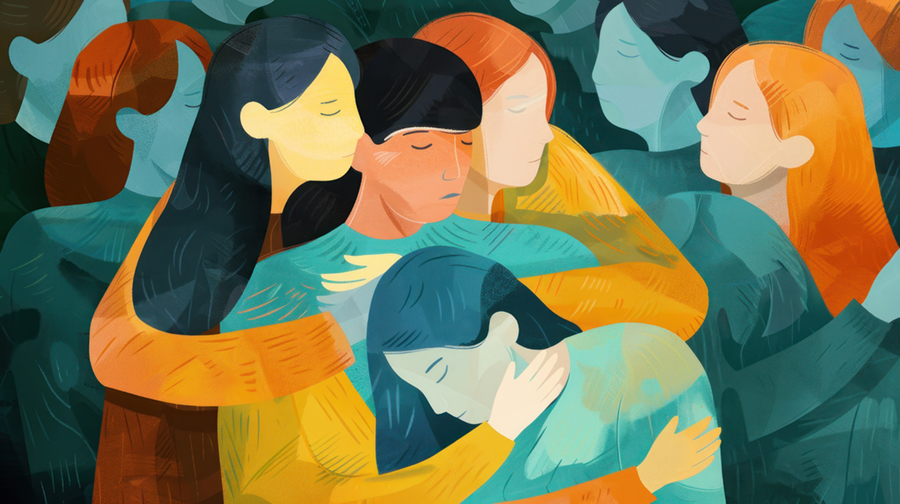
In the face of modernity, some people still hold onto tradition, and may not change their grief rituals because tradition influences how they perceive themselves.
Rituals are pre-determined acts that are repetitive and formal. They may be verbal or non-verbal with little room for dilution or substitution. For example, as rituals, the prayers offered before a meal cannot be substituted with the prayers said after a meal. However, in exercise of agency, humans can make changes to rituals to suit their purpose (Moran 2017).
Rituals have meaning to the people performing them, and the meaning may be personal or a reflection of a group to which the individual belongs (e.g., a culture, a family, or a religion). Without meaning, a ritual becomes a random act. For example, in African culture during a ceremony, to spill a drink on the floor before guests take a sip is to seek the blessings of ancestors. However, in another culture, without this belief system, this act becomes a random behavior and a waste of resources.
Researchers believe that humans are averse to situations that lack structure. Therefore, people are likely to impose meaning to a situation that makes no sense to them. To many individuals, death defies structure and poses a challenge to their comprehension. Death creates anxiety that requires that people be reassured (Neimeyer and Harris 2023). When a death occurs, rituals help to impose a structure in the following ways: a) to ease the transition from living to the afterlife; and b) to cope with the grief that accompanies this transition. A study from which bereaved individuals were asked to reflect on past rituals or were assigned new rituals reported a reduction in the grief experience of the participants. Also, these bereaved individuals experienced a sense of control over their loss (Norton and Gino 2014). Other studies with bereaved Catholics who attended church regularly and recited the rosary reported a faster recovery process from grief when compared to those who did not (Ahler and Tamney 1964). Also, through rituals, Turkish women were able to gain control over their loss (Aksor-Efe, Erdur-Baker, and Servaty-Seib 2018). Taiwan is a society where the word “death” is taboo. Yet, through rituals as well, Taiwanese women were able to gain control over the loss of their stillborn babies. Additionally, they were able to mention the word “death” and avoid parental guilt (Tseng, Hsu, Hsieh, and Cheng 2018).
As mentioned earlier, rituals could be acquired from being a member of a family or a culture. Rituals are effectively acquired through observational learning (e.g., Rogoff, Moore, Najafi, and Dexter 2007). In observing (or modeling) significant individuals like parents, children are able to develop a sense of identity within their family or culture (e.g., Miller and Goodnow 1995). However, observational learning (or modeling) would require attention; storage and recall of information; and the motivation to put into action and replicate that which has been observed. So, this may not apply to everyone.
Grief Rituals as Verbal or Non-Verbal Acts
Around the world, grief rituals can be verbal or non-verbal acts. To researcher Alfred Radcliffe-Brown, rituals have either expressive or symbolic elements to them (Radcliffe-Brown 2014). Grief rituals include taking care of the remains of the deceased and helping the decedent with the transition to an afterlife. These grief rituals would vary from culture to culture, by the age of the deceased, or based on the decedent loved ones’ resources (Reeves 2011).
In African-American culture, the deceased is ushered into another life through chanting, singing, and praying (Baloyi 2014). In Jamaican culture, the emotional expression of grief includes dizziness, fainting, and wailing to demonstrate one’s closeness to the deceased (McIlwain 2001). In Nigeria, the Yoruba men use drumming in grief rituals. The drum rhythms for washing the body are different from those for lowering the body into the grave (Lund 2017). Drumming is a non-verbal act and replaces verbal expression in a culture in which grief by men, unlike women, is limited in the use of words. Haitians believe that the decedent’s spirit does not depart the world of the living to its final resting place until the ninth night. Thus, leading up to the ninth day, prayers are said each day.
Grief rituals are also influenced by religious beliefs. Latinos are predominantly Catholic, and during funerals, the rosary is recited by family and friends. After funerals, the rosary is also recited for the forgiveness of the decedent’s sins, each day for nine days (Diaz-Cabello 2004).
Grief rituals should be appropriately done. Across cultures, many people believe that in the afterlife the deceased has supernatural powers that could cause harm to the living, if displeased (e.g., Spellman 2014).
Grief Rituals Are Based on the Decedent’s Age
In most cultures, grief rituals for young children are different from those of older persons. Culturally and biologically, children are considered relatively too young to die and their death is viewed as an “off-time” loss. Also, children are perceived as innocent. Puerto Ricans, for example, dress their deceased children in white, which signifies the children’s innocence and purity. Also, deceased children’s faces are painted like angels (Parkes, Luangani, and Young 2015). Latinos believe that the nine-day prayers for the forgiveness of sin for adults should not extend to children because of their innocence (Brooten, Youngblut, Charles, et al. 2016). Furthermore, the deceased adult’s age, whether young-old or old-old, would determine the type of ritual that is appropriate. For example, Chinese mourners wear white or black and red outfits as a sign of happiness in the funeral of a deceased person who has lived a long life, and whose death is regarded as an “on-time” loss.
Generally, grief rituals do reflect a perceived understanding of an afterlife, based on the construction of the world of the living. Thus, the deceased in the afterlife continues on in their worldly roles and activities. In the world of the living, adult roles and activities are different from those of children. Unlike children, adults engage in work roles and in marital/long-term relationships. In the burial of a deceased adult, therefore, traditional Estonians include in the casket work tools such as knives, needles, whetstones, and fire steels (Heapost 2007). In Italy’s Cemetery of the Babies (or La Necropoli dei Bambini), reports suggest that children are buried with play items and pet animals.
Grief Rituals Are Influenced by Beliefs about the Location and Abilities of the Deceased in the Afterlife
From conducting a focus group study of bereaved persons from different cultures, researcher Sandra Lobar and colleagues (Lobar, Youngblut, and Brooten 2006) note that grief rituals are influenced by beliefs about what becomes of the deceased in the afterlife. Around the world, generally people have afterlife beliefs about the decedent, based on religious teachings or traditionally held understandings about the afterlife. These beliefs include the perceived location of the deceased and the perceived abilities of the deceased in the afterlife.
Grief rituals are based on perceived location of the deceased in the afterlife
For example, Christians believe that in the afterlife the deceased is located either in heaven or in hell. Based on this belief, a grief ritual would include the participation of a Christian clergy to affirm the departed person’s new location (usually heaven). The grief ritual might include readings from John 14:2–3 in the Bible, in which Jesus makes the promise to his followers that heaven will be their dwelling place after death. Muslims also believe in a heavenly place called “paradise,” and this would be reflected in the eulogy for the deceased. Buddhism believes in rebirth, as does Hinduism, and grief rituals would reflect this as well. African traditional religion believes that departed ancestors are domiciled in the earth. This is reflected in prayers and libations poured to the ground in reverence to departed ancestors during special occasions.
Grief rituals are based on beliefs about the abilities of the deceased in the afterlife
After death, the deceased is believed to take on a spirit persona. Spirits are believed to have supernatural powers that humans cannot wield in bodily form because they are unseen, ubiquitous, and not limited in time and space. Spirits are also believed to dwell in non-humans, such as animals and trees. When visiting the world of the living, spirits can take on the form of a bird or a butterfly (e.g., Loorits 1949). Spirits are believed to inhabit inanimate objects such as mirrors as well. After a death, in several cultures, mirrors are covered because the dead person’s spirit is believed to inhabit a mirror, and seeing yourself in a mirror could make you join the deceased in death.
The supernatural powers of spirits are believed to be used for good or for bad. Therefore, the general human response to the perceived supernatural powers of deceased spirits is either avoidance or embracement/consultation.
Avoidance grief rituals
These would include acts that discourage interactions with the spirit of the deceased. These acts are meant to send a message that the spirit of the deceased is unwelcome in the world of the living. For example, the following avoidance grief rituals are practiced by traditional Estonians: place the soap/bath whisk used to wash the decedent’s body in the coffin; pour water that is used to wash the decedent’s body at a place nobody goes; fumigate the room where the dead body was kept; and avoid saying the name of the deceased during the mourning period (Heapost 2007).
Embracement/consultation grief rituals
These are the opposite of avoidance grief rituals. Here, the spirit of the deceased is welcomed to the world of the living. This spirit is believed to be the guide and protector of the living (Simpson 1980). For example, within three days following a funeral, the Chinese expect the spirit of their deceased loved one to visit them.
Embracement rituals include consultation with the spirit of the deceased. For example, the Bible in 1 Samuel 28:3–25 states that Saul, the first king of Israel, was concerned about the war he was going to wage with the Philistines. So he approached a female sorcerer known as the Witch of Endor, who then conjured up the spirit of the dead prophet Samuel to find out about the outcome of the war. The spirit of Samuel, which Saul himself identified, stated that the Philistines would defeat the Israeli army and that Saul and his three sons would be killed in the war.
Consultation with the spirit of the deceased occurs in contemporary times as well. In the United States, Denise Richards, an American actress and television personality, sought the help of a median to connect her to the spirit of her deceased mother. Also, Brett Eldridge, an American country music singer, asked a medium to connect him to the spirit of his deceased grandfather. George Clooney, another American celebrity, requested a medium to connect him with the spirit of a departed friend. From a survey of 18,607 people drawn from the United States and thirteen European countries, 25% of the participants reported having sought an encounter with the spirit of the dead (Haraldsson and Houtkooper 1991).
Grief rituals can be proactive or retroactive
Grief rituals can be done proactively, to precede an imminent death. For example, among Catholics, in preparation for heaven, the last rites are administered to a dying person. Also, Chinese Buddhists believe that a dying person’s final thoughts are important. Thus, the recitation of a Sutra (statement of beliefs) helps the dying person to stay focused on the prospects of a good rebirth. Hindus believe that it is important to face death with a clear mind. Therefore, mind-altering medications such as narcotics are discouraged, as these could adversely influence the rebirth process (Sharma et al. 2013). Hinduism also stresses the importance of completing unfinished businesses prior to death in order to improve a dying person’s chances for a good rebirth. Unfinished business includes doing good deeds, offering apology, reconciling differences with others, and distributing belongings to heirs and charities (e.g., Firth 2005).
Alternatively, rituals can be done retroactively, if not performed at the appropriate time. Researcher Shirley Firth (2005) narrates a situation that involved a Hindu family that could not administer the last rites to their loved one before doctors switched off her life-support machine. Generations later, this Hindu family performed those rites to seek penance, before engaging in any social activities such as family weddings. According to researchers Shen Qin and Yan Xia (2015), Chinese practitioners of Taoism believe that in order to experience peace and balance, the ritual of voicing appreciation to or righting wrongs with the deceased is never too late.
Grief Rituals Are Reflected in Body-Disposal Methods
As stated above, rituals as verbal or non-verbal acts have meaning. There are verbal or non-verbal meanings attached to various body-disposal methods. Cremation is a common practice among people who believe in rebirth. As a body disposal method, therefore, cremation hastens the release of the spirit of the deceased for rebirth. On the contrary, whole-body burial is common among Christian believers of bodily resurrection. Also, donation of organs or the entire body to science is common among people who see themselves as continuing their lives through others.
Grief Rituals: Tradition versus Modernity
Due to several factors, a society would experience changes over time. These factors, among others, are socio-economic and shift with generational values. As a society experiences changes, so do grief rituals. In the United States, for example, due in part to economic factors, cremation is becoming a popular means of body disposal (National Cremation 2015). In 2020, the cost of cremation was between $800 and $3,000 (depending on the area). This amount was about one-third or less the cost of whole-body burial, at $9,135. By 2040, in the United States, cremation is projected to account for 78.7% of all bodily disposal methods (https://www.nfda.org/news/statistics).
However, apart from economic factors, there are other reasons that account for this increased interest in cremation. For example, green cremation (also known as bio-cremation or water cremation) is the choice of people who care about the environment. And these are mostly the younger generation. Here, the corpse is placed in a water solution of potassium hydroxide, which reduces the body to the bones; and the bones are then pulverized into ashes and given to the family.
In the face of modernity, however, some people still hold onto tradition, and these individuals may not change their grief rituals because tradition influences how they perceive themselves. To embrace modernity for them is to lose a sense of who they are. Again, grief rituals are meant to serve two purposes: a) to aid with the transition from living to the afterlife and b) to help survivors cope with the grief that accompanies this transition. Whereas a change in grief rituals to align with modernity may help the bereaved to cope with their grief, this may not work well for the deceased with the transition to the afterlife. For example, would cremation (influenced by modern values) help the deceased with a transition to the afterlife, if the decedent’s preference is for whole-body burial? Would it be better to please the bereaved or the deceased who in spirit form is able to engage the world of the living with supernatural powers—a belief held by many? This author provides a new perspective on this issue and more in his books: Eyetsemitan, F. (2022), The Deceased-focused approach to grief: An alternative model, Springer Nature Switzerland; and Eyetsemitan, F. (2023), Verstorbenen-fokussierte Trauerbewältigung: Ein alternativer Ansatz (German Edition), Springer Nature Switzerland.
References
Ahler, J. G., Tamney, J. B. 1964. “Some Functions of Religious Ritual in a Catastrophe.” Sociological Analysis, 25(4), 212–230.
Aksoz-Efe, I., Erdur-Baker, O., and Servaty-Seib, H. 2018. “Death rituals, religious beliefs, and grief of Turkish women.” Death Studies, 42(9), 579–592.
Baloyi, M. E. 2014. “Distance no impediment for funerals: Death as a uniting ritual for African people—A pastoral study.” Verbum et Ecclesia, 35(1), 1–7.
Brooten, D., Youngblut, J. M., Charles, D., Roche, R., Hidalgo, I., and Malkawi, F. 2016. “Death Rituals Reported by White, Black, and Hispanic Parents Following the ICU Death of an Infant or Child.” Journal of Pediatric Nursing, 31(2), 132–140.
Diaz-Cabello, N. 2004. “The Hispanic Way of Dying: Three Families, Three Perspectives, Three Cultures.” Illness, Crisis & Loss, 12(3), 239–255.
Firth, S. 2005. “End-of-life: A Hindu view.” The Lancet, 366(9486), 682–686.
Haraldsson, E., Houtkooper, J.M. 1991: “Psychic experiences in the multinational human values study: Who reports them?” Journal of the American Society for Psychical Research, 85 (2), 145–165.
Heapost L. 2007. “The cemetery of Siksälä: osteological and paleodemographical analysis. In S. Laul and H. Valk (eds.) A community at the frontiers. Iron Age and Medieval.” Tallinn–Tartu: University of Tartu, 213–236.
Lipner, J. 2012. Hindus: Their Religious Beliefs and Practices. Routledge.
Lobar, S. L., Youngblut, J. M., and Brooten, D. 2006. “Cross-cultural beliefs, ceremonies, and rituals surrounding death of a loved one.” Pediatric Nursing, 32(1), 44–50.
Loorits, O. 1949. Grundz¸ge des estnischen Volksglaubens, 1. (Skrifter utgivna av Kungl. Gustav Adolfs akademien för folklivsforskning, 18: 1.) Lundequist.
Lund, D. 2017. Death and Bereavement Around the World, Volume 5: Reflective Essays. Routledge.
McIlwain, C. D. 2001. “Death in black and white: A study of family differences in the performance of death rituals.” Communication Quarterly, 49(3), Q1.
Miller, P. J., Goodnow, J. J. 1995. “Cultural practices: Toward an integration of culture and development.” In J. J. Goodnow, P. J. Miller, & F. Kessel (Eds.), Cultural practices as contexts for development (pp. 5–16). Jossey-Bass/Wiley.
Moran, M. H. 2017. “Missing Bodies and Secret Funerals: The Production of “Safe and Dignified Burials” in the Liberian Ebola Crisis.” Anthropological Quarterly, 399–421.
National Cremation. 2015. “Why is cremation becoming more popular in the US?” Retrieved from https://www.nationalcremation.com/cremation-information/why-is-cremation-becoming-more-popular-in-the-us, April 25, 2024.
Neimeyer, R.A., Harris, D.L. 2023. “Bereavement and Grief.” In: Friedman, H.S., Markey, C.H. (Eds.), Encyclopedia of Mental Health, vol. 1. Elsevier, Academic Press, 204–211.
Norton, M. I., Gino, F. 2014. “Rituals Alleviate Grieving for Loved Ones, Lovers, and Lotteries.” Journal of Experimental Psychology: General, 143(1), 266.
Parkes, C. M., Laungani, P., and Young, W. 2015. Death and Bereavement Across Cultures. Routledge.
Qin, S., Xia, Y. 2015. “Grieving rituals and beliefs of Chinese families.” The World of Bereavement: Cultural Perspectives on Death in Families, 69–80.
Radcliffe-Brown, A. R. 2014. Taboo. Cambridge University Press.
Reeves, N. C. 2011. “Death acceptance through ritual.” Death Studies, 35(5), 408–419.
Rogoff, B., Moore, L., Najafi, B., Dexter, A., Correa-Chávez, M., and Solís, J. 2007. “Children’s Development of Cultural Repertoires through Participation in Everyday Routines and Practices.” In J. E. Grusec & P. D. Hastings (Eds.), Handbook of Socialization: Theory and Research (pp. 490–515). The Guilford Press.
Sharma, H., Jagdish, V., Anusha, P., and Bharti, S. 2013. “End-of-life care: Indian perspective.” Indian Journal of Psychiatry, 55 (Suppl 2), S293.
Simpson, G. E. 1980. “Ideas about Ultimate Reality and Meaning in Haitian Vodun.” Ultimate Reality and Meaning, 3(3), 187–199.
Spellman, W. M. 2014. A Brief History of Death. Reaktion Books.
Tseng, Y., Hsu, M., Hsieh, Y., and Cheng, H. 2018. “The meaning of rituals after a stillbirth: A qualitative study of mothers with a stillborn baby.” Journal of Clinical Nursing, 27(5–6), 11.
Frank Eyetsemitan is a Professor of Psychology at Roger Williams University in Bristol, Rhode Island, USA, where he previously held the position of Associate Dean of the Social Sciences Division, College of Arts and Sciences. Dr. Eyetsemitan is also a Faculty Associate at the University of Maine Center on Aging and a Trustee at the Providence Public Library. His recent books include The Deceased-Focused Approach to Grief: An Alternative Model (with a German edition); Death, Dying, and Bereavement Around the World; and Understanding Death and Dying: Encountering Death, Dying and the Afterlife.