
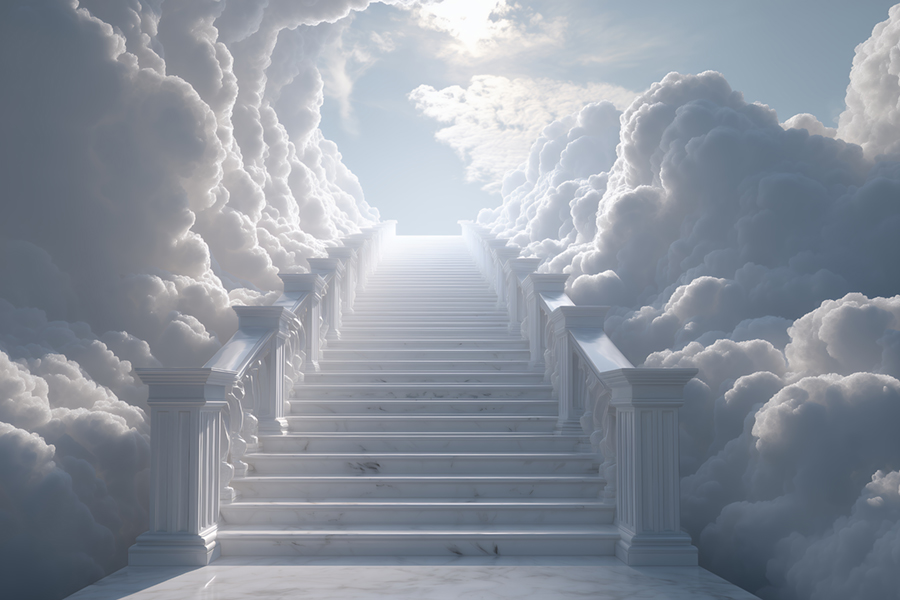
We in the present do not necessarily know better than people in the past; we may be afflicted by our own illusions and limitations that blind us.
Three hundred years ago, most people in the world had a solid sense of what would happen to them when they died. If they were Christian or Muslim, they believed that heaven or hell awaited them. If they were Hindu or Buddhist, they believed that they would be reincarnated into their next life. Not everyone believed these things, of course, but most people did: the religion to which they belonged gave them a doctrine of what their lives meant beyond this world, and most people followed these doctrines without much question.
Today, however, in a range of societies from the United States to Western Europe to Japan to China, many people have turned away from the established religious teachings of their forebears. Twenty percent of American baby boomers believe in reincarnation, one survey found; and there are now more Chinese Christians than Communist Party members, scholars of Chinese religion maintain. Increasingly, the sense of life after death has become individualized, with some people believing deeply in heaven or in reincarnation, others believing deeply that there is nothing at all after we die—that we die and only vanish—and still others professing that they simply do not know. Beliefs around what happens after we die have become private: friends might not know what one another thinks will happen, and even husbands and wives may hardly ever discuss this. Today, for many people in Europe, the United States, China, and Japan, what happens after you die is socially not very important—not worth arguing about with your friends or family. This isn’t always true—families with members having mixed religious beliefs may indeed argue—but by and large it is indeed true.
Why has this happened? Partly this is due to the advance of science, making religious scriptures from thousands of years ago seem less than believable to many today. More than that, though, it is because of the growth of relativism. Unlike past eras, each of us are likely to know people of various beliefs, from Christians to Buddhists to Muslims to agnostics to atheists. This diversity in different conceptions of life after death makes many of us wonder, “Who knows what happens after we die?” and makes our decision about what to believe a matter of personal choice rather than ultimate conviction: we have no basis for knowing what might be true. Today, one person believes in reincarnation while another believes in heaven and another in nothingness—just as one person likes café latte, another mint tea, and another craft beer. It can be seen as simply one more personal consumer preference.
What I have just described is what I have broadly found in my 2023 book Life After Death Today in the United States, Japan, and China, written with Yang Yang and Miu Ying Kwong, based on some 400 interviews with people from all walks of life, conducted over five years in these three societies. Of course, each of these societies has its own particular ways of thinking about life after death. In the United States, Christianity has lost considerable credibility over the past few years, with many people leaving the religion, but the idea of God in heaven still maintains a powerful hold. In American popular literature, bestselling books argue over whether the Christian message is true or whether God is simply a delusion. Many individual Americans have left Christian churches, which they see as overly politicized, but continue to believe in their own personal conception of God and the afterlife. Other have turned to Buddhist beliefs or New Age thought, adhering to reincarnation or belief in a collective consciousness that survives death. Many others—almost a quarter of Americans, statistics broadly show—believe in nothing at all after death, assuming that they will simply die and vanish. But even among the agnostics and atheists we interviewed, there was concern over how the United States could flourish without a common moral message uniting its citizens. As one non-believing man said, “If there’s no common sense of life after death, you do wonder what social glue will hold increasingly diverse people together. What do you need for diverse people to live together in peace?”
In Japan, there are many popular books on life after death, but unlike in the United States, these books generally don’t preach a single answer. Rather, they ask, “shindara do naru?” (What happens after we die?), offering an array of possible fates for readers to choose from. The Japanese institutional equivalent of Christianity has been ancestor veneration, but it has been changing greatly in Japan. In earlier eras, ancestor veneration was based on the family line, with each household having its family altar and lineage traced through the male heir. This has been giving way, as Japanese families have fewer children. Instead, ancestor veneration has for many become a matter of personal mourning for one’s lost loved ones. As one woman said, “My husband has been dead for twenty years, but I continue talking with him [at the family altar] and asking him for help. . . . It’s not just that I want to meet my husband when I die. I will meet him, I’m sure.” Many Japanese do not hold a similar belief, feeling instead that when they talk to their ancestors at the family altar or grave, their ancestors cannot really hear them. Statistics show that some 50% of Japanese believe that after death, there is nothing—only other people’s memories of the deceased. All in all, if in the U.S. a sense of life after death is thought to provide collective moral guidance for life, in Japan, this is not seen as necessary; instead, life after death is thought of as a sort of moral escape. The Japanese we interviewed saw the world in the next life as a place open to their imagination—“Maybe I’ll become a butterfly! That would be really wonderful!”—unlike the Japanese world in this life, with its unrelenting social pressure.
In both the United States and Japan, there has been a broad trend of people turning away from belief in life after death. In China, however, people have been turning toward belief in life after death. The Chinese Communist Party, in Chinese schools since 1949, has resolutely taught that belief in life after death is superstition, and atheism is the only correct belief. In recent decades, however, the Party has grown somewhat more tolerant of religion, and more and more Chinese have been moving away from Communist orthodoxy to instead embrace an array of faiths, from Buddhism to Christianity to Baha’i, believing in reincarnation or heaven as their ultimate fate. We found from our interviews that even some Communist Party members believe in life after death; they cannot publicly say so, given their positions, but they do indeed privately hold that belief. In one woman’s words, “Communist Party members are not allowed to be religious [but] we are allowed to follow the rituals when visiting a temple. . . . I pray there just like everybody else,” without telling her Party colleagues what she really believes. The large majority of Chinese continue to believe that there is no life after death, but the numbers of those who do believe are growing. Many Chinese have found that government-taught atheism is insufficient as a basis on which to understand their lives and coming death; this is what we discovered in our research. They may feel a sense of moral loss: even though China has become affluent, they feel that the Communist Party has lost its ethical basis, and so turn to religious faith and belief in life after death for a sense of life’s ultimate meaning.
Despite this return among many Chinese to a belief in life after death, in a broader sense there is a shift around the world toward non-belief in life after death, as I earlier noted. Three hundred years ago, very few people believed there was no life after death. Today, some 20–30% of people on Earth believe that there is no life after death, mostly within the more affluent countries in the world. A hundred years from now, as medical life extension—even immortality—becomes more and more viable, and life extension through AI also becomes increasingly plausible and available, traditional religious belief in life after death will no doubt become less and less adhered to in this world. Scholars have argued a great deal about secularization in recent decades, with some saying that it is inevitable and others saying that it is not inevitable and may not happen. I personally think that while in the short term, it may not happen, in the long term, it is indeed inevitable: human beings as a whole are gradually turning away from traditional religions as providing answers to the uncertainties of their lives.
This may be a real loss. While our research has been unable to conclusively show that people who believe in life after death are on average happier than those who do not—there are indeed in this world many unhappy believers and many happy atheists—it does seem clear that many human beings need, in times of trouble, stress, and grief, the solace that a sense of life after death can provide. However, if more and more of us in the long run cannot fully believe in what the classic religious teachings have told us about life after death, then what we can continue to do is to hope. A standard Japanese statement about ano yo, the other world, is that no one has ever come back from that world to tell us what it’s like. No one knows. Most of the believers we interviewed in all three societies acknowledged that they were not absolutely certain in their beliefs; and the non-believers we interviewed often left some room for envisioning a world beyond this one, saying, in one man’s words, “Probably there’s nothing at all after death, but who knows? Possibly there is something.” Physicists today are writing books about the cosmos having an infinite number of universes. These are realms far beyond what we can imagine—including at least the possibility of some form of collective or individual life after death. No one knows for sure what might happen when we die, but this is not a matter for despair but for hope. Who knows what we might find beyond the grave?
Is there life after death? Over the past century, the dominant scientific assumption has been that human beings are now increasingly moving beyond such a belief. The astronomer Carl Sagan, shortly before his premature death, wrote that “I would love to believe that when I die, I will live again. . . . But as much as I want to believe that, and despite the ancient and worldwide cultural traditions that assert an afterlife, I know of nothing to suggest that it is more than wishful thinking.” By this logic, human beings are now coming to understand reality in a way that they did not in the past. Jesus, Muhammed, Buddha, the Hindu sages in their depictions of life after death, were simply victims of illusion; but now we are coming to know better. Another view, however, is that we in the present do not necessarily know better than people in the past; we may be afflicted by our own illusions and limitations that blind us. As the sociologist Peter Berger has written, “Our ancestors didn’t know about particle physics, but they spoke with angels. . . . It is quite possible that in the dawn of its history the human race had an access to reality that it subsequently lost.” We human beings in this contemporary age may have become imprisoned in an overly rational, scientific worldview that has caused us to become blind to spiritual realities that our ancestors were indeed able to perceive.
I don’t know which of these views may be ultimately more correct. I only know that the universe has granted me life. This is true for us all—why do we exist? Why are we here? On the basis of that miracle, the gift of life, we will all encounter sooner or later the mystery of death. Perhaps it will simply be nothingness. Or perhaps it will be something far stranger and more miraculous than anything we can possibly imagine from within our lives now. I, for one, am looking forward to that experience, whatever it might bring.
Gordon Mathews is an emeritus professor in the Department of Anthropology at the Chinese University of Hong Kong. He has written or edited a dozen books, on topics ranging from ikigai in Japan and the United States to cultural identity and the global cultural supermarket, to Hong Kong’s Chungking Mansions as a “ghetto at the center of the world.” This article is based on the 2023 book he has written with Yang Yang and Miu Ying Kwong, Life After Death Today in the United States, Japan, and China.