
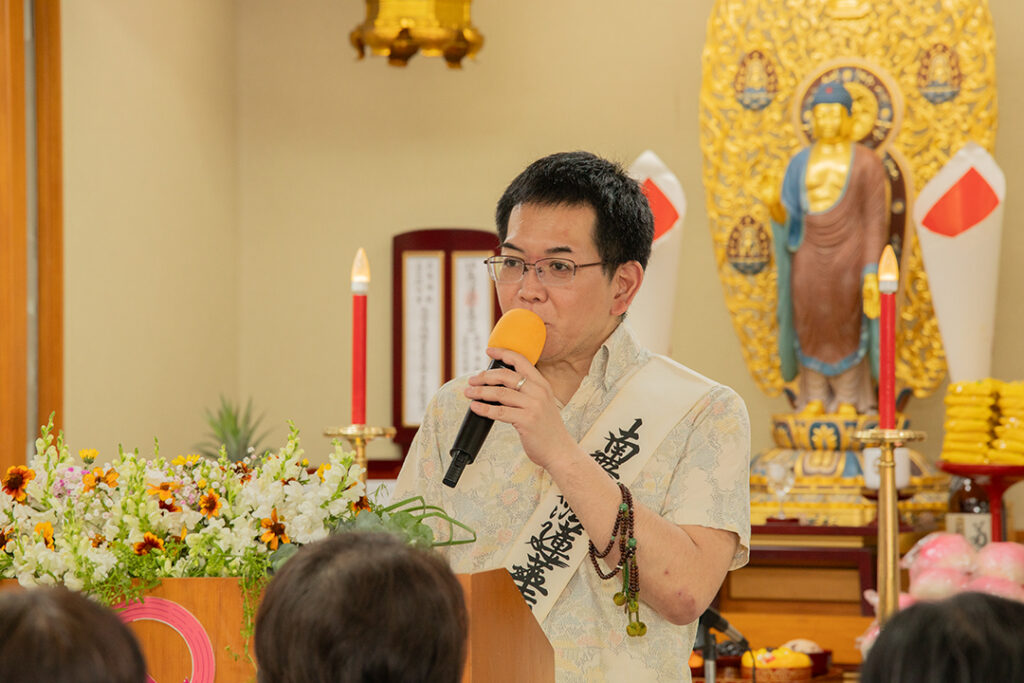
This Dharma Journey was presented at the Taipei Dharma Center on May 6, 2025, during the ceremony for the fortieth anniversary of the founding of Rissho Kosei-kai of Taipei.
I am truly grateful for this opportunity to share my Dharma Journey on this joyous and momentous occasion marking the fortieth anniversary of the founding of Rissho Kosei-kai of Taipei.
Back in 2015, during the ceremony for the thirtieth anniversary of Rissho Kosei-kai of Taipei, I had the honor of presenting its history under the title “A Retrospective Look at the History of Rissho Kosei-kai of Taipei.” Today, on the occasion of the fortieth anniversary, I am deeply thankful to the Buddha for allowing me to have this opportunity to share my Dharma Journey.
I was born on Ishigaki Island in Okinawa as the eldest of four siblings. After graduating from the local high school at the age of eighteen, I went to Taiwan to study at university. As a Japanese student, taking classes conducted in Chinese was a constant struggle, but with encouragement from my classmates and through much trial and error, I gradually adapted to university life in Taiwan. I returned to Okinawa after graduation. At the time, however, there were few jobs or workplaces in Okinawa where I could use Chinese. After some deliberation, I decided to move to Tokyo for work. In Tokyo, I initially took on part-time jobs for a few months to establish a stable foundation for my life, and then I was hired by a company that operated supermarkets. Later, I changed jobs and joined a company that sold machine tools and electronic components overseas. I was assigned to sales for clients in Taiwan and China, and eventually, I was given the opportunity to work at the company’s branch office in Taiwan.
While working at the office in Taiwan, I had the opportunity to encounter the teachings of Rissho Kosei-kai. One of our company’s important clients at the time was Mr. Ookoshi, head of the Men’s Group at Rissho Kosei-kai’s Toyama Dharma Center. When Mr. Ookoshi came to Taiwan on a business trip, I heard that he wished to visit a local Buddhist temple to pray for success in his work there. I took him to a well-known temple in Taipei and guided him through the visit. After the temple visit, Mr. Ookoshi kindly said, “Next time, I’ll take you to a place where the Buddha I know resides.” In 2005, I was fortunate to be introduced to Rissho Kosei-kai of Taipei, which at the time covered the whole of Taiwan and was led by Rev. Masumi Goto.
When I was a child, my father and mother each followed a different religion, and because of their differing beliefs, they often argued at home. Growing up watching them, I constantly wondered why there was disagreement and discord, even though they were both practicing their faiths in pursuit of happiness. Why couldn’t religion bring peace to our family?
Perhaps because of this background, I was deeply moved when Mr. Ookoshi told me that it was at the invitation of Rev. Nikkyo Niwano, Founder of Rissho Kosei-kai, that religious leaders from around the world gathered in Kyoto for the World Conference of Religions for Peace. He also introduced me to the teaching “all religions have the same root,” which expresses the idea that all religions are fundamentally the same at their core. This philosophy had a profound impact on me. I became eager to learn more about the teachings of the Founder and began reading many of his writings with great interest and devotion.
At the same time, while receiving personal guidance from Mr. Ookoshi, I had the opportunity to participate in various activities such as training sessions and seminars at the Toyama Dharma Center, as well as special events like the “Birthplace Festival” held in Tokamachi City, Niigata Prefecture, where the Founder was born and raised. I was also able to experience various religious activities of Kosei-kai in Japan, including a Dharma circle and connecting people to the Dharma. Through these experiences, even though I had always felt resistance toward religions that focus solely on mysterious blessings or supernatural benefits, I came to feel that Rissho Kosei-kai is a place where we can learn the essence of the Lotus Sutra based on the teachings of the Founder, and where we apply and practice the teachings in everyday life. As I continued my religious training, I realized that Rissho Kosei-kai is a community of people who, having been liberated through learning and practicing the teachings, aspire to become bodhisattvas who seek to help others. I found myself naturally accepting and embracing the teachings of Kosei-kai. With this growing understanding, I began to genuinely aspire to become a compassionate and wise person, like Founder Niwano, President Nichiko Niwano, Mr. Ookoshi, and Rev. Chien Miao Fang, the minister of Rissho Kosei-kai of Taipei. Through this aspiration, I could have a new purpose in life.
By nature, I have always been a logical and analytical person. However, through my experiences of faith, I have come to realize that there are mysterious things in life that cannot be understood through logic alone. Through these encounters, which I can only describe as the compassionate workings of the Buddha, I have continued to meet and connect with Rissho Kosei-kai in new and meaningful ways.
During this time, as I was thinking of establishing a more rooted life in Taiwan, I decided to stop relying on my employer and pursue independence by starting my own business. In 2006, I left my job, and I opened a restaurant in Taipei using the savings I had accumulated during my employment. However, things didn’t go as I had expected, and regrettably, the restaurant had to close just a few months after opening. After that setback, I was blessed with an opportunity to serve as the branch manager of the Taiwan office of a system development company headquartered in Japan. Thanks to this position, I was able to travel to many countries, including China and those in Southeast Asia, through my work in the company’s international business division, greatly expanding my knowledge and experience. Then, in 2013, a year after I married my wife, I was once again given the chance to venture into the restaurant industry and open a Japanese-style pub in Taipei. At first, my wife’s younger sister managed the restaurant, and later, my wife also helped manage the business alongside me. Thanks to their support, the business grew steadily, and we were even able to hire several staff members.
However, in 2020, the global COVID-19 pandemic struck, dealing a severe blow to the restaurant industry. Business performance across the sector dropped dramatically. The Taiwanese government introduced strict safety measures, including reducing the number of seats in restaurants, and at one point even banned in-house dining altogether. As a result, my pub suffered major losses, and the savings I had worked so hard to build up were quickly depleted. The struggle was so intense and relentless that I can barely remember how I managed to get through it.
During those days when I felt completely stuck, unable to move forward, I heard from Mr. Ookoshi that his wife had been hospitalized due to cancer. Both he and his wife had dedicated themselves to helping so many people and had accumulated great virtue through their practices. So I naturally assumed that, without a doubt, they would receive the Buddha’s protection, that she would recover, and that once the pandemic was over, I would be able to see her again. However, one day, I received the heartbreaking news from him that his wife had passed away. The shock hit me like a blow to the head. It was so overwhelming that for several days, I was completely stunned and unable to think clearly. I couldn’t help but ask “Why did such an unimaginable loss have to happen to Mr. and Mrs. Ookoshi, who had continuously supported others through their Rissho Kosei-kai practice and daily lives? Can these teachings truly bring people happiness?” Doubts began to arise in my heart one after another, and I experienced a deep wavering in my faith.
Eventually, in 2022, the COVID-19 pandemic gradually began to subside. My business managed to recover from its most critical point, and the system development company also regained its footing. Thanks to my determined efforts, the system development company was able to significantly expand its business overseas. However, this success came at a price. My work became more demanding than ever before, and as I continued to push myself beyond my limits, I was suddenly struck by severe abdominal pain at the end of 2022. I was rushed to the hospital, where I was diagnosed with an intestinal obstruction and had to be admitted as an emergency patient. Fortunately, surgery was not required, but I ended up spending thirty-six days in the hospital, receiving IV treatment throughout my stay.
Even after being discharged from the hospital, the workload at the company remained unchanged. Due to handling business in both Chinese and English, I couldn’t receive sufficient support from the company’s headquarters in Japan, and the demanding days continued. Although I was mentally and physically exhausted from lack of sleep, I didn’t realize it myself. Then one day, I suddenly became aware that my body simply couldn’t keep up any longer. Since there was no one else who could take over my responsibilities, I couldn’t take time off, even though I desperately wanted to. Quitting was not an option either, and I found myself pushed to the limits of my mental endurance.
I’m naturally an optimistic person, and I had previously thought mental illness had nothing to do with me. But for the first time in my life, I was experiencing depression. I caused much worry and trouble for my wife, my family, and my staff at work. In the midst of all this, seeking peace of mind, I visited the Taipei Dharma Center and consulted with Rev. Chien. Rev. Chien listened sincerely to the voice of my heart and prayed with me before the Eternal Buddha for my recovery. I would like to express my heartfelt gratitude once again to Rev. Chien. It was an incredibly painful and difficult experience, but I believe that through it, I grew into someone who can better understand the hearts of those who are suffering.
I have since resigned from the system development company and returned to my former path in the restaurant industry, making it the foundation of my life once again. I now feel that I have entered a new phase, one in which I can spend more time with my wife and family, and rebuild a foundation of trust with my staff.
As I began to feel a change in my mind and mindset last year, something truly meaningful happened. While visiting Taiwan to prepare for the fortieth anniversary of the founding of Rissho Kosei-kai of Taipei, Rev. Keiichi Akagawa and Ms. Kiwako Yajima from Rissho Kosei-kai International, and several other headquarters staff members came to visit my restaurant. During that visit, I had the opportunity to share my journey of faith. That conversation became a turning point, and I was kindly invited to participate in this ceremony and was also entrusted with the honor of sharing my Dharma Journey.
Although I had drifted away from the Dharma for a while, being given the role of delivering this talk reminded me once again of the deep connection I have with the Buddha and the teachings. Going forward, though I am still immature in Buddhist practice, I hope to devote myself with all sincerity—without pushing myself too hard, without slacking off, without rushing, and without letting my vow fade—in order to be of service to others in any way I can and to remain under the Buddha’s compassionate protection.
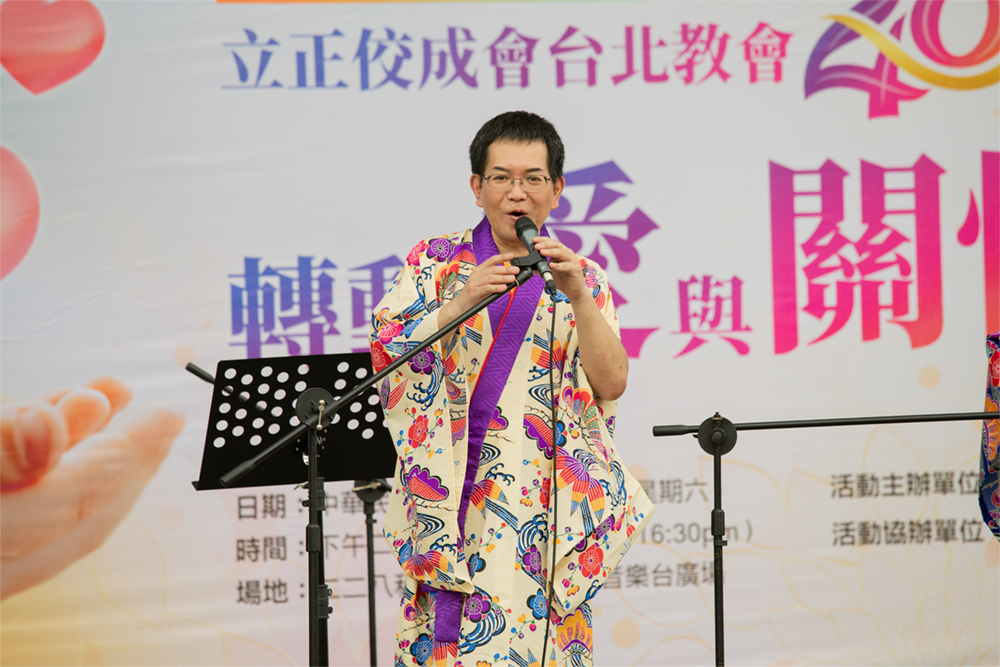
Mr. Kuroshima performs Okinawan folk songs at the afternoon exchange event.
Today, I have been entrusted with several important responsibilities in this ceremony, including giving a Dharma Journey talk, introducing the history of Rissho Kosei-kai of Taipei, and coordinating the afternoon exchange program. With firm resolve, I now accept that I cannot separate myself from the Buddha. Though my strength is limited, I will give my all to fulfill these roles. Together with everyone in the Taipei sangha, I vow to treat this ceremony as an opportunity to deepen my spiritual training and devotion. Let us also work together to make this afternoon’s event a lively and joyful one. Thank you all very much for listening today.