
April–June 2013, Volume 40
Features
Modern Meanings of Festivals
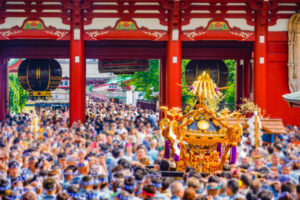
Festivals are defined as certain days or periods of time set aside to commemorate, ritually celebrate or re-enact, or anticipate events or seasons (agricultural, religious, or socio-cultural) that give meaning to, and promote cohesiveness between, individuals and their community.
In Japan, because of rapid industrialization and urbanization in the late twentieth century, local communities rich in traditional culture have become homogenized. Material abundance has made life more comfortable, but the market economy has weakened the unique cultures of local communities and damaged the natural environment on which they have depended.
Most Japanese have not lost their love of festivals, however. Festivals are a unique occasion that reminds us of our local identity, which we tend to forget in our daily lives. In northeastern Japan, festivals also have served as occasions to reunite people for reconstruction after the devastation caused by the massive earthquake and tsunami in March 2011 and pay tribute to the victims.
In other countries, too, we think that the role of festivals in preserving the local identity can be very important. Though many festivals have become tourist attractions, these events can still enhance the self-identification of local communities. Indeed, since many festivals have sacred origins, religion can be central to promoting the unifying role of festivals in contemporary society.
In our time, when in many countries traditional models of family and community life are breaking down and human relationships have weakened, we hope to shed light on festivals and their significance for society.
Features
The Significance of Festivals for Rissho Kosei-kai
by Waichiro Izumita
The Oeshiki festivals allow participating young members to be at one with the mind of the Buddha and widen their circle of close friends.
Chaos and Cosmos: Cultural Revival in the Wake of Natural Disasters
by Minoru Sonoda
The experience of recovering unbowed from natural disasters, from which Japan has suffered many times in its history, rising again out of catastrophic chaos through a trust in the regenerative power of nature and the ties binding the community, has been handed down to us within our religious culture in the form of shrine festivals and performing arts.
Modern Meanings of Kagura Performances
by Irit Averbuch
In the period immediately following the tsunami, most folk performers in and around the devastated areas thought it was not possible to perform in such disastrous times. However, they soon remembered that their “arts” were originally rites of spirit pacification, and they started performing wherever they could, intentionally reestablishing the original meaning of their dances.
Kagura: Dramatic Interplay between Nature and Humanity
by Masataka Suzuki
Kagura has diversity—it may be a solemn ritual inviting the deities to a sacred ritual site, or equally a secular event associated with town revitalization and the promotion of the local area
The Cultivation of Memory and Invention in Contemporary Thai Festivals
by Rachelle M. Scott
Some Thai festivals are reputed to have ancient origins that are based on the agricultural seasons and stories from Hindu, Buddhist, and Chinese traditions, while others are wholly new—the products of skillful tourist marketing or new cultural tastes and sensibilities.
Shugendo, Festivals, and the Performing Arts
by Gaynor Sekimori
In recent years there have been efforts to embrace lost Shugendo traditions to create a distinct local culture that enriches the whole community and is attractive to visitors.
Essay
On the Islamic View of Global Ethical Values
by Anis Ahmad
How are we to determine values that can be globally acceptable? There can be at least five benchmarks for evaluating and judging global relevance, acceptability, and application of values: universality, consistency and practicality, flexibility, simplicity and understandability, impartiality.
Interview
An Ongoing Journey into Buddhism An interview with Dr. Elizabeth J. Harris
Dr. Elizabeth J. Harris, president of the European Network of Buddhist-Christian Studies, visited Rissho Kosei-kai headquarters in Tokyo on September 11, 2012, to confer with interfaith affairs directors. Dharma World interviewed her about her journey into Buddhism and her perspectives on Buddhist-Christian encounter in Europe.
Essay
Spiritual Plenty from One Cup of Tea
by Sojitsu Kobori
In the Way of Tea, we constantly focus on what we ourselves should do so that our guests are satisfied. That being said, it is still impossible to learn in a short time to put others first. That is why daily practice is so important.
Our Future Depends on “A Little”
by Keibo Oiwa
The ability to enjoy “a little” is a function of great wisdom. Humanity’s future hangs on this. It depends on whether we can get back enough wisdom to stop depleting resources and start living with less energy use.
Simple Living for Our Shared Future
by Mary Pat Fisher
We seem to lack the political and personal motivation to change our living patterns. As if oblivious to the effects on our children and grandchildren—let alone other people’s children and grandchildren—we continue our patterns of overconsumption, pollution, and destruction of the natural environment.