
October–December 2015, Volume 42
Features
The Modern Significance of Meditative Practices in Religions
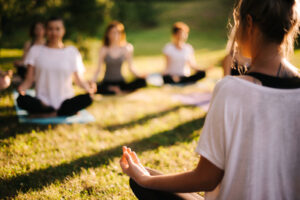
Meditative practices are entering the mainstream of societies in many parts of the world. These practices are not necessarily tied to religions, but as Time magazine observed of “mindfulness meditation” in its February 3, 2014, issue, meditation is becoming popular as a neurophysiological approach to mental stress in hectic contemporary societies, and is even used as a complementary treatment for physical pain.
Meditation, or voluntary self-regulation practices to develop fully focused awareness or gnosis, has been an important component of many religious traditions. Zen Buddhists, for example, hold that zazen is an essential practice on the path to enlightenment, or liberation from suffering.
The aims and forms of meditative practices vary according to different religions, however, and there is also significant diversity within single religious traditions. The meaning of meditation in each religious tradition is also framed by different belief systems. This makes it hard to grasp the significance and meaning of meditative practices in religious traditions other than one’s own.
While meditative practices are drawing attention as forms of mental or physiological fitness, examining their current religious significance would promote understanding of meditative practices as an important aspect of religious training, and not only as methods of stress reduction. Our examination would shed new light on this ancient religious heritage, and we hope meditation will become a more ample religious resource for happier and healthier lifestyles of people today.
To gain an overview of what significance meditation has in religions today, we would like to approach the theme from the following angles: (1) What are the various forms of meditative practices, and are they associated with different effects or mental and physiological benefits? (2) Why have meditation practices (e.g., mindfulness meditation, yoga, etc.) gained mainstream popularity as ostensibly “secular” practices? (3) Can these practices be separated from their religious contexts, and if so, what are the consequences? (4) What does the popularity of meditation practices signal about contemporary culture and the needs of people in advanced technological societies? (5) Are religious meditative practices crossing sectarian lines? Have they become the basis for, or facilitated, intersectarian and interreligious cooperation and understanding? (6) Are meditative practices as medically effective as their advocates claim?
Features
Meditation in the Contemporary World
by Dominick Scarangello
Buddhist Meditation, Christian Contemplation, and Their Various Uses
by Peter Feldmeier
In the modern world we find popular movements engaging either Buddhism or Christianity and sometimes uniting them in ways that are both questionable and inspiring.
Meditation without Borders: Christians Who Engage in Meditation Practices from Other Religious Traditions
by Leo D. Lefebure
For many Christians, the practice of meditation has led to a renewal of their faith and practice.
The Development and Significance of Meditation in Buddhism
by Kenryo Minowa
When, during meditation, we experience a state in which there is no judging, comprehending, or discriminating (the state of nondiscriminative wisdom), a feeling of great joy arises in our mind, and we could even say that the barriers between ourselves and others fall away.
Buddhist Meditation and Christian Contemplation: Wisdom Bringing Forth Selfless Love
by Ruben L. F. Habito
An individual who . . . engages in a sustained way in a form of Buddhist meditation or Christian contemplation . . . is launched into a winding path of awakening and transformation, with surprises at every turn.
Essay
Reforming World Order through Human Reformation: A Perspective through Religion
by Kamar Oniah Kamaruzaman
When the modern generation marginalized religion, and in some cases even threw out religion from their lives completely, they therewith also threw out the comprehensive definition of the human being, and with that they lost the comprehensive knowledge of how to live appropriately.
The Practical Ethics of Won-Buddhism and Liberal Religious Culture as a Path to World Peace
by Park Kwangsoo
Truth is one; the world is one; humankind is one family; the world is one workplace. Let us pioneer one world. —Taesan Kim Taego
Buddhism and Social Engagement (2) Building Peace
by Ranjana Mukhopadhyaya
Engaged Buddhism arose . . . out of the anti-war movement led by monks during the Vietnam War. Witnessing the destruction and suffering the war had brought his country, Thich Nhat Hanh called for positive social engagement based on adapting Zen meditation to modern needs.