
January–June 2017, Volume 44
Features
Religion and Animals
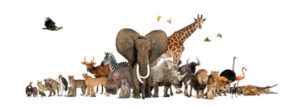
Animals contribute to human survival, as sources of food; add to human knowledge as subjects for research; and educate and entertain visitors to zoos, aquariums, and circuses. Many people enjoy the companionship of pets. Animals nurture us, giving us pleasure and purpose, and contribute to scientific progress, as in medicine. Some of us wear fur coats or leather jackets without a qualm.
People of various backgrounds, however, have recently criticized the relationship between human beings and animals, which dates back to prehistoric hunting and animal husbandry. Since the nineteenth century, concerns for animal welfare have prompted measures to prevent human beings from inflicting pain and distress on animals. The animal rights movement, which began in the 1970s, advocates that animals have the same rights as human beings to be free of suffering and exploitation.
The world’s religions have specific beliefs about the relations between human beings and animals. Judaism and Christianity believe that while humans have dominion over animals, humans are the caretakers of animals and must not exploit them. Hinduism and Buddhism teach that animals can be reborn as humans, and humans as animals, in an endless cycle of rebirth and suffering. Islam teaches respect for animals as God’s creatures, while Jainism teaches that it is wrong to harm to any living thing.
Numerous cases of abuse or suspected abuse of animals are being reported around the world. These include keeping them in small cages for industrial livestock production, animal testing of cosmetics, and in Japan, euthanizing many dogs and cats abandoned by their owners.
For religion to teach the sanctity of life, it may need to address more actively issues of the life and well-being of animals, which many people are so concerned about. How does religion see the current treatment of animals in many areas of society? Does not belief in the sanctity of life require religion to provide ethical grounds to prevent the mistreatment of animals and impart the wisdom to improve human relationships with them? With these questions in mind, we will examine how religion views animals today and how it approaches the issues of their life and well-being.
Religion and Nonhuman Animals
by Paul Waldau
Humans’ spiritual traditions provide profoundly moving wisdom about the value to both nonhumans and humans of developing caring, informed modi vivendi by which the diverse living beings that compose our shared earth community can coexist and thrive.
Japanese Ethical Attitudes to Animals
by Katsuhiro Kohara
The people of today, who can buy all the meat they want without any sense of pain or gratitude, thanks to intensive animal farming, may conceivably be living in the most barbaric era in human history.
Islam and Animals
by Magfi rah Dahlan
An increasing number of Muslims who are . . . critical of the modern farming and food system have sought more knowledge of and a greater proximity to the animals they consume as an alternative to abstaining from consuming meat or using animals in general.
Religion and Animals in the City
by Dave Aftandilian
By coming into closer connection with animals in the city, we will have more opportunities and greater reason to care about and for them. Such caring, in turn, can bring significant benefits to our animal neighbors and to us.
Gratitude and Treasuring Lives: Eating Animals in Contemporary Japan
by Barbara Ambros
The contemporary Japanese discourse of gratitude envisions an interconnected chain of becoming that is sustained by animal lives and culminates in human lives. As animal bodies are consumed and transformed into human bodies, humans have the moral obligation to face this reality and express their gratitude.
Miracle Stories of the Horse-Headed Bodhisattva of Compassion, Batō Kannon
by Benedetta Lomi
The horse’s head of the bodhisattva Batō Kannon has, canonically, a number of functions, the most important of which is the ability to remove the afflictions and defilements of sentient beings.
Interview
Nikkyo Niwano’s Vision for World Peace:
Interview with Dr. Gene Reeves, an International Advisor to Rissho Kosei-kai
Gene Reeves has researched and lectured on the Lotus Sutra worldwide for more than a quarter century. He has also put much effort into nurturing members of Rissho Kosei-kai’s International Buddhist Congregation since its founding in 2001, as well as organizing the annual International Lotus Sutra Seminar. In June Rev. Kosho Niwano, president-designate of Rissho Kosei-kai, interviewed him at Rissho Kosei-kai headquarters in Tokyo, on such topics as his impressions of Founder Nikkyo Niwano, Dr. Reeves’s reasons for concentrating on the Lotus Sutra, and the great principles in which the Founder believed.
Seminar Report
Bodhisattvas in Action: Living the Lotus Sutra in Text, Image, and History
by Thomas Newhall
The International Lotus Sutra Seminar is an annual academic conference sponsored by Rissho Kosei-kai that brings together researchers from Japan and other countries to engage in an ongoing discussion about the Lotus Sutra. They discuss the impact it and its ideas have had on history, thought, art, and religion, from the distant past to the modern day, in India, China, Japan, and beyond. From June 28 to 30, 2016, fourteen scholars from Europe, North America, and Japan were invited to participate in this seminar at the National Women’s Education Center of Japan in the town of Ranzan, Saitama Prefecture.